Painter of the Bible
Daniele Crespi
Daniele Crespi was a leading Lombard painter of the first third of the seventeenth century and one of the principal Milanese exponents of the early Italian Baroque manner that combined the late-Mannerist Lombard traditio…
.jpg%3Fwidth%3D600&w=2048&q=75)
Their faith
Why Daniele Crespi painted Christ
Daniele Crespi was a devoted Christian artist whose faith was deeply intertwined with his work. Active during the Counter-Reformation, Crespi dedicated his artistic talents to the service of the Catholic Church, creating altarpieces and frescoes that reflected his spiritual convictions. He trained under Giovanni Battista Crespi, known as Cerano, and absorbed the late-Mannerist Lombard tradition while also embracing the Caravaggesque style that emphasized dramatic lighting and emotional depth. Crespi's commitment to his faith is evident in his meticulous approach to scripture and the lives of saints, as he sought to inspire devotion through his art. His works were not just paintings; they were visual prayers meant to elevate the viewer’s spirit and draw them closer to God.
Crespi’s faith profoundly shaped his artistic vision, as seen in his masterpiece, the fresco cycle of the Life of Saint Bruno at the Certosa di Garegnano. This extensive work, consisting of twenty-eight scenes, captures the essence of the Carthusian order's spirituality and dedication to a life of prayer and contemplation. Another significant piece, The Last Supper of Saint Charles Borromeo, showcases the saint in a moment of ascetic reflection, illuminated by candlelight, which symbolizes divine presence. These works not only highlight Crespi's technical skill but also his ability to convey deep religious themes that resonate with viewers. Even centuries later, Crespi's devotion continues to inspire and uplift those who encounter his art, serving as a reminder of the power of faith expressed through creativity.
Life & work
Daniele Crespi was a leading Lombard painter of the first third of the seventeenth century and one of the principal Milanese exponents of the early Italian Baroque manner that combined the late-Mannerist Lombard tradition with the new Caravaggesque-Carracci pictorial vocabulary descending from Rome and Bologna. Born in or near Milan around 1597 (or perhaps slightly later), trained in Milan in the workshop of Giovanni Battista Crespi (called Cerano — the leading Milanese painter of the previous generation, no relation to Daniele despite the shared surname), he became the principal Milanese painter of his generation in the late 1620s and was active in Milan for his entire short career. He died of the plague in Milan in 1630, only thirty-three years old, in the same epidemic that swept much of northern Italy in 1629–1631.
His Christian religious work is concentrated in altarpieces and fresco cycles for the Lombard Counter-Reformation Catholic churches. The great fresco cycle of the Life of Saint Bruno in the Certosa di Garegnano in Milan (1629 — twenty-eight scenes from the life of the founder of the Carthusian order, painted in the cloister of the Milanese charterhouse and widely held to be Crespi's masterpiece and one of the supreme early-Baroque fresco cycles outside Rome), the Last Supper of Saint Charles Borromeo (Milan, c. 1628 — depicting the saint at his ascetic fast supper), the Pietà altarpieces in workshop variants, and the great altarpieces for the Milanese churches of San Giovanni in Conca, San Vittore al Corpo, and the Cathedral fill the painted corpus.
His personal style — combining the late-Mannerist Lombard chromatic warmth that he absorbed from his teacher Cerano with a strong Caravaggesque chiaroscuro and a particularly austere Counter-Reformation devotional sensibility — gave him a distinctive position in the early-seventeenth-century Lombard pictorial tradition. The Last Supper of Saint Charles Borromeo in particular — a single-figure half-length composition of the saint at his ascetic fast supper, painted with intense Caravaggesque single-source candlelight against a darkened ground — is among the supreme statements of Milanese Counter-Reformation devotional painting and was widely reproduced in the seventeenth and eighteenth-century Catholic devotional engraving market.
His early death in the 1630 Milan plague cut short what would almost certainly have been a major career. The Certosa di Garegnano frescoes survive substantially intact and remain in continuous use as the principal monument of his short brilliant career.
Notable works in detail
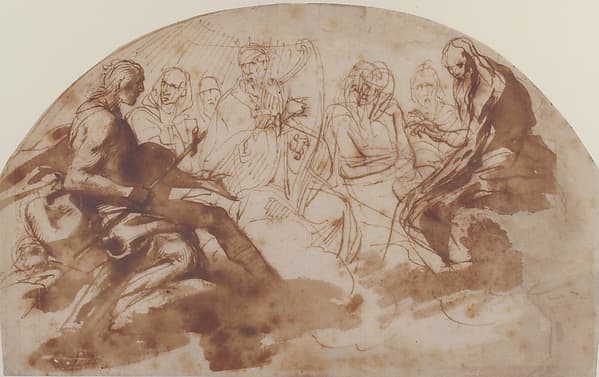
Saint John the Baptist, Saint Benedict, King David, and Other Seated Figures
Saint John the Baptist, Saint Benedict, King David, and Saint Lawrence, drawn by Daniele Crespi (the dating is contested — the Met lists 1597, but Daniele Crespi was likely born around that year and could not have drawn it as an infant; the drawing is more probably from the 1620s) in pen and brown ink with wash on paper and now in the Metropolitan Museum of Art in New York, is a preparatory drawing for one of his Lombard altarpiece commissions. The drawing shows the four saints arranged in formal symmetry: John the Baptist with his small reed cross on the far left, Saint Benedict with his Benedictine habit, King David with his harp, and Saint Lawrence with his iconographic gridiron on the far right. The drawing demonstrates the early Crespi draughtsmanship before his short brilliant career was cut short by the 1630 Milan plague.
Bible scenes Daniele Crespi painted
1 Samuel