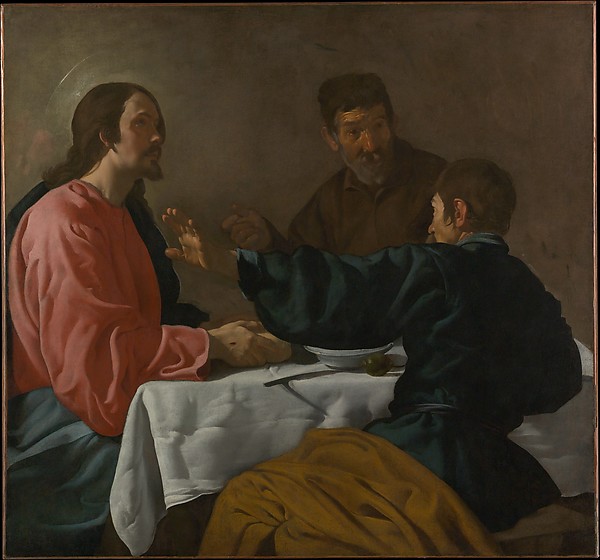
Painter of the Bible
Diego Velázquez
Diego Rodríguez de Silva y Velázquez was the leading Spanish painter of the seventeenth century and one of the supreme portraitists in the history of Western art.

Their faith
Why Diego Velázquez painted Christ
Diego Velázquez, a prominent Spanish painter of the seventeenth century, was deeply rooted in the Catholic faith, which significantly influenced his artistic endeavors. He was trained under Francisco Pacheco, a devout artist and writer who instilled in him a profound appreciation for the spiritual aspects of art. Velázquez's commitment to his faith is evident in his choice of subjects, particularly those that depict the life of Christ and the Virgin Mary. His works often reflect a reverence for scripture and a desire to convey the divine through his artistry. Despite his royal portraiture, Velázquez devoted time to creating religious art, which showcases his devotion and the importance of faith in his life. He was honored as a knight of the Order of Santiago, a recognition that underscored his commitment to both his craft and his faith.
Velázquez's religious paintings, such as "Christ on the Cross" and "The Coronation of the Virgin," reveal his spiritual vision and mastery of composition and color. In "Christ on the Cross," the somber tones and dramatic lighting evoke a profound sense of sacrifice and contemplation, inviting viewers to reflect on the Passion of Christ. Similarly, in "The Coronation of the Virgin," Velázquez captures a moment of divine grace, illustrating the honor and reverence bestowed upon Mary. Through these works, Velázquez not only showcases his technical brilliance but also his heartfelt devotion, allowing his faith to resonate through his art. Even centuries later, viewers are drawn to the beauty and depth of his religious imagery, experiencing a connection to the sacred that transcends time.
Life & work
Diego Rodríguez de Silva y Velázquez was the leading Spanish painter of the seventeenth century and one of the supreme portraitists in the history of Western art. Born in Seville in 1599 to a family of minor Portuguese-descended hidalgos, apprenticed to the Sevillian painter Francisco Pacheco (whose daughter Juana Velázquez later married, in 1618), and called to Madrid in 1623 by the Conde-Duque de Olivares to enter the service of the young King Philip IV, he served the Spanish royal house as court painter for the rest of his career and was eventually given the title Aposentador Mayor del Palacio (chief chamberlain of the royal palace). He died in Madrid in 1660.
His Christian religious work, while a smaller part of his output than his royal portraiture, includes some of the most concentrated Spanish Baroque images of the Passion and the Gospels. The Christ on the Cross (Prado, c. 1632), painted for the convent of San Plácido in Madrid, is one of the most reproduced Spanish religious images of any period — a single figure on a dark ground, the head fallen forward, the body almost monochrome against the black sky. The Coronation of the Virgin (Prado, c. 1645) for the oratory of Queen Elisabeth of France in the Alcázar, the Adoration of the Magi (Prado, 1619, painted in his Sevillian years), the Saint John the Evangelist on Patmos (London), the Immaculate Conception (London), and the late Christ in the House of Martha and Mary (London) round out the religious painted corpus.
His Sevillian early style was Caravaggesque-tenebrist, with thickly painted grayish flesh and dramatic single-source lighting. The two trips to Italy (1629–1631 and 1649–1651) transformed his manner toward the lighter Venetian color and the looser brushwork of Titian and Veronese — a transformation visible in the late royal portraits, in Las Meninas (Prado, 1656), in the Rokeby Venus (London, c. 1650), and in the religious commissions of his last decade.
He painted relatively few altarpieces — the demands of his court duties left little time for religious commissions — but his religious work, by its sheer compositional and chromatic authority, shaped the visual sensibility of Spanish religious art well into the eighteenth century. He was made a knight of the Order of Santiago in 1659 (a long-fought-for honor that required a special papal dispensation given his profession as painter), and was buried in the Madrid church of San Juan Bautista, since destroyed.
Notable works in detail

Christ in the House of Martha and Mary
Christ in the House of Martha and Mary, painted by Diego Velázquez in 1618 in oil on canvas and now in the National Gallery in London, is one of the principal early Sevillian works of the painter, completed when he was about nineteen years old in the workshop of his father-in-law and teacher Francisco Pacheco. The composition is unusual in its compound structure: the foreground shows a young Sevillian kitchen maid scowling at the viewer over a still life of fish, eggs, garlic, and chillies on a kitchen table, with an older woman beside her gesturing toward a small framed scene in the upper right corner — the moment from Luke 10 in which the busy Martha complains to Jesus that her sister Mary has neglected the meal-preparation in order to sit and listen at his feet. Whether the inset is a painting on the kitchen wall, a mirror reflection, or a small open window into the next room has been debated for four centuries; the device is unmistakably proto-modern in its handling of the picture-within-a-picture conceit. The painting was acquired by the National Gallery in 1934 and remains the central early Velázquez Sevillian canvas in any British collection.