Painter of the Bible
Domenichino (Domenico Zampieri)
Domenichino — born Domenico Zampieri in Bologna in 1581 — was the principal pupil of Annibale Carracci in Rome and one of the leading classicizing painters of the Italian Baroque generation.
_(14754967556).jpg%3Fwidth%3D600&w=2048&q=75)
Their faith
Why Domenichino (Domenico Zampieri) painted Christ
Domenichino, born Domenico Zampieri in Bologna in 1581, was deeply rooted in the Christian faith that permeated the art of his time. As the principal pupil of Annibale Carracci, he was immersed in a tradition that valued sacred subjects and the spiritual discipline of painting. His commitment to his craft was not merely technical; it was a devotional practice that reflected his reverence for scripture and the teachings of Christ. Throughout his career, Domenichino created numerous altarpieces and frescoes that served as visual sermons, inviting viewers to engage with the divine. His works often embody a classical restraint and emotional depth, indicative of his belief in the power of art to convey spiritual truths.
Domenichino's faith profoundly influenced his artistic vision, particularly in masterpieces such as "The Last Communion of Saint Jerome" and the fresco cycle depicting the "Stories of Saint Cecilia." In these works, he masterfully blends classical composition with a deep emotional resonance, inviting contemplation on the lives of the saints and their relationships with God. The serene yet profound atmosphere of his altarpieces reflects his understanding of the sacred, encouraging viewers to reflect on their own faith journeys. Even today, Domenichino's devotion continues to inspire and uplift, as his art remains a testament to the enduring power of Christian belief and the beauty of divine grace captured on canvas.
Life & work
Domenichino — born Domenico Zampieri in Bologna in 1581 — was the principal pupil of Annibale Carracci in Rome and one of the leading classicizing painters of the Italian Baroque generation. Trained first in his native Bologna in the Carracci academy founded by Ludovico, Annibale, and Agostino, then summoned to Rome by Annibale around 1602 to assist on the Farnese Gallery and the various Roman commissions of the early Carracci circle, he settled in Rome and made his career there until his late move to Naples in 1631. He died in Naples in 1641 under suspicious circumstances — eighteenth-century biographers suspected poisoning by Neapolitan rivals, though the documentary evidence is inconclusive.
His Christian religious work is concentrated in altarpieces, fresco cycles, and chapel decorations of strict classical composition and quiet emotional restraint. The Last Communion of Saint Jerome (Vatican Pinacoteca, 1614) — one of the most-copied altarpieces of the seventeenth century, taken by Napoleon's troops to Paris in 1797 and returned in 1815 — is widely held to be his masterpiece. The fresco cycle in the Polet Chapel of San Luigi dei Francesi (Stories of Saint Cecilia, 1612–1615) sits in the church whose Caravaggio Saint Matthew altarpiece had been installed a decade earlier, and the contrast between Domenichino's classicizing decorum and Caravaggio's chiaroscuro drama defines the central debate of early-seventeenth-century Roman religious painting.
His major Roman cycles include the pendentives of Sant'Andrea della Valle (the Four Evangelists, 1622–1627), the lunettes for the Abbey of Grottaferrata (the life of Saint Nilus, 1610), and the choir of San Carlo ai Catinari. The late Naples years produced the Treasury Chapel frescoes in the Cathedral of Naples (the life of San Gennaro, left incomplete at his death) and a series of altarpieces in Neapolitan churches.
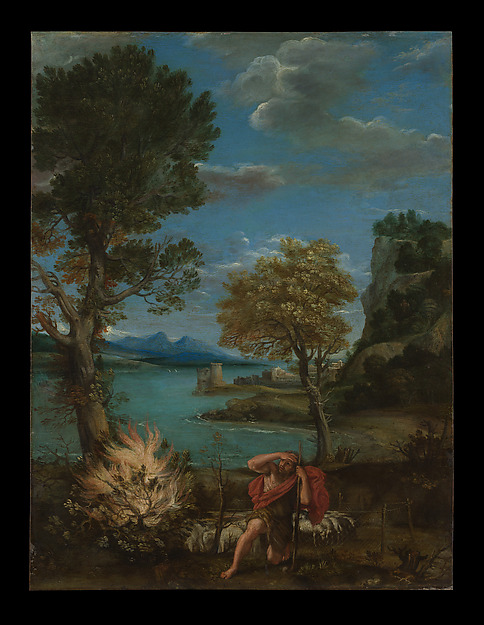
He was an unusually gifted draftsman; the great collection of his preparatory drawings at Windsor Castle, acquired by Pope Clement XI from the artist's heirs and given by the pope to King George III, remains the principal record of his working method. His landscape painting — pure landscape with biblical or mythological figures, painted partly outdoors, with attention to specific Roman countryside topography — was a direct technical and conceptual influence on Claude Lorrain and Nicolas Poussin a generation later.
Bible scenes Domenichino (Domenico Zampieri) painted
Exodus