Painter of the Bible
Donatello
Donatello — born Donato di Niccolò di Betto Bardi in Florence around 1386 — was the supreme Italian sculptor of the Quattrocento and one of the founding figures of the Florentine Renaissance alongside the architect Filippo Brunelleschi and the painter Masaccio.

Their faith
Why Donatello painted Christ
Donatello, born Donato di Niccolò di Betto Bardi in Florence around 1386, was deeply rooted in his Christian faith, which profoundly influenced his artistic journey. As a central figure in the Florentine Renaissance, he dedicated much of his life to creating sacred art for churches and religious institutions. His training in the workshop of Lorenzo Ghiberti, known for his own religious works, helped cultivate Donatello's devotion to scripture and Christian themes. Throughout his life, he engaged with the spiritual and intellectual circles of Florence, which were steeped in a rich tradition of Christian thought. This environment nurtured his faith, allowing him to explore the divine through his art, as he sought to express the beauty and complexity of the human experience in relation to God.
Donatello's faith is most vividly reflected in his iconic sculptures, such as the bronze David and the marble David, both of which showcase his ability to convey deep spiritual narratives through the human form. The bronze David, celebrated as the first freestanding nude bronze sculpture since antiquity, is not just a representation of the biblical hero; it embodies the triumph of faith over adversity, inviting viewers to contemplate the divine assistance that empowers believers. Similarly, his Penitent Magdalene, carved from polychrome wood, captures the essence of repentance and redemption, highlighting the transformative power of grace. Through these works, Donatello's devotion resonates with audiences, reminding us of the enduring connection between faith and artistry, and how his legacy continues to inspire a deeper understanding of Christ's love and sacrifice.
Life & work
Donatello — born Donato di Niccolò di Betto Bardi in Florence around 1386 — was the supreme Italian sculptor of the Quattrocento and one of the founding figures of the Florentine Renaissance alongside the architect Filippo Brunelleschi and the painter Masaccio. Trained in Florence in the workshop of the late Gothic sculptor Lorenzo Ghiberti (where he assisted on the second set of bronze doors for the Florence Baptistery), and active across Florence, Padua, Siena, and Rome for almost seventy years, he died in Florence in 1466 in his eighties.
His Christian religious work is concentrated in monumental sculpture — bronze, marble, and polychrome wood — for the Florentine churches and for the cathedral and ducal patrons of the Quattrocento. The bronze David (Bargello, Florence, c. 1440 — the first freestanding nude bronze sculpture cast in Europe since classical antiquity, and one of the founding works of the Renaissance interest in the recovered classical figural language), the marble David of about 1408 for the Florence Cathedral, the prophet figures for the Florence Cathedral campanile (Beardless Prophet, Bearded Prophet, Pensieroso, Habakkuk — known as Lo Zuccone), the great equestrian Gattamelata bronze in the Piazza del Santo in Padua (1453, the first equestrian monument cast in Europe since classical antiquity), the high altar sculptural program for the Basilica del Santo in Padua (1446–1450), the great Cantoria reliefs for Florence Cathedral, and the late polychrome wood Penitent Magdalene (Museo dell'Opera del Duomo, Florence, c. 1455) anchor the sculptural corpus.
His painted output (a small group of designs for stained-glass windows, predella panels for altarpiece structures, and small painted bronze reliefs) is overshadowed by the supreme sculpture but documents his close personal and professional friendship with the Florentine painter Brunelleschi and (through that friendship) his role in the founding intellectual circle of the Florentine Renaissance. Donatello's stylistic influence on the entire subsequent Italian Renaissance — through Michelangelo's direct study of his Florentine works, through Andrea del Verrocchio's late-Quattrocento workshop continuation, and through the bronze-casting tradition that ran through Pollaiuolo and Bertoldo into the High Renaissance — was foundational.
Notable works in detail
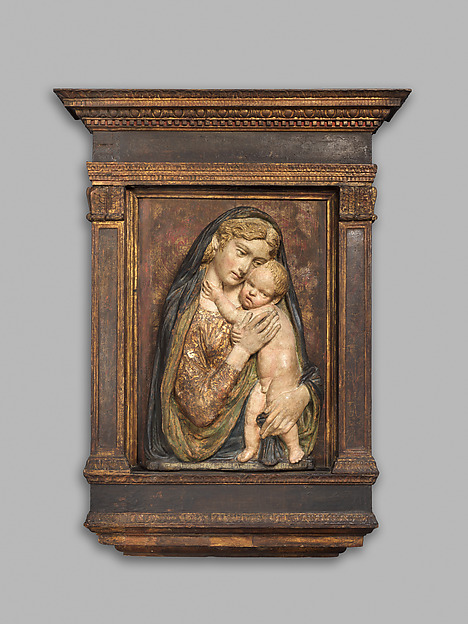
Madonna and Child, modeled by Donatello around 1450 in painted-and-gilded stucco and now in the Metropolitan Museum of Art in New York, is one of the small low-relief Madonna compositions Donatello produced in his late Florentine workshop years for the private domestic devotional market. The Virgin sits in three-quarter view holding the Christ Child against her chest in a tender intimate posture; the relief is modeled with the soft sfumato shallow carving Donatello pioneered (the technique now called rilievo schiacciato — flattened relief) and originally polychrome painted in flesh tones for the figures and gilded for the haloes and decorative borders. Workshop and follower copies of Donatello's Madonna compositions circulated through the Florentine Quattrocento devotional market in editions; the Met version is among the principal early examples and demonstrates Donatello's foundational role in shaping the standard Florentine domestic-altar Madonna type.
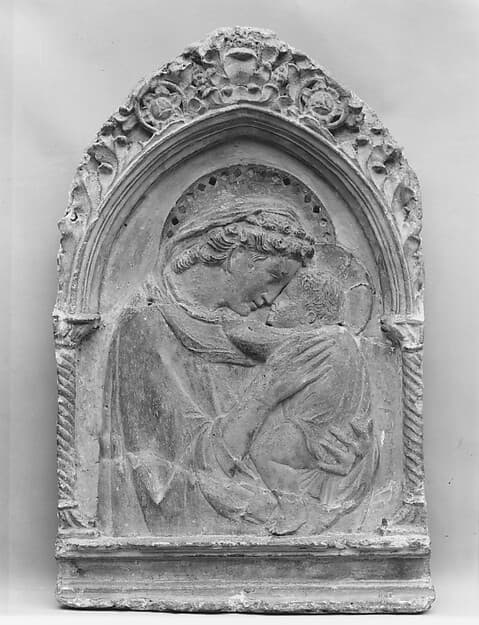
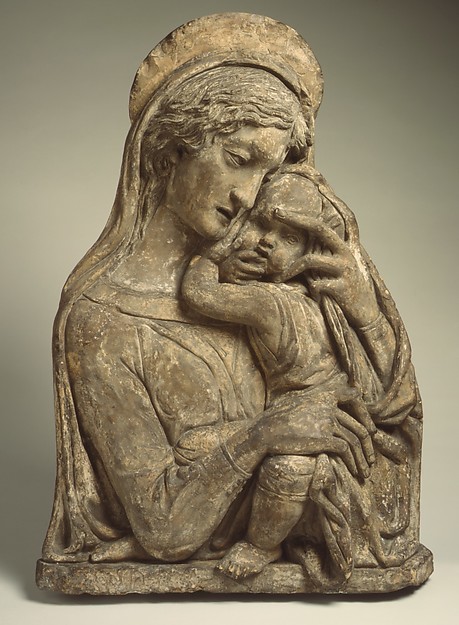
Virgin and Child, modeled by Donatello around 1430 in painted-and-gilded stucco and now in the Metropolitan Museum of Art in New York, is another of the small low-relief Madonna compositions from his Florentine workshop years. The composition shows the Virgin in three-quarter view with the standing Christ Child upright on her lap, the figures rendered in Donatello's characteristic soft-sfumato shallow-relief technique. The polychrome surface (now substantially worn) originally combined flesh-toned painting on the figures with gilded haloes and decorative borders. Pieces of this kind — small-format devotional reliefs intended for the private household altar of a Florentine merchant or banker — were produced in Donatello's workshop in editions and were among the most widely distributed of his domestic devotional output across Florence and the broader Tuscan region in the second quarter of the Quattrocento.
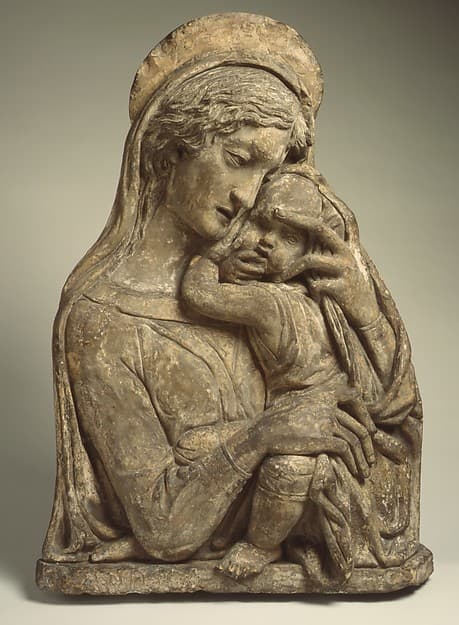
Madonna and Child, modeled by Donatello around 1445 in painted-and-gilded stucco and now in the Metropolitan Museum of Art in New York, is from the middle phase of his domestic-altar Madonna series. The Virgin holds the Christ Child against her shoulder in a tender intimate compositional formula that Donatello effectively invented and that the Florentine Quattrocento tradition would replicate in dozens of follower-and-workshop variants for the next half-century. The shallow-relief modeling and the originally polychrome surface demonstrate Donatello's signature combination of sculptural innovation with the Florentine domestic devotional tradition; the type was the standard Florentine private-altar Marian image until Andrea della Robbia's polychrome glazed terracottas displaced it in the 1480s.
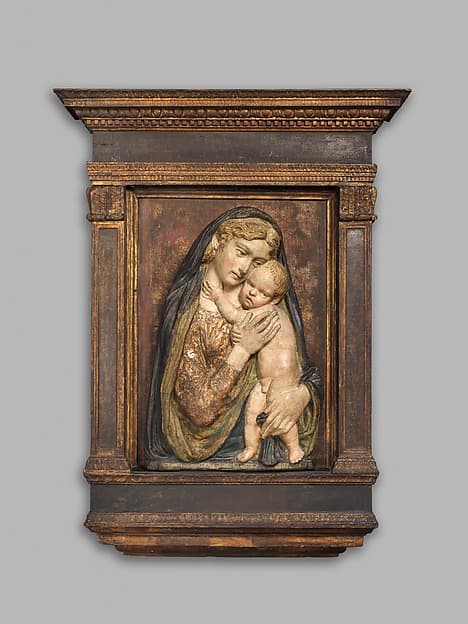
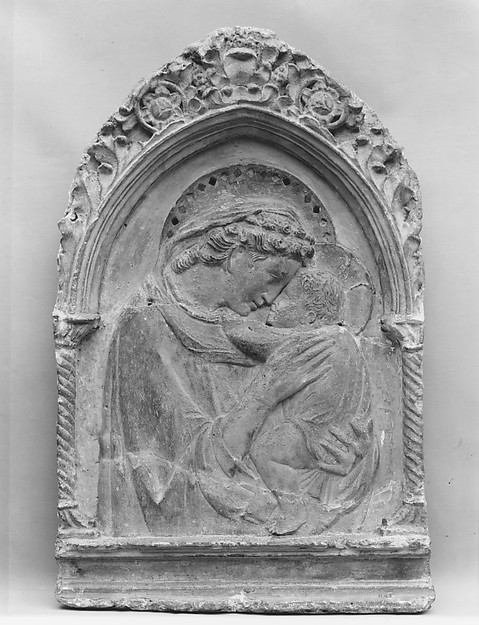
Madonna and Child, modeled by Donatello around 1400 (early in his career, in his pre-mature Florentine workshop years) in painted-and-gilded stucco and now in the Metropolitan Museum of Art in New York, is one of the earliest dated Donatello domestic Madonnas — modeled at a moment when Donatello had just begun his independent career after leaving Lorenzo Ghiberti's Florentine workshop where he had assisted on the Baptistery doors. The composition follows the late-Trecento Florentine devotional Madonna type that Donatello was beginning to transform with his new shallow-relief sfumato technique; the panel demonstrates the Florentine workshop tradition at the moment of transition from late-medieval to fully Renaissance pictorial-sculptural vocabulary.
Bible scenes Donatello painted
Luke