Painter of the Bible
Francesco Salviati (Francesco de' Rossi)
Francesco Salviati (Francesco de' Rossi) was a leading Florentine Mannerist painter of the second quarter of the sixteenth century and one of the principal Florentine-Roman painters who carried the Mannerist style across…

Their faith
Why Francesco Salviati (Francesco de' Rossi) painted Christ
Francesco Salviati, born Francesco de' Rossi in Florence in 1510, was deeply rooted in the Christian faith, which profoundly influenced his artistic journey. Trained in the workshop of Andrea del Sarto, a prominent figure in the Florentine Renaissance, Salviati embraced the spiritual dimensions of his craft. His patronage by Cardinal Giovanni Salviati not only provided him with opportunities in Rome but also connected him to the Church, allowing him to create significant religious works that reflect his devotion. Throughout his career, he dedicated himself to painting altarpieces and frescoes that conveyed biblical narratives, embodying the principles of faith and devotion that were central to his life and work.
Salviati's faith is vividly expressed in his notable works, such as the fresco cycle in the Cappella del Pallio of the Cancelleria Palace, where he depicted the Stories of Saint Lawrence. This cycle showcases his mastery of the Mannerist style while illustrating the life and martyrdom of the saint, inviting viewers to reflect on the themes of sacrifice and devotion. Similarly, his Visitation fresco in the Oratorio di San Giovanni Decollato captures the moment of divine encounter with grace and elegance, emphasizing the spiritual significance of the event. Through his intricate compositions and vibrant colors, Salviati's art continues to inspire and uplift, reminding us of the enduring power of faith and the beauty of the sacred narrative in our lives.
Life & work
Francesco Salviati (Francesco de' Rossi) was a leading Florentine Mannerist painter of the second quarter of the sixteenth century and one of the principal Florentine-Roman painters who carried the Mannerist style across central Italy in the generation between Pontormo and the late-Mannerist Cavaliere d'Arpino. Born in Florence in 1510, trained in Florence in the workshop of Andrea del Sarto (the same Florentine workshop that trained Pontormo and Rosso Fiorentino), he was active across Florence, Rome, Bologna, Venice, and France for his entire career — he took the professional name Salviati from his patronage by the Roman Cardinal Giovanni Salviati, who employed him in Rome from 1531 onward — and died in Rome in 1563.
His Christian religious work is concentrated in altarpieces and fresco cycles in his characteristic combination of Florentine Mannerist figural drawing and the new Roman Mannerist compositional density that he absorbed during his long Roman period under Cardinal Salviati's patronage. The fresco cycle in the Cappella del Pallio of the Cancelleria Palace in Rome (the principal central Roman ecclesiastical office, where Salviati painted the Stories of Saint Lawrence and other Christian subjects in the early 1550s), the great Visitation fresco in the Oratorio di San Giovanni Decollato in Rome (1538 — one of the supreme Roman Mannerist fresco compositions, painted in the Florentine confraternity church of the Beheaded Saint John), the altarpieces in the Florence Palazzo Vecchio and the Sala Regia of the Vatican, and the late Roman commissions for the Cardinal Farnese fill the painted corpus.
His personal style — figures in extreme elongation and complex foreshortening, jewel-bright color, dense decorative pattern, and a particular preference for crowded multi-figure narrative compositions — defined the mid-sixteenth-century Florentine-Roman Mannerist tradition. He was a personal friend and frequent rival of Giorgio Vasari (the two had been close in their Florentine apprentice years under Andrea del Sarto), and their parallel careers across Florence and Rome shaped the entire mid-Cinquecento Italian Mannerist scene.
He worked briefly in France in 1554–1555 at the invitation of the Cardinal of Lorraine, but returned to Italy and spent his last years in Rome under Farnese patronage. He was buried in the church of San Girolamo della Carità in Rome.
Notable works in detail
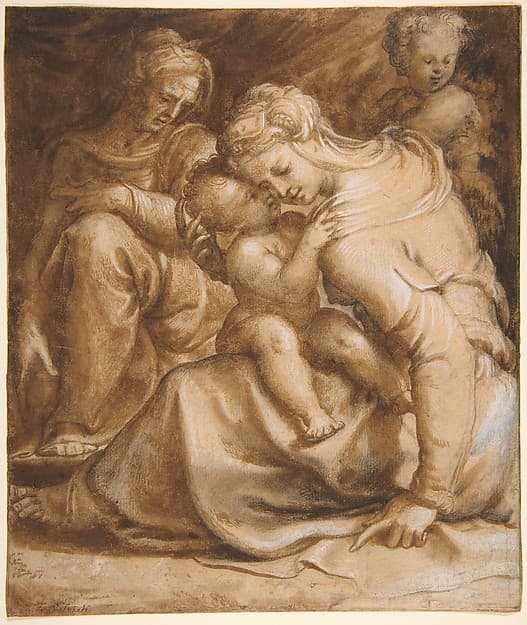
Virgin and Child with Saint Anne and John the Baptist
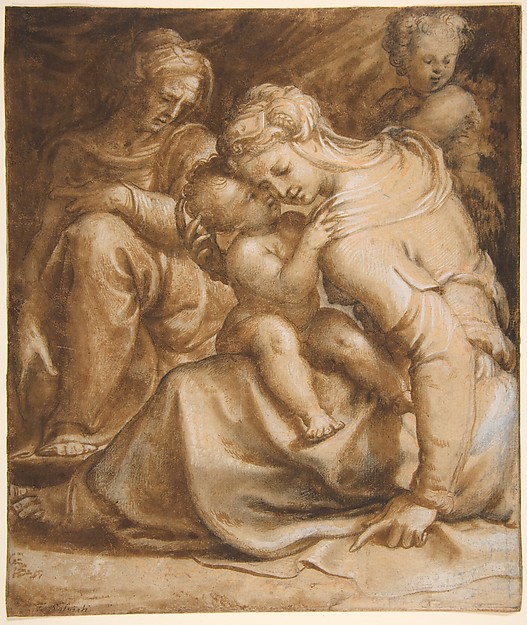
Virgin and Child with Saint Anne and John the Baptist, drawn by Francesco Salviati around 1545 in pen and brown ink with wash on paper and now in the Metropolitan Museum of Art in New York, depicts the iconographic subject of the Sacred Conversation among the seated Virgin holding the small Christ Child, her mother Saint Anne, and the small John the Baptist. Salviati stages the scene with characteristic late-Mannerist compositional density: the figures arranged in a pyramidal grouping, the Christ Child reaching toward the small John the Baptist while Anne supports the Virgin from behind. The drawing demonstrates the rapid confident pen-and-wash technique and the elongated Mannerist figural proportions that defined Salviati's mid-career Roman draughtsmanship under the patronage of Cardinal Salviati and the Farnese circle.
Bible scenes Francesco Salviati (Francesco de' Rossi) painted
Matthew