Painter of the Bible
Frans Floris I
Frans Floris (Frans de Vriendt, called Floris) was the leading Antwerp painter of the middle of the sixteenth century and the principal Antwerp Romanist of his generation — the painter who, after a long Italian sojourn, …
%2520-%2520Self-portrait.jpg%3Fwidth%3D600&w=2048&q=75)
Their faith
Why Frans Floris I painted Christ
Frans Floris I, a prominent painter of the sixteenth century, was deeply rooted in the Catholic faith, which profoundly influenced his artistic journey. Born into a family of stonemasons in Antwerp, he was trained under Lambert Lombard before embarking on a transformative journey to Italy. There, he immersed himself in the works of Michelangelo and Raphael, absorbing their Roman Mannerist style and returning to Antwerp with a renewed spiritual vision. His commitment to the Catholic Church was evident in his prolific production of altarpieces for local churches and confraternities during a time when such religious imagery was under threat from iconoclasm. Floris's works were not merely artistic endeavors; they were acts of devotion, reflecting his reverence for scripture and the divine narratives that shaped his faith.
Floris's faith is beautifully encapsulated in his altarpieces, such as "The Fall of the Rebel Angels" and "The Resurrection of Christ." In these works, he employed the muscular figural drawing and dramatic foreshortening characteristic of Roman Mannerism, creating a vivid portrayal of spiritual battles and divine triumphs. The dynamic compositions invite viewers to reflect on the cosmic struggle between good and evil, as well as the hope embodied in Christ's resurrection. Even as many of his works faced destruction during the iconoclastic upheaval, Floris's devotion endures through the beauty and power of his art, reminding us of the eternal truths of faith and redemption that resonate through the ages.
Life & work
Frans Floris (Frans de Vriendt, called Floris) was the leading Antwerp painter of the middle of the sixteenth century and the principal Antwerp Romanist of his generation — the painter who, after a long Italian sojourn, brought the Roman Mannerist figural vocabulary descending from Michelangelo and Raphael into the Antwerp painting tradition. Born in Antwerp in 1517 (or perhaps slightly earlier) to a stonemason family (his brothers Cornelis and Jacob Floris were also working artists), trained in Liège in the workshop of Lambert Lombard before traveling to Italy around 1541 (where he spent four years studying the Roman Mannerist altarpieces and the recent Sistine Chapel Last Judgment of Michelangelo), and active in Antwerp on his return until his death there in 1570.
His Christian religious work is concentrated in altarpieces produced for the Antwerp Catholic churches and confraternities of the 1540s, 1550s, and 1560s — the productive Antwerp decades immediately before the iconoclastic destruction of 1566 swept away most of the surviving Catholic religious imagery in the Low Countries. The Fall of the Rebel Angels (Antwerp Cathedral, 1554 — a large altarpiece commissioned by the Antwerp Confraternity of Fencers and depicting the cosmic battle in heaven with the rebellious angels tumbling from grace into hell, with characteristic Roman Mannerist muscular figural drawing and dramatic foreshortening), the Last Judgment altarpiece (Brussels, 1565), the Resurrection of Christ (Antwerp), and the Adoration of the Shepherds (multiple workshop variants) anchor the painted corpus.
His personal style — the Roman Mannerist muscular nude figural drawing absorbed from Michelangelo's Sistine ceiling and the late Roman commissions, combined with the post-Italian Antwerp colorist tradition descending from Quentin Matsys — defined the mid-sixteenth-century Antwerp Mannerist painting school and shaped the next generation of Antwerp painters who would absorb his Romanist vocabulary at one further remove. His pupil Maerten de Vos in particular carried the Floris workshop tradition into the second half of the sixteenth century.
He ran the largest and most prolific Antwerp workshop of his generation; his workshop is recorded as having had as many as 120 apprentices and assistants across his career, an unusually large operation by the Antwerp standards of the time. The 1566 iconoclastic destruction wrecked many of his altarpieces and the commercial collapse that followed substantially reduced his late-career output.
Notable works in detail
Christ Driving the Money Changers from the Temple
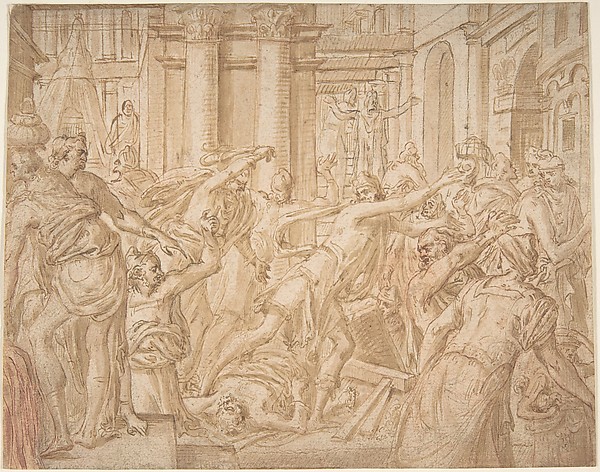
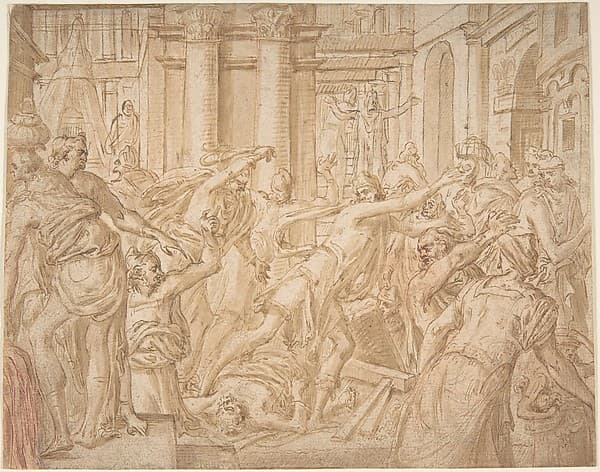
Christ Driving the Money Changers from the Temple, drawn by Frans Floris around 1530 (the dating is somewhat early — Floris would have been a teenager) in pen and brown ink with wash on paper and now in the Metropolitan Museum of Art in New York, illustrates the scene from John 2 (and parallel passages in the Synoptics) in which Christ overturns the tables of the money-changers and dove-sellers in the outer court of the Temple. The drawing shows Christ at the center of the composition with his arm raised in the act of driving out the merchants; the money-changers in postures of flight and resistance; the Temple architecture rising behind. The drawing demonstrates the early Floris draughtsmanship and the rapid confident pen-and-wash technique that the Antwerp Mannerist tradition would later refine in the post-Italian decades after Floris's transformative Italian sojourn of 1541–1545.
Bible scenes Frans Floris I painted
Mark