Painter of the Bible
Gaudenzio Ferrari
Gaudenzio Ferrari was the leading painter and sculptor of Lombardy and Piedmont in the first half of the sixteenth century and the principal artist of the great Sacro Monte sanctuary of Varallo in the foothills of the Alps north of Milan.

Their faith
Why Gaudenzio Ferrari painted Christ
Gaudenzio Ferrari's life and work were deeply rooted in his Christian faith, which was expressed through his dedication to the sacred art of the Italian Renaissance. As the principal artist of the Sacro Monte sanctuary in Varallo, he devoted much of his career to creating works that not only depicted biblical narratives but also served as a spiritual pilgrimage for those unable to travel to the Holy Land. His training in the Lombard tradition and his connection to the Franciscan order, which emphasized the importance of Christ's life and teachings, profoundly influenced his artistic vision. Ferrari's commitment to his faith is evident in the way he approached scripture, using it as a source of inspiration and guidance in his artistic endeavors, and his works reflect a sincere reverence for the divine.
Ferrari's faith is beautifully illustrated in his masterpieces, particularly in the frescoes and sculptures he created for the chapels of the Sacro Monte. The Adoration of the Magi chapel showcases his ability to convey emotion and spirituality through polychrome figures, inviting viewers to engage with the scene of Christ's birth. Similarly, the Crucifixion chapel, with its dramatic assembly of life-sized figures, captures the profound moment of Christ's sacrifice, drawing the audience into a deeper contemplation of their faith. Through these works, Gaudenzio Ferrari not only enriched the spiritual lives of those who encountered his art but also left a lasting legacy that continues to inspire viewers today, reminding us of the beauty and depth of Christ's love and sacrifice.
Life & work
Gaudenzio Ferrari was the leading painter and sculptor of Lombardy and Piedmont in the first half of the sixteenth century and the principal artist of the great Sacro Monte sanctuary of Varallo in the foothills of the Alps north of Milan. Born in Valduggia in the Piedmont in 1471 (or perhaps a few years later), trained in Vercelli and Milan in the orbit of Bramantino and the late-Quattrocento Lombard-Leonardesque school, and active in Vercelli, Varallo, Saronno, and Milan for his entire career, he died in Milan in 1546.
His Christian religious work is concentrated in fresco cycles, altarpieces, and polychrome polygonal sculpture for the Lombard and Piedmontese churches and (above all) the Sacro Monte sanctuary of Varallo. The Sacro Monte — a great mountain-top religious complex begun in 1486 by the Franciscan friar Bernardino Caimi as a Holy Land pilgrimage substitute for those unable to travel to Jerusalem, with thirty-five small chapels representing the principal scenes of the Life of Christ in painted-and-sculpted tableaux — became Gaudenzio Ferrari's principal life work. He worked at Varallo intermittently across his entire career, producing the principal frescoes and the monumental polychrome terracotta sculptures for the Adoration of the Magi chapel (1515–1530), the Crucifixion chapel (1517–1525, with its dense crowd of more than thirty life-sized polychrome figures gathered around the cross), the Last Supper chapel, and several other chapels of the sanctuary.
Beyond Varallo, his major commissions include the great fresco cycle of the Life of Christ in the Madonna delle Grazie in Varallo (1513), the Saronno Cathedral cupola fresco of the Choir of Angels (1534–1536 — a vast assembly of small angels playing every imaginable musical instrument, painted across the entire cupola surface), the polyptych altarpieces in Vercelli, and the late Milanese commissions of the 1540s.
His personal style — combining the soft chromatic warmth of the Lombard tradition with a particularly Piedmontese-Northern emotional intensity in the religious narrative subjects — gave him a uniquely regional position in the Italian Renaissance. The combination of his painted frescoes and his polychrome polygonal sculptures across the Sacro Monte chapels created an immersive total-art-environment that anticipated by a century the seventeenth-century Italian Baroque interest in immersive sacred theater. He was buried in Milan.
Notable works in detail
met-338641
Standing Virgin Holding the Christ Child, drawn by Gaudenzio Ferrari around 1475 (early in his career — though the dating is contested; some scholars place the drawing decades later) in pen and ink on paper and now in the Metropolitan Museum of Art in New York, is a small preparatory drawing for one of his many painted Marian compositions. The drawing shows the standing Virgin in three-quarter view holding the small Christ Child against her chest; the rapid confident pen technique demonstrates the late-Quattrocento Lombard workshop tradition that Gaudenzio absorbed during his apprentice years before developing the distinctive Piedmontese-Northern emotional intensity that would define his mature work at the Sacro Monte sanctuary of Varallo.
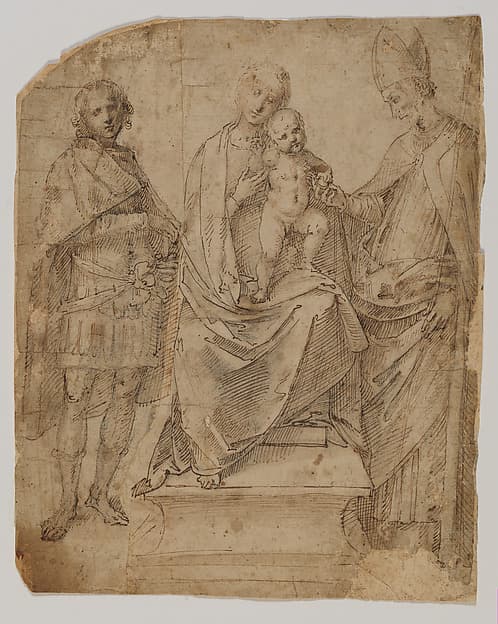
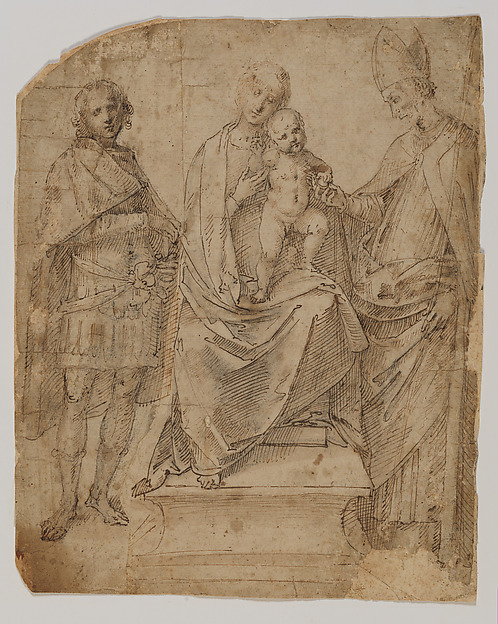
Madonna and Child with Saints Martin and Maurice (?)
Madonna and Child with Saints Martin and Maurice, painted by Gaudenzio Ferrari around 1527 in oil on panel and now in the Metropolitan Museum of Art in New York, is a small altarpiece panel from the central productive period of his Lombard-Piedmontese career. The composition shows the seated Virgin holding the Christ Child upright on her lap, with two attendant saints — Martin on horseback (the iconographic attribute that distinguishes him from any other male saint) and Maurice in soldier's armor — standing on either side in formal devotional grouping. The chromatic palette of saturated crimson, ultramarine, and warm Piedmontese flesh is characteristic of Gaudenzio's mature manner, and the panel demonstrates his ability to combine the Lombard pictorial tradition with the particularly Piedmontese-Northern emotional intensity that defined his entire output.
Bible scenes Gaudenzio Ferrari painted
Luke