Painter of the Bible
Giorgio Vasari
Giorgio Vasari was the principal painter, architect, and art-historian of the late-Mannerist Tuscan-Roman generation — the artist whose Lives of the Most Excellent Painters, Sculptors, and Architects (Florence, 1550, exp…

Their faith
Why Giorgio Vasari painted Christ
Giorgio Vasari's faith was deeply intertwined with his artistic endeavors, reflecting the religious fervor of the Italian Renaissance. As a devout Christian, Vasari's work was often commissioned by the Medici family and the Catholic Church, which were pivotal in shaping his artistic direction. His upbringing in Arezzo, a city steeped in Christian tradition, and his training under renowned artists imbued him with a profound reverence for scripture and sacred themes. Vasari's commitment to his faith is evident in his altarpieces and public religious commissions, where he sought to glorify God through his artistry. His devotional habits included prayer and reflection, which guided his creative process, ensuring that his works were not merely artistic expressions but also acts of worship.
Vasari's faith significantly influenced his most notable works, including the frescoes of the cupola in Florence Cathedral and the altarpiece of the Allegory of the Immaculate Conception. In the Last Judgment fresco, he envisioned the resurrection and divine judgment, capturing the awe and majesty of God's power. The Allegory of the Immaculate Conception reflects his understanding of the Virgin Mary’s pivotal role in salvation history, showcasing his ability to convey profound theological concepts through visual art. Vasari's legacy as an artist and historian continues to inspire viewers today, as his works invite contemplation of the divine and remind us of the beauty that emerges when faith and creativity intertwine.
Life & work
Giorgio Vasari was the principal painter, architect, and art-historian of the late-Mannerist Tuscan-Roman generation — the artist whose Lives of the Most Excellent Painters, Sculptors, and Architects (Florence, 1550, expanded edition 1568) founded the modern discipline of art history and remains, almost five hundred years later, the indispensable primary source for the lives and works of every Italian Renaissance master from Cimabue to his own contemporaries. Born in Arezzo in 1511, trained as a teenager in the workshop of Andrea del Sarto and then with the Florentine portraitist Baccio Bandinelli, and active across Florence, Rome, Naples, Bologna, and his native Arezzo for his entire career, he served the Medici grand-ducal court in Florence from 1554 until his death in Florence in 1574.
His Christian religious work is concentrated in altarpieces, ceiling decorations, and large public-religious commissions for the Medici and the Counter-Reformation Florentine church. The cupola frescoes of Florence Cathedral — the Last Judgment program he began in 1572 and left unfinished at his death (completed by Federico Zuccaro in 1579) — fill the inside of Brunelleschi's great dome with a vast Mannerist composition of the resurrected dead, the Apostles, and the choirs of angels. The frescoes of the Sala Regia in the Vatican (1572–1573, completed for Pope Gregory XIII) show the Battle of Lepanto and the Massacre of Saint Bartholomew — the latter, painted in celebration of the 1572 French Catholic killings of Protestants, is one of the more uncomfortable historical commissions of the late-Renaissance papacy. The decoration of the Palazzo Vecchio in Florence — the Salone dei Cinquecento and the Studiolo of Francesco I — combines mythological and religious subjects in dense allegorical program for the Medici grand-ducal court.
His altarpieces — the Allegory of the Immaculate Conception (Santi Apostoli, Florence, 1541), the Adoration of the Shepherds (Galleria Palatina, Florence), the Saint Sigismund (Camaldoli), and dozens of provincial commissions in Tuscan churches — are competent rather than innovative; modern criticism has been more interested in his Lives than in his paintings.
His designed architecture — the Uffizi in Florence (1560–1581), the corridor connecting the Palazzo Vecchio to the Pitti Palace across the Ponte Vecchio (the Vasari Corridor), the Loggia in Arezzo, the church of the Cavalieri di Santo Stefano in Pisa — survived in better repute than his painting and remains in active civic and museum use today. He was buried in his own family chapel in Arezzo, in the church he had designed for it.
Notable works in detail
Saint Paul Speaking before King Agrippa (Acts 26)
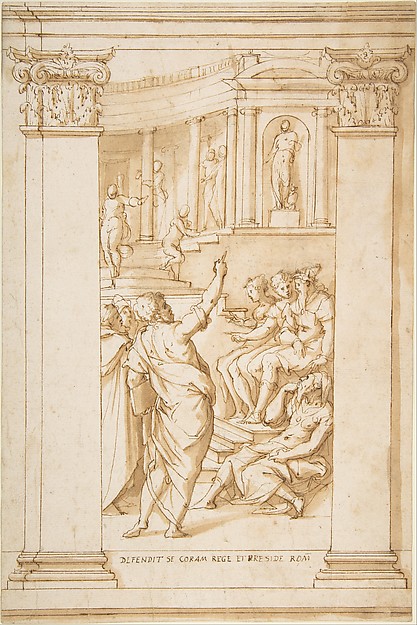
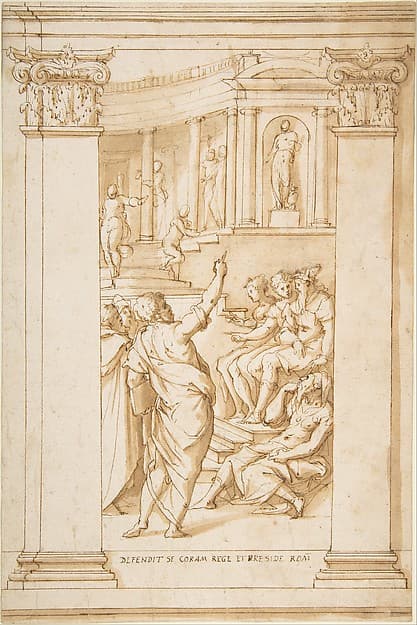
Saint Paul Speaking before King Agrippa (Acts 26), drawn by Giorgio Vasari around 1573 in pen and brown ink with brown wash on paper and now in the Metropolitan Museum of Art in New York, is a preparatory drawing for one of the Vatican Sala Regia frescoes that Vasari was painting in 1572–1573 for Pope Gregory XIII. The drawing illustrates the scene from Acts 26 in which the imprisoned Paul, brought before the Jewish client king Agrippa II in Caesarea, makes his great defense speech of the Gospel before the king and the Roman governor Festus. Vasari stages the scene as a late-Mannerist judicial composition with Paul standing in profile at the lower right gesturing in the act of speaking, the king and governor seated under a baldachin at the upper left in attitude of attentive listening, and a small crowd of Roman soldiers and Jewish religious authorities filling the background. The drawing is one of the principal Vasari preparatory drawings for the Sala Regia program in any American collection.
Bible scenes Giorgio Vasari painted
Acts