Painter of the Bible
Giovanni Lanfranco
Giovanni Lanfranco was a leading Italian Baroque painter and the principal innovator of the illusionistic ceiling-fresco vocabulary that would define late-Baroque Roman ceiling decoration through Pietro da Cortona, Andre…

Their faith
Why Giovanni Lanfranco painted Christ
Giovanni Lanfranco was a devoted Christian whose faith deeply permeated his artistic endeavors. Born in Parma in 1582, he trained under the renowned Agostino Carracci and later Annibale Carracci, both of whom instilled in him a reverence for sacred subjects. Lanfranco's commitment to his faith is evident in the way he approached his work, dedicating himself to painting altarpieces and ceiling frescoes for major churches in Rome and Naples. His devotion was not merely a backdrop to his artistry; it was an integral part of his creative process, guiding him in his depiction of divine themes and spiritual narratives. His works were often commissioned by the church, reflecting a strong connection to the religious community and a desire to inspire faith in viewers through his art.
Lanfranco's faith found its most stunning expression in masterpieces like the Assumption of the Virgin in the cupola of Sant'Andrea della Valle and the Apotheosis of San Gennaro in the Cathedral of Naples. In these works, he utilized the innovative di sotto in sù perspective to create a sense of divine elevation, drawing the viewer's gaze upward into the heavens. The swirling vortex of figures and the vibrant colors serve to evoke a spiritual transcendence, inviting contemplation of the sacred. His ability to blend illusionistic techniques with profound religious themes not only marked a turning point in Baroque art but also continues to inspire awe and reverence in viewers today. Lanfranco's legacy as a painter of faith endures, reminding us of the power of art to elevate the soul and connect us with the divine.
Life & work
Giovanni Lanfranco was a leading Italian Baroque painter and the principal innovator of the illusionistic ceiling-fresco vocabulary that would define late-Baroque Roman ceiling decoration through Pietro da Cortona, Andrea Pozzo, and the eighteenth-century Tiepolo generation. Born in Parma in 1582, trained in his native Parma under Agostino Carracci and then in Bologna and Rome under Annibale Carracci (whom he assisted on the great Farnese Gallery ceiling between 1602 and 1608), he was active in Rome through the 1620s before moving to Naples in 1633, where he worked for thirteen years at the Spanish viceregal court producing the principal Neapolitan ceiling cycles of the seventeenth century. He returned to Rome in 1646 and died there in 1647.
His Christian religious work is concentrated in altarpieces and ceiling frescoes for the major Roman and Neapolitan churches. The cupola fresco of Sant'Andrea della Valle in Rome (1625–1627 — the great Assumption of the Virgin painted in the cupola of the largest dome in Rome after Saint Peter's, with the soaring vortex of figures spiraling up into the open sky in the di sotto in sù manner Lanfranco was effectively inventing as the new Baroque ceiling vocabulary), the Treasury Chapel cupola in the Cathedral of Naples (1641–1643 — depicting the Apotheosis of San Gennaro in a similar vortex composition), the great altarpieces for the Roman Sant'Agostino, the Quirinal, and several Neapolitan churches anchor the painted corpus.
The Sant'Andrea della Valle cupola in particular is the central monument of his career and one of the foundational documents of the Baroque illusionistic ceiling. Pietro da Cortona, who was Lanfranco's principal Roman rival and frequent collaborator, would extend the di sotto in sù vocabulary in the slightly later Barberini ceiling; Andrea Pozzo would push it further in the Sant'Ignazio nave fresco a generation later; and the eighteenth-century Tiepolo and the Würzburg Residenz frescoes would refine it to its supreme statement. Lanfranco's contribution was the founding step.
He was Correggio's principal seventeenth-century interpreter — the soft sfumato modeling, the upward-spiraling figural composition, and the saturated chromatic palette of his ceilings descend directly from Correggio's earlier Parma cupolas of 1520–1530, which Lanfranco had studied closely as a young painter in his native Parma.
Notable works in detail
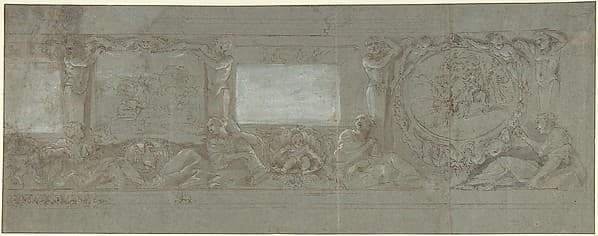
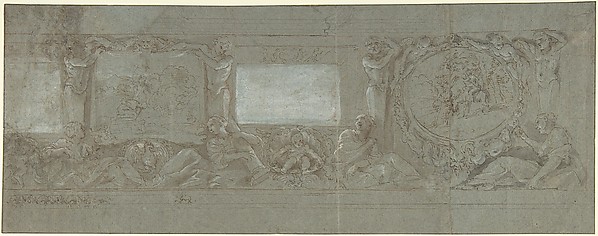
Design for a Wall Decoration with the Sacrifice of Abraham and the Flight into Egypt
Design for a Wall Decoration with the Sacrifice of Abraham, drawn by Giovanni Lanfranco around 1620 in his early Roman workshop years in pen and brown ink with wash on paper and now in the Metropolitan Museum of Art in New York, is a preparatory drawing for one of the wall-decoration commissions Lanfranco was producing in his early Roman career under Pope Paul V and his nephew Cardinal Scipione Borghese. The drawing shows the climactic moment of Genesis 22 in which the angel descends to stop Abraham from sacrificing his son Isaac on the altar at the top of Mount Moriah. The composition demonstrates the early Lanfranco combination of late-Carraccian figural discipline with the new Caravaggesque dramatic intensity that defined the Roman pictorial scene of the 1610s and early 1620s, in the years immediately before Lanfranco's great Sant'Andrea della Valle cupola fresco of 1625–1627 transformed his career.
Bible scenes Giovanni Lanfranco painted
Genesis