Painter of the Bible
Hugo van der Goes
Hugo van der Goes painted the masterpiece that introduced Northern realism to Italy.

Their faith
Why Hugo van der Goes painted Christ
Hugo van der Goes, a master painter of the Northern Renaissance, dedicated his life to creating art that reflected his deep Christian faith. After being admitted to the Ghent painters' guild in 1467, he rose to prominence within the community, eventually serving as its dean. However, in the late 1470s, van der Goes experienced a profound spiritual crisis, leading him to withdraw from public life and enter the Roode Klooster, an Augustinian monastery. Here, he lived as a lay brother, dedicating himself to prayer and contemplation while continuing to produce remarkable works of art. His struggles with faith and salvation, as documented by contemporaries, only deepened his devotion to God and the themes of redemption and grace found in his paintings.
Van der Goes' faith profoundly influenced his artistic vision, most notably in his masterpiece, the Portinari Altarpiece. This triptych, commissioned for the family church of Sant'Egidio in Florence, features the Adoration of the Shepherds, where the serene yet haunting expressions of the shepherds reflect the awe and humility of encountering the divine. The meticulous realism and rich iconography in the painting invite viewers to contemplate the sacred narrative, revealing van der Goes' desire to connect the earthly and the heavenly. His other works, like the Death of the Virgin and the Monforte Altarpiece, also showcase his commitment to portraying biblical themes with emotional depth and spiritual significance. Through his devotion, van der Goes' art continues to inspire and uplift those who encounter it, reminding us of the beauty and grace found in the Christian faith.
Life & work
Hugo van der Goes painted the masterpiece that introduced Northern realism to Italy. Born around 1440, probably in Ghent, he was admitted to the Ghent painters' guild as a master in 1467 and elected dean of the guild in 1473–75. In the late 1470s he withdrew from public life into the Roode Klooster, an Augustinian monastery in the Sonian Forest east of Brussels, where he continued to paint for outside commissions while living as a lay brother. Contemporaries describe a final crisis in which he attempted self-harm under the conviction that he could not be saved. He died at the monastery in 1482.
The work that secured his European reputation, before and after his death, was the Portinari Altarpiece (1475–76), an enormous triptych commissioned by Tommaso Portinari, the Medici bank's representative in Bruges, for the family church of Sant'Egidio in Florence. The central panel — an Adoration of the Shepherds set in a wintry, twilight Northern landscape — was crated overland and across the Alps to Florence in 1483, where its exacting realism, the haunted faces of the shepherds, and the dense iconographic still-life of flowers in the foreground reset the visual standard for Florentine painters who saw it. Domenico Ghirlandaio's Adoration of the Shepherds and Filippino Lippi's and Botticelli's late Madonnas all carry traces of its impact. The triptych now hangs in the Uffizi.
His other surviving panels include the Death of the Virgin (Groeningemuseum, Bruges), the Monforte Altarpiece showing the Adoration of the Magi (Gemäldegalerie, Berlin), the small Trinity Altarpiece (National Gallery of Scotland), and a few isolated devotional Madonnas. His pre-monastic civic identity in Ghent is largely documented by guild records; almost no preparatory drawings survive, and the chronology of his work is built from infrared imaging, dendrochronology, and a small set of contemporary accounts of his final illness — most notably the chronicle of Gaspar Ofhuys, the prior of the Roode Klooster while van der Goes was in residence.
Notable works in detail
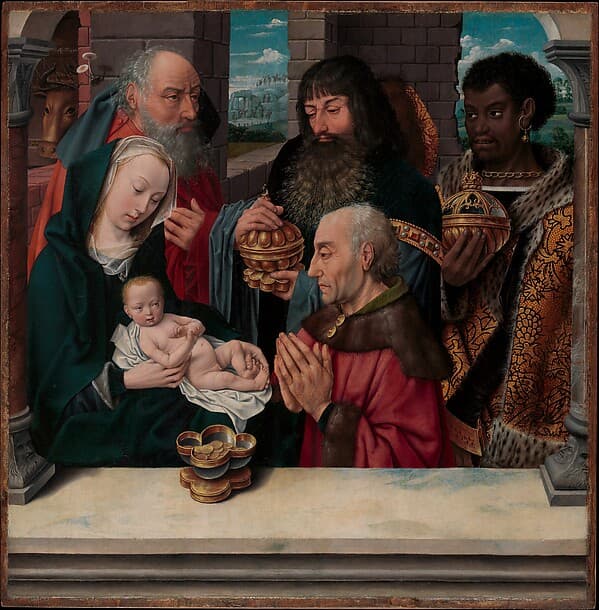
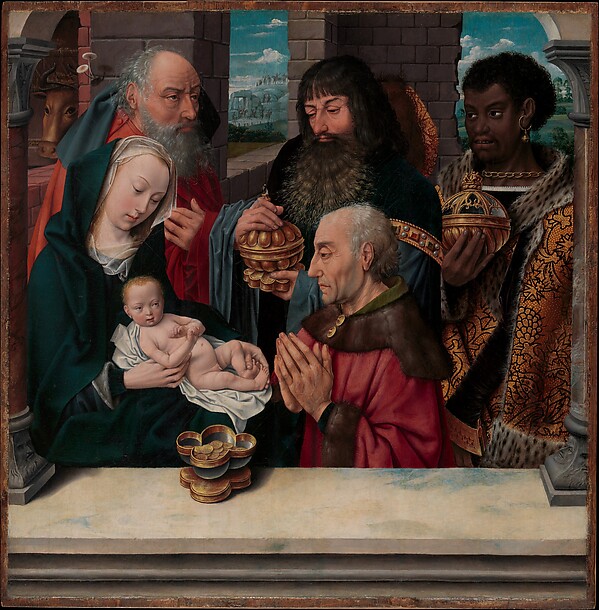
The Adoration of the Magi, painted by Hugo van der Goes (or by his immediate workshop) around 1470 in oil on panel and now in the Metropolitan Museum of Art in New York, depicts the visit of the three kings to the infant Christ as recorded in Matthew 2. Van der Goes stages the scene in a dense vertical composition: the seated Virgin and the Christ Child in the lower foreground, the eldest king kneeling in profile offering his gift, the second and third kings standing behind him in formal attendance, the small thatched lean-to of Bethlehem rising behind. The chromatic palette of saturated crimson, ultramarine, gold, and warm flesh against the soft Northern landscape opening to a low horizon is the unmistakable Bruges-Ghent Early Netherlandish signature, and the elongated proportions and intense devotional faces show the Hugo van der Goes manner that the Portinari Altarpiece in the Uffizi (his masterpiece) would refine to its supreme statement a few years later. The panel is one of the principal works in the Hugo van der Goes circle in any American collection.
Bible scenes Hugo van der Goes painted
Matthew