Painter of the Bible
Jacopo Bellini
Jacopo Bellini was the founding patriarch of the Bellini dynasty — the family workshop that ran Venetian painting for three generations and shaped the late-Quattrocento turn of Venice into the principal Italian center of…

Their faith
Why Jacopo Bellini painted Christ
Jacopo Bellini, born around 1400 in Venice, was a deeply devoted Christian whose faith was intricately woven into his artistic practice. He was trained under Gentile da Fabriano, a prominent painter of the International Gothic style, and his work reflects a commitment to the spiritual and devotional aspects of art. Although not much of his painted output survives, the altarpieces he created, such as the 'Crucifixion' and 'Madonna and Child with a Donor,' reveal his reverence for sacred subjects. His sketchbooks, filled with over three hundred detailed drawings, showcase not only his artistic prowess but also his dedication to biblical narratives and themes, illustrating the profound impact of scripture on his life and work.
Bellini's faith profoundly influenced his artistic vision, as seen in works like 'Christ in Limbo' and his various depictions of the Crucifixion. These pieces reflect a deep understanding of Christ's sacrifice and the hope of redemption, central tenets of Christian belief. His meticulous sketches for the 'Stations of the Cross' demonstrate his desire to convey the narrative of Christ's passion in a way that resonates with viewers. Although many of his paintings have been lost to time, the spirit of his devotion continues to inspire those who engage with his surviving works. Through his art, Bellini invites us to reflect on the beauty of faith and the enduring message of Christ's love, reminding us that the act of creation can be a powerful expression of devotion.
Life & work
Jacopo Bellini was the founding patriarch of the Bellini dynasty — the family workshop that ran Venetian painting for three generations and shaped the late-Quattrocento turn of Venice into the principal Italian center of pictorial color and atmospheric landscape. Born in Venice around 1400, trained in the workshop of Gentile da Fabriano (the great International Gothic painter, with whom Jacopo traveled to Florence in 1423–1425 for the Florentine Linen Drapers' Confraternity altarpiece), and active in Venice, Padua, and Verona for his entire career, he was the father of the painters Gentile and Giovanni Bellini and the father-in-law of Andrea Mantegna (whose marriage to Jacopo's daughter Nicolosia in 1453 made the Bellini and Mantegna families a single Italian Renaissance dynasty). He died in Venice around 1471.
His Christian religious painted output is small in surviving numbers — most of his finished paintings have been lost or destroyed — but the surviving altarpieces include the Madonna and Child with a Donor (Louvre), the Christ in Limbo (Museo Padovano), the Crucifixion (Verona Cathedral, c. 1436), and a small number of Madonnas in Italian and American collections.
His enduring importance lies in the two surviving sketchbooks — one in the Louvre and one in the British Museum, totaling more than three hundred sheets of detailed pen-and-ink and silverpoint drawings of biblical narratives, classical antiquities, animals, and architectural studies. The sketchbooks are among the most important surviving Italian Renaissance drawn cycles and document the encyclopedic ambitions of his late workshop. His Crucifixion drawings, his Adoration of the Magi sheets, his architectural fantasies, and his studies for the Stations of the Cross fill page after page in a continuous chronological program.
His sons inherited and transformed the workshop. Gentile Bellini became the leading Venetian state portraitist and the chronicler of Venetian state-religious processions (his great Procession in Saint Mark's Square in the Accademia is the supreme document of fifteenth-century Venice). Giovanni Bellini became the towering Venetian religious painter of the next generation and the master of Giorgione and Titian. Jacopo's career — modest in surviving paintings, monumental in surviving drawings — is the foundation of all of it.
Notable works in detail
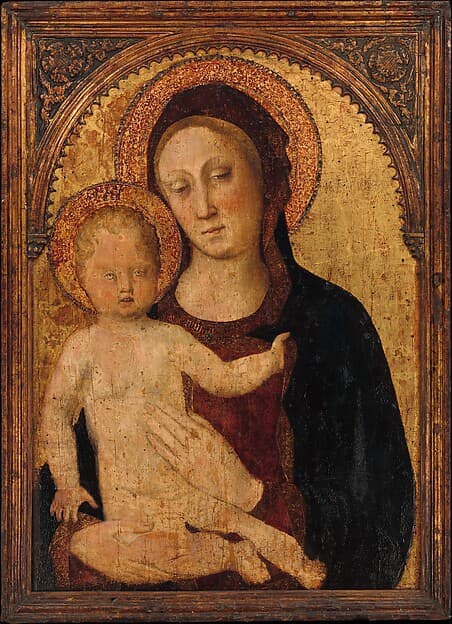
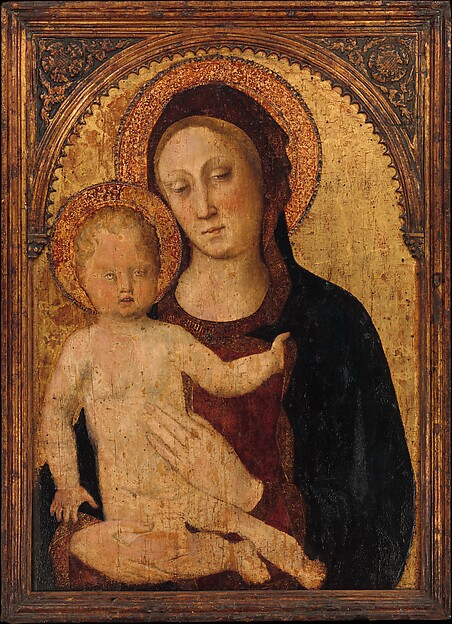
Madonna and Child, painted by Jacopo Bellini around 1440 in tempera on panel and now in the Metropolitan Museum of Art in New York, is one of the few surviving paintings by the founding patriarch of the Bellini Venetian dynasty. The Virgin sits in three-quarter view holding the standing Christ Child upright on her lap; the chromatic palette of saturated crimson, ultramarine, and tooled gold against a patterned gold ground is characteristic of the early Quattrocento Venetian devotional manner that combined the late-medieval Italo-Byzantine gold-ground convention with the new Renaissance interest in three-dimensional figural drawing. Most of Jacopo's finished paintings have been lost; the principal record of his career is the two great surviving sketchbooks (in the Louvre and the British Museum) of detailed pen-and-ink drawings. This Met panel is among the few surviving finished paintings and a defining document of the early Venetian fifteenth-century Bellini workshop.
Bible scenes Jacopo Bellini painted
Luke