Painter of the Bible
Jan Brueghel the Elder
Jan Brueghel the Elder was the second son of Pieter Bruegel the Elder and one of the leading Antwerp painters of the early seventeenth century.
%2520-%2520Portrait%2520of%2520Jan%2520Brueghel%2520the%2520Elder.jpg%3Fwidth%3D600&w=2048&q=75)
Their faith
Why Jan Brueghel the Elder painted Christ
Jan Brueghel the Elder, born into a family of artists, was deeply influenced by his Christian upbringing and the artistic legacy of his father, Pieter Bruegel the Elder. Raised by his grandmother, the painter Mayken Verhulst, Brueghel cultivated a profound appreciation for the beauty of God's creation. His faith was evident in his meticulous attention to detail in nature, reflecting a reverence for the divine artistry found in the world around him. Throughout his life, he maintained a close relationship with Cardinal Federico Borromeo, a significant patron who shared his devotion to the Christian faith. This connection not only provided him with support but also reinforced his commitment to creating art that celebrated biblical themes and the splendor of God's creation.
Brueghel's faith profoundly shaped his artistic vision, particularly in his Edenic landscapes that depict biblical narratives. His renowned painting, "Adam and Eve in Paradise," created in collaboration with Peter Paul Rubens, showcases the harmonious beauty of the Garden of Eden, with vibrant flora and fauna surrounding the biblical figures. This work is a testament to Brueghel's ability to weave together spirituality and artistry, inviting viewers to reflect on the divine narrative of creation. His other notable works, such as "The Animals Entering the Ark" and various allegorical pieces, further illustrate his commitment to portraying the intersection of faith and nature. Through his art, Brueghel continues to inspire viewers, reminding them of the beauty of God's creation and the profound stories found within scripture.
Life & work
Jan Brueghel the Elder was the second son of Pieter Bruegel the Elder and one of the leading Antwerp painters of the early seventeenth century. Born in Brussels in 1568, only a year before his father's death, raised by his maternal grandmother the Antwerp painter Mayken Verhulst, and trained first in Antwerp and then in Italy (where he traveled across the peninsula in 1589–1596 and worked at the Roman court of Cardinal Federico Borromeo, who became his lifelong patron and friend), he settled in Antwerp on his return and worked there for the rest of his life. He died in Antwerp in 1625, in the cholera epidemic that swept the city.
His specialty was small-format paintings of unprecedented detail — flowers, fruit, birds, paradisal landscapes filled with animals, allegories of the senses, and Garden of Eden scenes — that earned him the nicknames Velvet Brueghel (for the soft sheen of his paint surface) and Flower Brueghel (for his floral specialties). His Christian religious work is concentrated in the Edenic landscapes — Adam and Eve in the Garden of Eden, the Animals Entering the Ark, the Earthly Paradise — in which the small biblical figures are dwarfed by panoramic landscapes filled with extraordinarily detailed observation of dozens of plant and animal species. The Adam and Eve in Paradise (Mauritshuis, The Hague, c. 1615 — painted in close collaboration with Peter Paul Rubens, who supplied the Adam and Eve figures while Brueghel painted the Edenic animal-and-plant landscape) is the supreme statement of this collaborative Antwerp paradisal genre and one of the most reproduced single religious paintings of the early seventeenth century.
He worked in close partnership with Peter Paul Rubens — the two were intimate personal friends as well as frequent collaborators — and their joint paintings (in which Rubens supplied the figures and Brueghel supplied the landscape, animals, and floral detail) form one of the most distinctive collaborative bodies of work in the entire history of European painting. The Garden of Eden compositions, the Cimon and Iphigenia, the Sense of Smell, and several smaller religious-allegorical pieces in the Prado and the Mauritshuis are the principal surviving collaborative paintings.
His sons Jan Brueghel the Younger and Ambrosius Brueghel continued the workshop after his death; the Brueghel-name workshop continued issuing detailed botanical-and-paradisal compositions for several generations.
Notable works in detail
met-415885
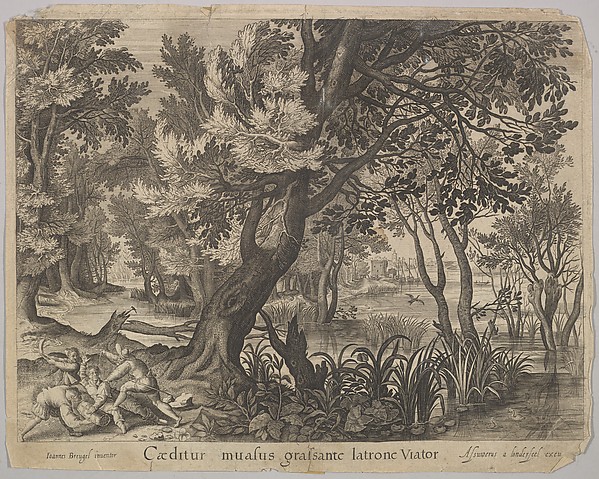
The Good Samaritan Finds the Man, designed by Jan Brueghel the Elder around 1565 (the dating is somewhat early — Jan Brueghel was probably a child if the design is his) and engraved by his workshop, illustrates the climactic scene of the parable from Luke 10. Brueghel stages the scene at the side of the road from Jerusalem to Jericho: the wounded man lies on the dusty ground in the foreground, the Samaritan kneels beside him in the act of binding the wounds, while in the deep background the priest and the Levite who had passed by on the other side are still visible as small figures continuing their journey. The print belongs to the long sequence of biblical landscape narratives that Brueghel and his Antwerp workshop produced for the Counter-Reformation publishing market.
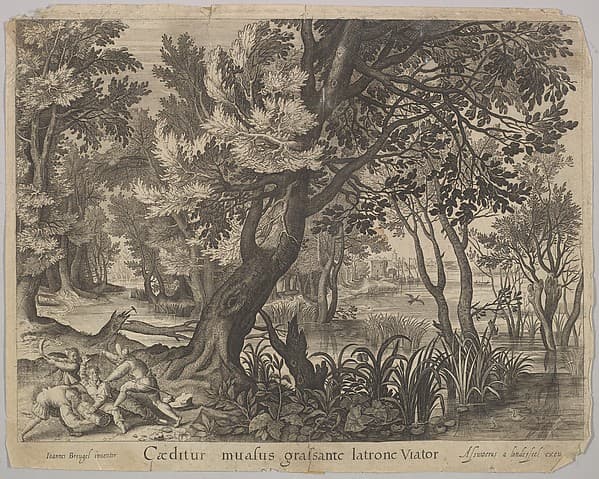
The Thieves Robbing the Man from The Good Samaritan
The Thieves Robbing the Man, from the Good Samaritan series engraved by Jan Brueghel the Elder around 1593, illustrates the opening scene of the Luke 10 parable: the unnamed traveler is set upon by the bandits who beat him, strip him, and leave him half-dead by the roadside on the road from Jerusalem to Jericho. Brueghel stages the scene as a panoramic landscape encounter: the bandits surrounding the fallen traveler in the foreground, the rocky desert landscape of the Judean wilderness opening behind, and (in the deeper background) the small figures of the priest and the Levite about to encounter the wounded man on their way down the road. The print is one of the principal Jan Brueghel the Elder treatments of a Gospel parable subject.
Bible scenes Jan Brueghel the Elder painted
Luke