Painter of the Bible
Joachim Patinir
Joachim Patinir is the painter who turned Northern landscape into a subject in its own right while keeping a biblical figure tucked inside it.

Their faith
Why Joachim Patinir painted Christ
Joachim Patinir, a master painter of the early 16th century, was deeply rooted in his Christian faith, which profoundly influenced his artistic vision. Born in the Prince-Bishopric of Liège, Patinir registered as a master in the Antwerp guild in 1515, where he dedicated his life to creating art that reflected his devotion to scripture. His works often feature biblical scenes set against the backdrop of expansive landscapes, suggesting an intimate relationship between the divine and the natural world. This connection is evident in his meticulous attention to detail and the atmospheric perspectives he employed, which invite viewers to contemplate the spiritual significance of the scenes depicted. His faith was not merely a backdrop but a driving force in his life and work, as he sought to glorify God through his artistry.
Patinir's paintings, such as "The Rest on the Flight into Egypt" and "Saint Jerome in the Desert," exemplify how his faith shaped his artistic expression. In these works, small biblical figures are nestled within grand landscapes, symbolizing the omnipresence of God in nature. The serene yet majestic vistas evoke a sense of awe and reverence, encouraging viewers to reflect on their own spiritual journeys. By placing sacred narratives within the vastness of creation, Patinir invites us to see the divine in the everyday world. His unique approach laid the groundwork for future artists, merging the spiritual with the natural in a way that continues to inspire and uplift those who encounter his work today. Through his devotion, Patinir's legacy endures, reminding us of the beauty and majesty of God's creation.
Life & work
Joachim Patinir is the painter who turned Northern landscape into a subject in its own right while keeping a biblical figure tucked inside it. Born around 1480 in Bouvignes-sur-Meuse (or possibly in nearby Dinant) in the Prince-Bishopric of Liège, he registered as a master painter in the Antwerp guild in 1515 and lived and worked in Antwerp until his death in 1524. Albrecht Dürer, who passed through Antwerp on his Netherlandish journey of 1520–21 and met Patinir in person — drawing his portrait, attending his second marriage, and praising him in the diary as the great "good landscape painter" — left the earliest documentary appraisal of his importance.
His paintings are recognizable on sight. A small religious scene — the Rest on the Flight into Egypt, the Baptism of Christ, Saint Jerome in the wilderness, Charon Crossing the Styx — sits at the foot of a vast, sweeping panoramic landscape: bluish jagged outcroppings, distant rivers, scattered villages, an impossibly high horizon, and a soft grayed-blue atmospheric perspective that he was probably the first Northern painter to handle systematically. The figures, often by Patinir's collaborators (Quentin Massys signed at least one joint panel with him), are dwarfed by the world they walk through.
His most-cited works — the Rest on the Flight into Egypt and Saint Jerome in the Desert in the Prado, the Baptism of Christ in the Kunsthistorisches Museum in Vienna, the Penitent Saint Mary Magdalene in the National Museum of Art of Catalonia, and the Charon Crossing the Styx in the Prado — all use the same compositional formula: small foreground devotional drama, vast Patinir-blue middle ground.
His direct influence is enormous. The "world landscape" tradition he established was carried forward by Pieter Bruegel the Elder's mid-century paintings of biblical and seasonal subjects, by Herri met de Bles in the second generation, and indirectly by every later Flemish landscape painter from Jan Brueghel the Elder to Paul Bril. The marriage of small biblical figure to vast natural drama that we now associate with Romantic painting begins, in the West, with Patinir's Antwerp panels.
Notable works in detail
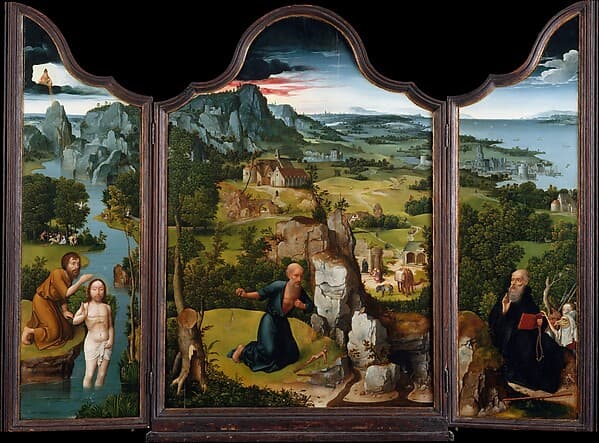
The Penitence of Saint Jerome, painted by Joachim Patinir (or his workshop) around 1510 in oil on panel and now in the Metropolitan Museum of Art in New York, depicts the early Church Father in the conventional iconographic posture of his hermit years in the Syrian desert — half-naked, kneeling on his rocks, beating his breast with a stone in penitence — set against the panoramic landscape that defined Patinir's revolutionary contribution to Northern painting. Patinir is widely credited as the first European master to make landscape itself the primary subject of his pictures rather than a backdrop for narrative figures; the small saint in the foreground here is dwarfed by the vast craggy mountain panorama that fills the rest of the panel, with distant towns, rivers, and a pale luminous Flemish horizon receding into atmospheric haze. The chromatic palette of warm flesh, deep crimson, and the unmistakable Patinir blue-green of the distant landscape is the founding signature of what would become the Antwerp panoramic landscape tradition.
Bible scenes Joachim Patinir painted
Matthew
