Painter of the Bible
Johannes Vermeer
Johannes Vermeer was a leading Dutch Golden Age painter and the supreme master of the small intimate domestic interior.

Their faith
Why Johannes Vermeer painted Christ
Johannes Vermeer was born into a family with deep ties to the Christian faith, being baptized in the Dutch Reformed Church. However, his marriage to a Catholic woman from the Bolnes family likely marked a significant turning point in his spiritual journey, as he probably converted to Catholicism around that time. This transition reflects a commitment to his faith that was evident in his early works, where he engaged with themes from scripture and the lives of saints. Vermeer’s religious upbringing and personal devotion shaped his artistic vision, even if only a few of his paintings explicitly depict biblical narratives. His early life was marked by a deep reverence for the divine, which he expressed through his art and daily practices, suggesting a life lived in pursuit of spiritual truth.
Vermeer's faith is particularly illuminated in his early biblical works, most notably in "Christ in the House of Martha and Mary." This painting captures a moment from the Gospel of Luke, where Christ gently admonishes Martha for her busyness, highlighting the importance of spiritual attentiveness and devotion. The intimate setting and the tender interaction between Christ and the sisters reveal Vermeer’s understanding of the sacredness of everyday life and the call to listen to Christ amidst our daily distractions. Although he later shifted his focus to domestic interiors, the spiritual undertones in his renowned works, such as "The Milkmaid" and "Girl with a Pearl Earring," remind viewers of the presence of the divine in the mundane. Vermeer’s devotion continues to resonate, inviting us to seek the beauty of Christ in our own lives and surroundings.
Life & work
Johannes Vermeer was a leading Dutch Golden Age painter and the supreme master of the small intimate domestic interior. Born in Delft in 1632 to an art-dealer and tavern-keeper, baptized into the Dutch Reformed Church before his marriage in 1653 into the Catholic Bolnes family (he probably converted to Catholicism around the time of his marriage), and active in Delft for his entire career, he ran a small workshop and modest art-dealing business until his death in Delft in 1675 at age forty-three. He produced fewer than fifty paintings across his short career; the surviving catalogue runs to about thirty-four panels.
His Christian religious work consists of just two paintings, both from the very early years of his career before he settled into the small-format domestic interior subjects that would define his mature reputation. Christ in the House of Martha and Mary (Scottish National Gallery, Edinburgh, c. 1654–1655 — a large early canvas, almost two meters tall, depicting the moment from Luke 10 in which Christ visits the home of the two sisters and gently corrects the busy Martha by commending the listening Mary; one of his earliest dated works and his only major biblical painting) and the Saint Praxedis (private collection, attribution somewhat contested, c. 1655) constitute the entire known religious painted output. Both reflect his early experiment with the Italianate biblical-history-painting tradition that the slightly older Utrecht Caravaggesques (Honthorst, Baburen, ter Brugghen) had brought back to the Netherlands a generation earlier; Vermeer abandoned this tradition almost immediately in favor of the small intimate genre interiors for which he became famous.
The supreme Vermeer paintings — the Girl with a Pearl Earring (Mauritshuis), the View of Delft (Mauritshuis), the Milkmaid (Rijksmuseum), the Allegory of Painting (Vienna), the Music Lesson (Royal Collection) — are not religious in subject, though several of them include subtly placed biblical or devotional references in the small wall-paintings, books, and household objects of their carefully observed Dutch interiors.
He died in Delft in 1675 in considerable financial distress, leaving his widow Catharina with eleven young children and a workshop full of unsold paintings. His reputation faded almost immediately and was substantially recovered only in the second half of the nineteenth century through the writing of the French critic Théophile Thoré-Bürger.
Notable works in detail
Allegory of the Catholic Faith
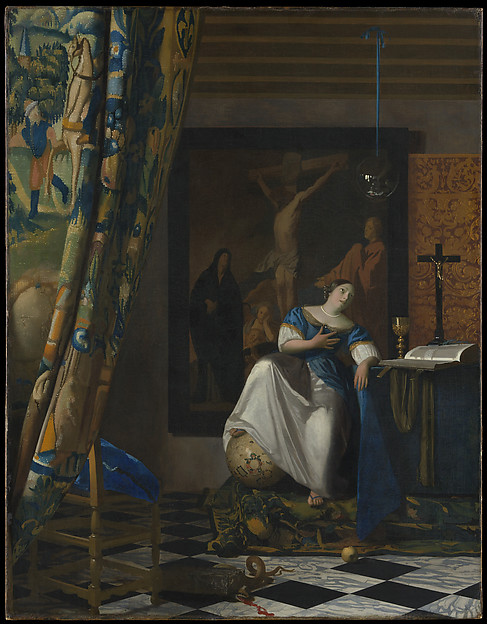
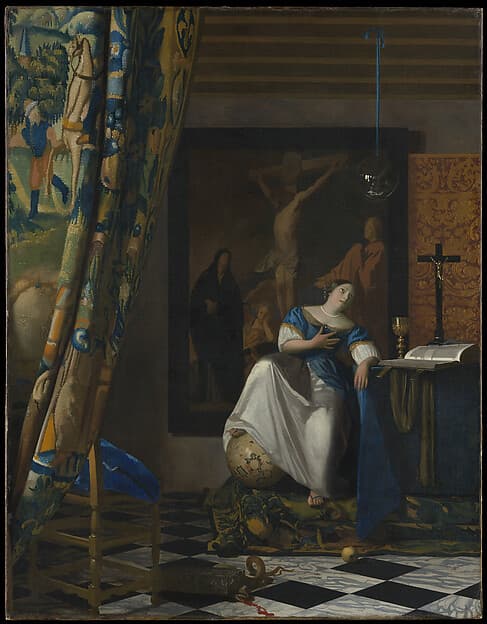
Allegory of the Catholic Faith, painted by Johannes Vermeer around 1670–1672 in oil on canvas and now in the Metropolitan Museum of Art in New York, is one of just two openly religious paintings in Vermeer's surviving catalogue (the other being his early Christ in the House of Martha and Mary in Edinburgh). The painting depicts a seated woman in white-and-blue costume — the personification of Faith — with her foot resting on a globe, an apple at her feet (Eden), and a serpent crushed beneath the cornerstone, with a chalice and a crucifix on the table beside her. The composition derives from a 1644 engraved emblem in Cesare Ripa's Iconologia, the standard Italian Counter-Reformation handbook of personifications. The painting was almost certainly commissioned by a Catholic patron — Vermeer had probably converted to Catholicism in 1653 around his marriage into the Catholic Bolnes family — and is among the most-debated works in his small surviving catalogue. The painting entered the Metropolitan in 1931 and is the only Vermeer in the museum's collection.
Bible scenes Johannes Vermeer painted
John