Painter of the Bible
Luca della Robbia
Luca della Robbia was a leading Florentine sculptor of the early Quattrocento and the inventor of glazed terracotta as a major sculptural medium — the technique that gave the Della Robbia family workshop its century-long international reputation.

Their faith
Why Luca della Robbia painted Christ
Luca della Robbia was a devout Christian whose faith was deeply intertwined with his artistic practice. Born in Florence in 1399, he trained as a marble carver and became a prominent figure in the early Quattrocento, a period marked by a resurgence of interest in classical art and Christian themes. His commitment to his faith is evident in his work, particularly in the way he approached scripture and the themes of praise and worship. The Cantoria, a magnificent marble singing-gallery relief for Florence Cathedral, showcases his devotion to God through the joyful depiction of children singing and playing musical instruments, illustrating Psalm 150's call to praise the Lord. This piece not only reflects his artistic skill but also his desire to glorify God through his creations.
Luca's innovative spirit led him to develop the technique of glazed terracotta, which allowed for vibrant color and durability, making religious art more accessible to the faithful. His works, such as the Resurrection lunette and the Madonna of the Apple, reveal a profound understanding of the sacred narratives and a desire to convey the beauty of divine love. The Madonna and Child compositions he created for the Florentine devotional market exemplify his ability to connect the viewer with the sacred through tender and intimate representations of Christ and His mother. Through his art, Luca della Robbia continues to inspire viewers today, inviting them to reflect on the beauty of faith and the joy of worship, as he masterfully captured the essence of Christian devotion in every piece he crafted.
Life & work
Luca della Robbia was a leading Florentine sculptor of the early Quattrocento and the inventor of glazed terracotta as a major sculptural medium — the technique that gave the Della Robbia family workshop its century-long international reputation. Born in Florence around 1399 to a wool-comber, trained as a marble carver in the workshop of the late Gothic Florentine sculptor Nanni di Banco (and possibly with Lorenzo Ghiberti), he was active in Florence for his entire career and died in the city in 1482.
His Christian religious work is concentrated in marble sculpture and (from about 1440 onward) in his innovative glazed-terracotta technique. The Cantoria — the great marble singing-gallery relief for Florence Cathedral, carved between 1431 and 1438 with ten panels of dancing children illustrating Psalm 150's call to praise the Lord with all musical instruments — is the principal early-marble masterpiece, paired in the cathedral with Donatello's contemporary cantoria on the opposite wall. The marble panels are now in the Museo dell'Opera del Duomo of Florence.
His invention of glazed terracotta around 1440 came at a moment when sculpture in marble had become prohibitively expensive and bronze was increasingly used for civic monuments. The technique — modeling in clay, glazing with white tin-oxide enamel for the flesh and with deep colored glazes for the drapery, then firing — produced a sculptural medium that was dramatically less expensive than marble or bronze, weather-resistant, and brilliantly colored. The Resurrection lunette over the Sacristy door of Florence Cathedral (1442–1445), the Visitation in the church of San Giovanni Fuorcivitas in Pistoia (c. 1445), the Madonna of the Apple (Bargello), the polychrome ceiling roundels in the Cardinal of Portugal Chapel in San Miniato al Monte (1461–1466 — the Five Virtues), and the dozens of small Madonna and Child compositions Luca produced in workshop variants for the Florentine devotional market established the Della Robbia signature.
His nephew Andrea della Robbia continued the workshop after his death; the Della Robbia ceramic-sculpture tradition continued through Andrea's son Giovanni and into the late sixteenth century before being absorbed into the broader Italian Renaissance sculpture tradition.
Notable works in detail
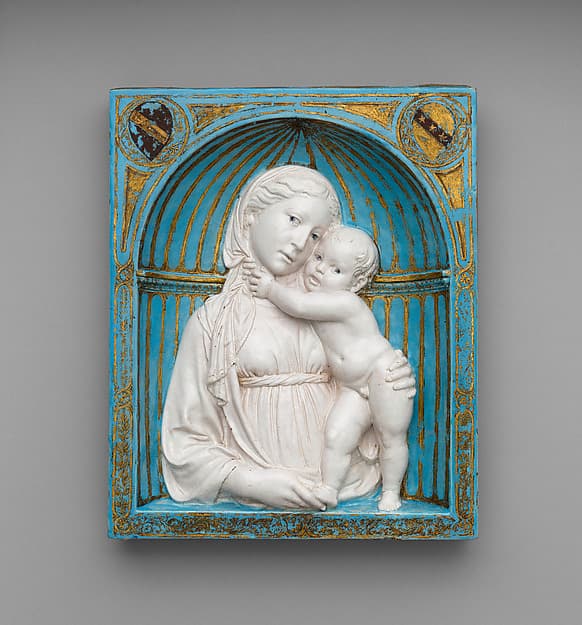
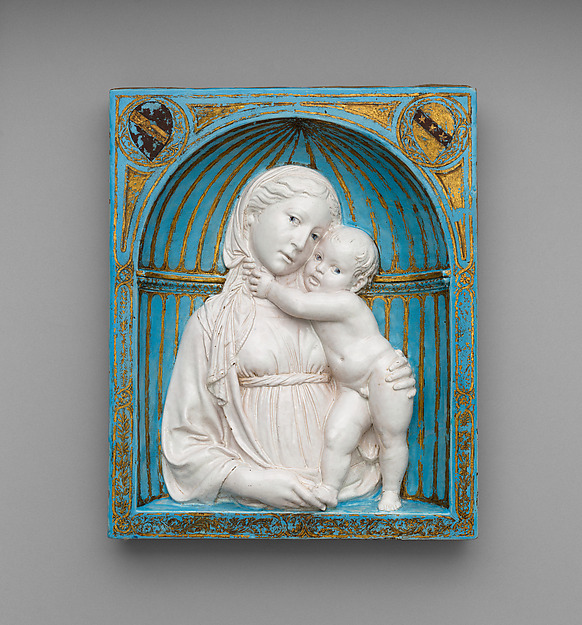
Virgin and Child in a Niche, modeled by Luca della Robbia around 1455 in glazed terracotta and now in the Metropolitan Museum of Art in New York, is one of the small early glazed-terracotta Madonnas from the workshop in the years immediately after Luca's invention of the technique around 1440. The composition shows the standing Virgin in a small architectural niche holding the Christ Child against her chest; the figures glazed in the unmistakable Della Robbia white tin-oxide for the flesh, the niche framed in deep ultramarine, the small architectural details (the carved capitals, the egg-and-dart molding around the niche frame) demonstrating Luca's combination of Florentine sculptural discipline and the new ceramic medium he had effectively invented. The piece is among the earliest small-format glazed-terracotta Madonnas in any American collection.
Bible scenes Luca della Robbia painted
Luke