Painter of the Bible
Luca Signorelli
Luca Signorelli — born Luca d'Egidio di Luca di Ventura in Cortona in southern Tuscany around 1450 — was an Umbrian-Tuscan painter of the late Quattrocento and the principal Italian master, before Michelangelo's Sistine ceiling, of the muscular nude in motion.

Their faith
Why Luca Signorelli painted Christ
Luca Signorelli, born in the heart of Tuscany, was deeply influenced by the rich spiritual and artistic traditions of his time. Though specific details about his personal faith are sparse, his monumental works, particularly in religious contexts, suggest a profound reverence for Christian themes. Signorelli's training under Piero della Francesca, a master known for his meticulous approach to both geometry and spirituality, likely instilled in him a sense of the divine order reflected in creation. His dedication to depicting biblical narratives, especially in the grand frescoes of the San Brizio Chapel, indicates that he viewed his art as a form of worship, a way to communicate the sacred truths of Christianity to the viewer. The sheer scale and ambition of his work reveal a man who was not only a skilled artist but also a devout believer committed to exploring and expressing his faith through his craft.
Signorelli's faith is particularly evident in his fresco cycle in the San Brizio Chapel, where he vividly portrays scenes of the End Times, including the Last Judgment and the Resurrection of the Flesh. These works are not merely artistic achievements; they are theological meditations that invite the viewer to reflect on eternal truths and the fate of the soul. His dramatic use of muscular figures in motion captures the intensity of spiritual struggle and divine justice, echoing the urgency of repentance and redemption. The legacy of Signorelli's devotion continues to inspire viewers today, as his art serves as a powerful reminder of the Christian hope in resurrection and eternal life, inviting all who encounter it to contemplate their own spiritual journeys.
Life & work
Luca Signorelli — born Luca d'Egidio di Luca di Ventura in Cortona in southern Tuscany around 1450 — was an Umbrian-Tuscan painter of the late Quattrocento and the principal Italian master, before Michelangelo's Sistine ceiling, of the muscular nude in motion. Trained almost certainly in the Arezzo workshop of Piero della Francesca (whose careful figural geometry shaped Signorelli's whole approach to anatomy and composition), and active across Cortona, Florence, Siena, Orvieto, and Rome for his long career, he died in Cortona in 1523.
His central monument is the great fresco cycle in the San Brizio Chapel of Orvieto Cathedral (1499–1504), the chapel originally begun by Fra Angelico fifty years earlier. Signorelli completed the program with scenes of the End of the World, the Sermon and Acts of the Antichrist, the Resurrection of the Flesh, the Damned in Hell, the Blessed in Heaven, and the Last Judgment — a sustained meditation on the End Times across four walls and a vault, with hundreds of nude or semi-nude figures in extreme physical motion. The cycle is widely held to be the principal precedent for Michelangelo's Sistine Chapel Last Judgment of forty years later; Michelangelo himself is reported by Vasari to have studied Signorelli's Orvieto figures during his trips back to central Italy in the 1530s.
His earlier work includes the panel of the Education of Pan (Berlin, c. 1490, destroyed in the 1945 fire that burned much of the Berlin painting collection but known from photographs), the Madonna and Child (Uffizi, c. 1490), the Communion of the Apostles (Cortona Diocesan Museum, 1512), the Crucifixion with Saint Mary Magdalene (Uffizi), the Lamentation of Christ (Cortona, c. 1502), and the great altarpieces in the church of Sant'Agostino in Siena and the cathedral of Volterra. His Sistine Chapel contribution of 1481–1482 — the Testament and Death of Moses, painted alongside Botticelli, Perugino, and Ghirlandaio — is one of the original Sixtus IV wall scenes.
His personal style — densely muscled bodies in dramatic foreshortening, a particular skill at the writhing nude figure, and a characteristic willingness to crowd figural narrative to the edges of the picture frame — defined a Tuscan-Umbrian alternative to the calmer Florentine and Venetian High Renaissance manner. He worked into his seventies, produced a substantial late workshop output in Cortona, and was buried in his native city.
Notable works in detail
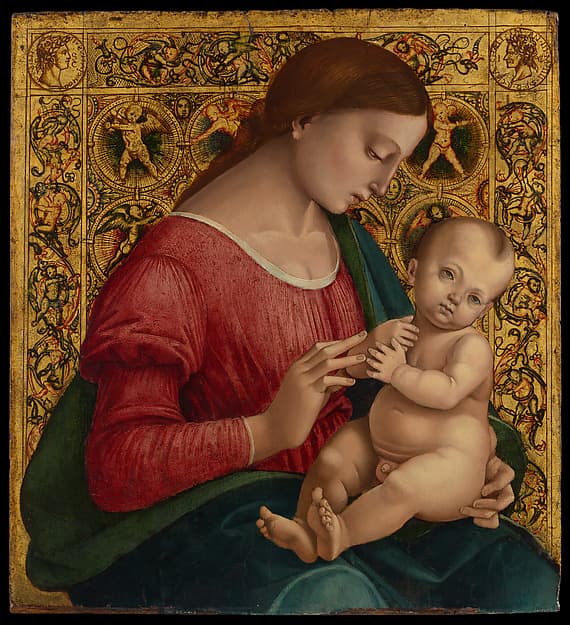
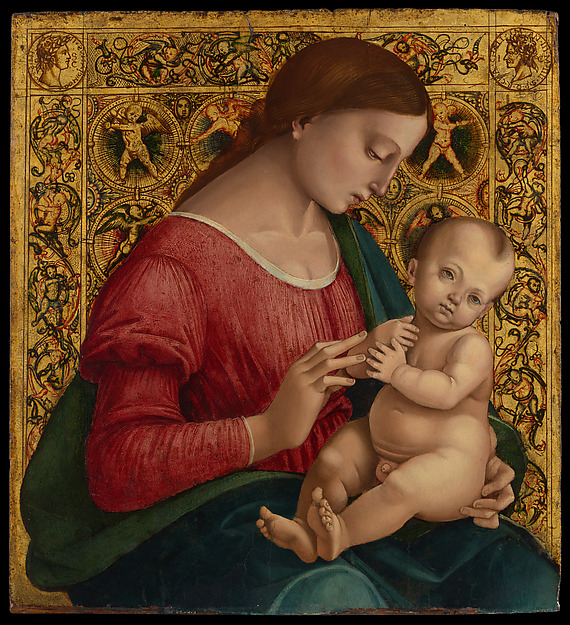
Madonna and Child, painted by Luca Signorelli around 1505 in tempera on panel and now in the Metropolitan Museum of Art in New York, is one of the late Madonnas Signorelli produced after his great Orvieto Cathedral San Brizio Chapel cycle was completed in 1504. The Virgin sits in three-quarter view holding the Christ Child upright on her lap; the chromatic palette of warm flesh, soft rose, and earthy ochre against a darkened landscape opening to a low Umbrian horizon is characteristic of the late Signorelli manner. The painting demonstrates the same dense muscular figural drawing that distinguishes the Orvieto frescoes — even at this small intimate devotional scale — and is one of the principal late Signorelli Madonnas in any American collection.
Bible scenes Luca Signorelli painted
Luke