Painter of the Bible
Mattia Preti (Il Cavalier Calabrese)
Mattia Preti — called Il Cavalier Calabrese (the Calabrian Knight) for his birthplace and his appointment as a knight of the Order of Malta in 1661 — was a leading Italian Baroque painter who worked across Rome, Naples, …

Their faith
Why Mattia Preti (Il Cavalier Calabrese) painted Christ
Mattia Preti, known as Il Cavalier Calabrese, was a devout Christian whose faith was deeply intertwined with his artistic journey. Born in Taverna, Italy, in 1613, he was not only a skilled painter but also a knight of the Sovereign Military Order of Malta, a testament to his commitment to the Christian faith and the values of the Order. Throughout his life, Preti dedicated himself to creating religious art, with a particular focus on altarpieces and large devotional canvases for churches. His training in Rome and Naples under the influence of Caravaggesque masters instilled in him a reverence for scripture, which he expressed through his art. His works were not merely aesthetic endeavors; they were acts of devotion that reflected his spiritual beliefs and his desire to inspire others in their faith journey.
Preti's faith profoundly shaped his artistic output, especially in his monumental works such as the frescoes at the Co-Cathedral of Saint John in Valletta. This masterpiece, depicting the Stories of Saint John the Baptist, showcases his ability to convey deep emotional intensity and spiritual depth through dramatic chiaroscuro and a vibrant color palette. The central scene of the Baptist's beheading serves as a powerful reminder of sacrifice and faithfulness, inviting viewers to reflect on their own spiritual commitments. Through his art, Preti's devotion continues to resonate, drawing viewers closer to the divine and inspiring a sense of reverence for the sacred narratives he portrayed. His legacy lives on, as each brushstroke speaks of a life dedicated to glorifying God through the beauty of art.
Life & work
Mattia Preti — called Il Cavalier Calabrese (the Calabrian Knight) for his birthplace and his appointment as a knight of the Order of Malta in 1661 — was a leading Italian Baroque painter who worked across Rome, Naples, and Malta in the middle and late seventeenth century. Born in the small Calabrian town of Taverna in 1613, trained in Rome from his late teens in the orbit of his older brother Gregorio Preti and the Caravaggesque-Neapolitan painter Battistello Caracciolo, he was active in Rome (where he produced major fresco programs at Sant'Andrea della Valle and the Quirinal Palace), Naples (where he was forced to flee briefly during the 1656 plague), and finally Malta from 1661 onward. He was made a Knight of Magistral Grace of the Sovereign Military Order of Malta and worked in Valletta for the rest of his life, dying there in 1699.
His Christian religious work is concentrated in altarpieces and large-format devotional canvases for the Maltese churches and for export back to the Italian peninsula. The great vault frescoes of the Co-Cathedral of Saint John in Valletta (1661–1666) — the Stories of Saint John the Baptist painted across the entire ceiling and apse of the Maltese Knights' principal church, with the Baptist's beheading filling the central scene — are widely held to be his masterpiece and one of the supreme Italian Baroque ceiling cycles outside Rome. The earlier Roman commissions — the Sant'Andrea della Valle frescoes and the Quirinal Palace work — and the Neapolitan altarpieces of the 1650s round out the principal painted corpus.
His personal style — combining the Caravaggesque chiaroscuro of his Roman and Neapolitan training with a particularly Calabrian-Neapolitan dramatic emotional intensity and a deep saturated chromatic palette of crimson, ochre, and silver — made him one of the most identifiable Italian Baroque masters. The Maltese altarpieces of his late career, painted across nearly four decades of residence on the island, gave him a uniquely insular late-career trajectory; the Knights of Malta were his primary patrons and the Maltese church commissions his principal output.
He left a substantial Maltese workshop that continued issuing his characteristic compositions for some decades after his death; the dispersal of these workshop variants across the European Mediterranean church market in the eighteenth century carried the Mattia Preti compositional vocabulary into the broader late-Baroque Catholic devotional tradition.
Notable works in detail
met-438824
Saint John the Baptist Preaching, painted by Mattia Preti around 1645 in oil on canvas and now in the Metropolitan Museum of Art in New York, depicts the cousin of Christ in his desert ministry of preaching as recorded in the Synoptic Gospels. Preti stages the scene with characteristic Calabrian-Neapolitan Caravaggesque drama: the Baptist standing in the center of the composition in his camel-hair garment, his right hand raised in the act of preaching, the assembled listeners gathered around him in postures of attentive listening. The chromatic palette of warm earth tones, deep crimson, and silvery cool white against the dark background is the unmistakable mid-career Preti Roman signature, painted in the years immediately before his Maltese commission of 1661 transformed his late career.
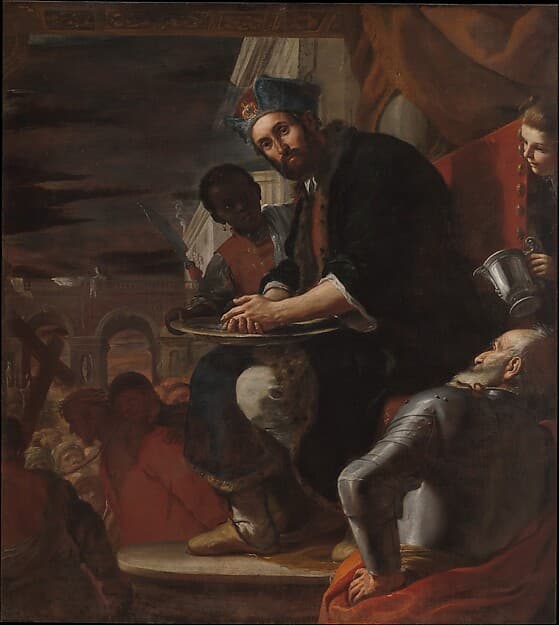
Pilate Washing His Hands, painted by Mattia Preti around 1663 in oil on canvas during his Maltese career and now in the Metropolitan Museum of Art in New York, depicts the moment from Matthew 27 in which the Roman governor Pontius Pilate publicly absolves himself of responsibility for the death of Jesus by performing the ritual hand-washing in front of the assembled crowd. Preti stages the scene as a dramatic three-quarter-length encounter: Pilate seated on the right with his hands extended over the basin, an attendant servant pouring water from a metal ewer, Christ in the deeper background with his hands bound in attendance. The chromatic palette of warm earth tones and deep saturated chiaroscuro is the unmistakable late-Preti Maltese signature, painted in the years of his decoration of the Co-Cathedral of Saint John in Valletta.
Bible scenes Mattia Preti (Il Cavalier Calabrese) painted
Matthew
