Painter of the Bible
Pierre Mignard
Pierre Mignard was a leading French Baroque painter of the second half of the seventeenth century and the principal rival of Charles Le Brun for the title of premier painter to Louis XIV.

Their faith
Why Pierre Mignard painted Christ
Pierre Mignard, a prominent French Baroque painter, dedicated much of his life to creating sacred art that reflects his deep Christian faith. Born in 1612, Mignard was trained in the rich artistic traditions of Paris and spent over two decades in Rome, where he worked under papal patrons. His connection to the Church was profound, as he produced numerous works for ecclesiastical clients, including portraits of seven popes. This devotion to his faith was evident in his artistic practice; he often created altarpieces and devotional canvases for royal chapels and prominent churches in Paris. His commitment to the divine was not merely professional but personal, as he sought to convey the beauty and glory of God through his art, particularly in his depictions of the Virgin Mary and Christ.
Mignard's faith profoundly shaped his artistic vision, leading him to create works that resonate with spiritual significance. His celebrated fresco, "The Glory of the Blessed in Heaven," adorning the cupola of the Val-de-Grâce, exemplifies his ability to capture heavenly beauty and divine majesty. Additionally, his numerous Madonnas, characterized by soft features and luminous backgrounds, reveal a tender representation of the Virgin Mary that invites viewers into a deeper contemplation of faith. Mignard's altarpieces, such as those in Saint-Eustache and Saint-Sulpice, serve as testaments to his devotion, designed to inspire worship and reverence. Through his remarkable body of work, Mignard continues to reach the hearts of viewers, inviting them to experience the beauty of Christ and the divine through his art.
Life & work
Pierre Mignard was a leading French Baroque painter of the second half of the seventeenth century and the principal rival of Charles Le Brun for the title of premier painter to Louis XIV. Born in Troyes in 1612 to a hat-maker, trained in Paris in the workshop of Simon Vouet (the same Paris workshop that trained Le Brun), and traveling to Italy in 1635 (where he spent twenty-two years in Rome, working under successive papal patrons and producing portraits of the principal Roman ecclesiastical and aristocratic clientele), he returned to Paris in 1657 at the urgent recall of King Louis XIV. He served the French royal court for the rest of his career and died in Paris in 1695.
His Christian religious work is concentrated in altarpieces and large-format devotional canvases for the Paris royal chapels and the principal French churches. The great cupola fresco of the Val-de-Grâce in Paris (1663 — the Glory of the Blessed in Heaven, painted across the cupola of Anne of Austria's votive church and one of the supreme French Baroque ceiling decorations), the Crucifixion altarpieces in workshop variants, the Madonnas of the Virgin in dozens of small devotional panels (the Mignard Madonna type — a soft-faced Virgin holding the Christ Child against a luminous ground, reproduced in workshop variants for French aristocratic patrons across his entire career), and the late great altarpieces for the Paris churches of Saint-Eustache and Saint-Sulpice fill the religious painted corpus.
His Roman portraits — of seven successive popes (Urban VIII, Innocent X, Alexander VII, Clement IX, Clement X, Innocent XI, Alexander VIII), of the Roman aristocratic clientele, and of the French ambassadors and visitors to Rome — established his Roman reputation and provided him with the international clientele network that he carried into his Paris royal years. He was particularly admired in his lifetime for his portrait painting and continued to produce major royal and aristocratic portraits in Paris through the 1660s, 1670s, and 1680s.
His long professional rivalry with Charles Le Brun for control of the French royal patronage was one of the defining battles of seventeenth-century French art-political life. After Le Brun's death in 1690, Mignard succeeded him as Premier Peintre du Roi and as Director of the French Royal Academy of Painting and Sculpture, finally winning the rivalry that had defined his entire career. He held the posts until his own death five years later.
Notable works in detail
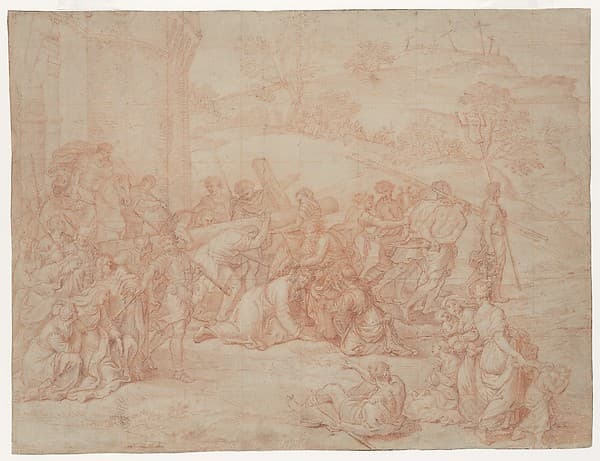
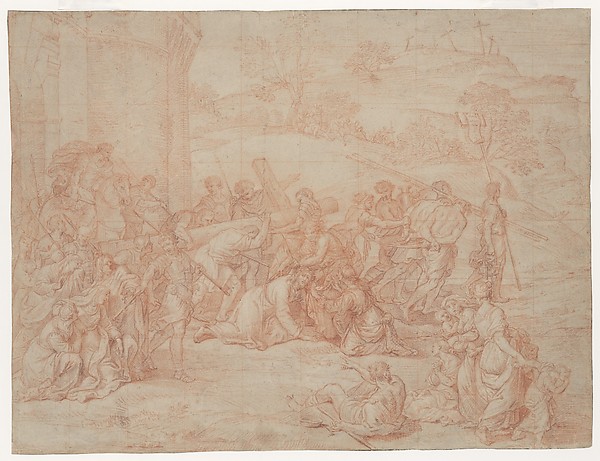
Christ Carrying the Cross, drawn by Pierre Mignard around 1679 in his late Paris royal-court career in pen and ink with wash on paper and now in the Metropolitan Museum of Art in New York, depicts the moment from the Synoptic Gospels in which Christ, after the scourging and the crowning with thorns, carries his cross through the streets of Jerusalem on the way to Golgotha. Mignard stages the scene with characteristic late-Baroque French compositional density: Christ in the center stumbling under the weight of the cross, Simon of Cyrene reaching to take a portion of the burden from his shoulders, the Roman soldiers driving him forward, the women of Jerusalem watching from the sides with expressions of grief. The drawing demonstrates the late Mignard Paris-court draughtsmanship at full mature statement.
Bible scenes Pierre Mignard painted
Mark