Painter of the Bible
Pietro Lorenzetti
Pietro Lorenzetti was, with his younger brother Ambrogio Lorenzetti, one of the two leading Sienese painters of the second quarter of the fourteenth century — the generation that came of age between Duccio's death in 131…

Their faith
Why Pietro Lorenzetti painted Christ
Pietro Lorenzetti, a prominent Sienese painter of the early 14th century, was deeply rooted in the Christian faith that permeated the art of his time. Influenced by the teachings and traditions of the Catholic Church, he trained in the workshop of Duccio, a master who emphasized the importance of spirituality in art. Lorenzetti's works reflect a devotion to scripture and the life of Christ, as he dedicated his talents to creating altarpieces and fresco cycles that conveyed profound religious narratives. His commitment to his faith is evident in his meticulous attention to detail and the emotional depth he infused into his subjects, drawing viewers closer to the divine through the beauty of his artistry.
One of Lorenzetti's most significant contributions to Christian art is the Passion cycle in the lower church of the Basilica of San Francesco in Assisi, where he masterfully depicted scenes from Christ's entry into Jerusalem to His Resurrection. The famous Deposition, with its dramatic diagonal composition, captures the poignant moment of Christ's body being lowered from the cross, surrounded by figures embodying grief and devotion. This work, along with his altarpiece, The Birth of the Virgin, showcases not only his technical skill but also his spiritual vision, inviting viewers to reflect on the mysteries of faith. Lorenzetti's legacy continues to inspire, reminding us that through art, the sacred can be made visible, and the love of Christ can be felt across generations.
Life & work
Pietro Lorenzetti was, with his younger brother Ambrogio Lorenzetti, one of the two leading Sienese painters of the second quarter of the fourteenth century — the generation that came of age between Duccio's death in 1319 and the Black Death of 1348 (in which both brothers may have died). Born in Siena around 1280 (or perhaps a few years later), trained almost certainly in Duccio's late workshop and influenced by the more weighty figural drawing of his Florentine contemporary Giotto, he was active in Siena, Assisi (where he painted the great Passion fresco cycle in the lower church of San Francesco), and the smaller Sienese hill towns for the rest of his career. He died around 1348, almost certainly in the Black Death.
His Christian religious work is concentrated in altarpieces and fresco cycles in his characteristic combination of Sienese decorative refinement and Giottesque figural weight. The Passion cycle in the lower church of the Basilica of San Francesco in Assisi (c. 1320–1330) — frescoes covering the entire south transept of the lower church with scenes from the entry into Jerusalem through the Resurrection, including the famous Deposition with its long diagonal of Christ's body — is widely held to be his masterpiece and one of the supreme Italian Trecento fresco cycles outside Padua. The Birth of the Virgin altarpiece (Siena Cathedral, 1342 — now in the Museo dell'Opera del Duomo of Siena, his last documented work) and the polyptych panels in the Pinacoteca Nazionale of Siena round out the painted corpus.
His personal style is unmistakable: weighted figures derived from Giotto's Florentine example, but rendered in the jewel-bright Sienese chromatic palette with the Sienese workshop's careful attention to narrative tenderness and decorative pattern. The Assisi Deposition in particular — with the body of Christ supported in a long diagonal across the foreground while the Virgin and the Magdalene clutch the head and feet, and John the Evangelist gestures in grief — became one of the most reproduced and most-quoted compositions in subsequent Italian Trecento and Quattrocento religious painting.
His brother Ambrogio Lorenzetti — slightly younger, slightly more theoretically ambitious — produced the great Allegories of Good and Bad Government in the Palazzo Pubblico of Siena (1338–1339) almost certainly in close consultation with Pietro. The two brothers together represent the supreme Sienese pictorial achievement of the generation between Duccio and the catastrophe of 1348.
Notable works in detail
met-438605
The Crucifixion, painted by Pietro Lorenzetti around 1340 in tempera and gold on panel and now in the Metropolitan Museum of Art in New York, depicts the moment of Christ's death on the cross with the conventional Sienese Trecento attendant figures of the swooning Virgin and the mourning John the Evangelist. The cross stands at the upper center against the tooled-gold background; the swooning Virgin in the arms of the holy women on the left, the mourning John on the right, the centurion on horseback in the foreground recognizing the divinity of the dying Christ. The chromatic palette of saturated crimson, ultramarine, and tooled gold is the unmistakable mid-career Pietro Lorenzetti signature, and the figural weight and emotional gravity demonstrate the Sienese painter's debt to his Florentine contemporary Giotto's slightly earlier Paduan example.
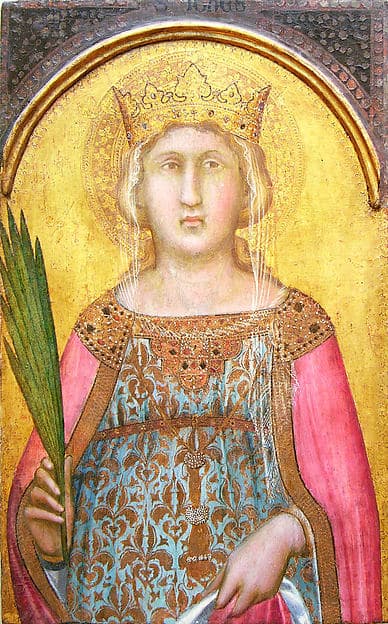
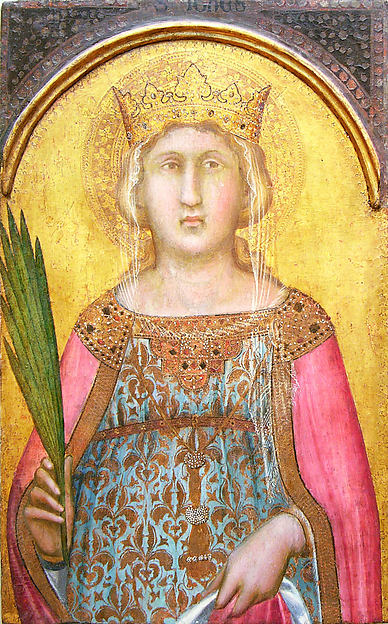
Saint Catherine of Alexandria, painted by Pietro Lorenzetti around 1337 in tempera and gold on panel and now in the Metropolitan Museum of Art in New York, depicts the legendary fourth-century Christian martyr in her conventional iconographic posture — standing in three-quarter view with her hand resting on the wheel of her martyrdom (the wheel from which she escaped through divine intervention before her eventual beheading). The chromatic palette of saturated rose, ultramarine, and tooled gold against the patterned gold-tooled background is the unmistakable mid-career Pietro Lorenzetti signature. The panel was originally part of one of his larger Sienese polyptych altarpieces with the Virgin and Christ Child at the center and individual saints in the side panels, and was dispersed in the eighteenth or nineteenth century.
Bible scenes Pietro Lorenzetti painted
Romans