Painter of the Bible
Rogier van der Weyden
Rogier van der Weyden is the great early-Netherlandish painter of the Passion.
.jpg%3Fwidth%3D600&w=2048&q=75)
Their faith
Why Rogier van der Weyden painted Christ
Rogier van der Weyden, a prominent early-Netherlandish painter, dedicated his life to capturing the profound moments of Christ's Passion. Born around 1399 in Tournai, he likely trained under Robert Campin, a master painter known for his religious works. Van der Weyden's commitment to his craft and faith is evident in his meticulous approach to scripture and the sacred narratives he portrayed. His role as city painter in Brussels allowed him to create deeply spiritual works that resonated with the Christian community, reflecting a life devoted to God and the teachings of Christ. He was buried in the cathedral of Saint Michael and Saint Gudula, a testament to his lasting connection with the church and his faith.
His most influential painting, the "Descent from the Cross," exemplifies his spiritual vision and emotional depth. In this work, the lifeless body of Christ is cradled by grieving figures, including the Virgin Mary, whose pose mirrors that of her Son, creating a powerful visual representation of sorrow and redemption. This piece not only reshaped European Passion iconography but also served as a profound meditation on the sacrifice of Christ. Van der Weyden's other works, such as the "Seven Sacraments Altarpiece" and the "Last Judgment polyptych," further illustrate his dedication to exploring the themes of salvation and grace. Through his art, Rogier van der Weyden invites viewers to engage with the beauty of faith and the depth of Christ's love, leaving a legacy that continues to inspire and uplift the hearts of many today.
Life & work
Rogier van der Weyden is the great early-Netherlandish painter of the Passion. Born around 1399 in Tournai (then part of the County of Hainaut), he probably trained in the workshop of Robert Campin, qualified as a master painter in Tournai in 1432, and within a few years moved to Brussels, where he was named city painter and remained for the rest of his life. He died in Brussels in 1464 and was buried in the cathedral of Saint Michael and Saint Gudula.
His most influential work is the Descent from the Cross (Prado, c. 1435), painted as the central panel of an altarpiece for the Chapel of Our Lady Outside the Walls of Leuven. Within a shallow gilded niche the size of a stage box, ten figures fold around the lifeless body of Christ as it is lowered from the cross; the Virgin collapses below in a near-mirroring of his pose, and the whole composition reads like a freeze-frame from a Passion play in which every body is twisted into the same line of grief. No other early Northern panel reshaped European Passion iconography to the same degree; copies, derivations, and pastiches turn up across Flanders, France, Germany, and Spain into the seventeenth century.
He painted Crucifixion triptychs and panels through his career — the great Crucifixion Diptych in the Escorial, the Crucifixion Triptych in the Kunsthistorisches Museum in Vienna, the Abegg Triptych in Riggisberg — and a body of independent Madonnas and donor portraits commissioned by Burgundian, Italian, and Spanish patrons. The Seven Sacraments Altarpiece (Royal Museum of Fine Arts, Antwerp, c. 1448) sets the seven sacraments inside a single Gothic church interior, with the Crucifixion towering over the central nave. The Last Judgment polyptych at the Hôtel-Dieu in Beaune, painted for Nicolas Rolin between 1443 and 1452, is one of the largest Northern panel paintings of the fifteenth century and still hangs in the chapel of the hospital it was made for.
Almost no original drawings or signed paintings survive, and the chronology of his work is reconstructed from documentary records, contemporary copies, and stylistic comparison. His workshop trained or influenced almost every major Netherlandish painter of the next generation, and he is the documented teacher (or formative example) of Hans Memling.
Notable works in detail
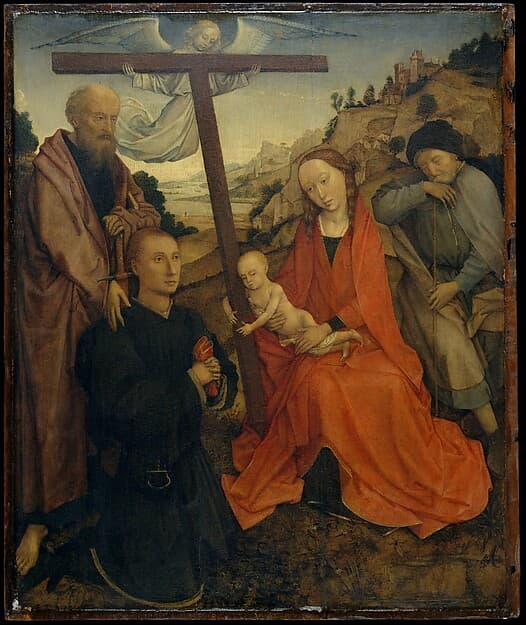
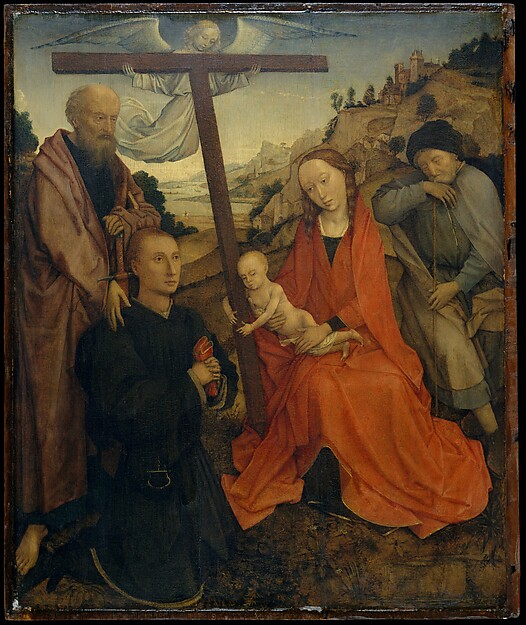
The Holy Family with Saint Paul and a Donor
The Holy Family with Saint Paul and a Donor, painted in the workshop of Rogier van der Weyden around 1430–1450 in oil on panel and now in the Metropolitan Museum of Art in New York, is one of the surviving small-format Weydenesque devotional panels of the mid-fifteenth century. The composition shows the Virgin and Child enthroned in the center, with Saint Paul standing in armor on the right holding the sword of his martyrdom, and a kneeling male donor figure in the lower-left foreground. The chromatic palette — deep ultramarine, crimson, and pale grey — and the small architectural niche behind the throne are characteristic of the Bruges-Brussels Weyden workshop tradition. The panel may have been the surviving central section of a small triptych whose wings have been lost; whatever its original setting, it remains one of the principal Weyden-school devotional panels in any American collection and a defining example of the Early Netherlandish small-format domestic-altar tradition.
Bible scenes Rogier van der Weyden painted
Acts