Painter of the Bible
Sebastiano del Piombo
Sebastiano del Piombo — born Sebastiano Luciani in Venice around 1485, called del Piombo from his late appointment as Keeper of the Papal Seal (the piombo, the lead bull) in Rome — was a Venetian-born painter who worked …
%2520Bust%2520of%2520Sebastiano%2520del%2520Piombo%2520by%2520Lorenzo%2520Moretti%2520Larese%2520-%2520gallerie%2520Accademia%2520Venice.jpg%3Fwidth%3D600&w=2048&q=75)
Their faith
Why Sebastiano del Piombo painted Christ
Sebastiano del Piombo, born Sebastiano Luciani in Venice, was deeply rooted in the Christian faith that permeated the High Renaissance. His artistic journey began under the tutelage of Giovanni Bellini, a master known for his devotion to sacred subjects. Sebastiano's move to Rome in 1511 marked a pivotal moment in his life, as he became closely associated with prominent figures like Michelangelo and Raphael, both of whom shared a profound reverence for God and scripture. His works reflect not only his technical prowess but also his spiritual devotion, as he often infused his paintings with a sense of gravity and divine presence. The altarpieces and devotional panels he created are imbued with a deep understanding of Christian themes, showcasing his commitment to illustrating the divine narrative through art.
Sebastiano's faith is particularly evident in masterpieces such as the "Pietà" and the "Flagellation of Christ." In the "Pietà," he captures the poignant moment of Christ's sacrifice, evoking deep emotions and inviting viewers to reflect on the gravity of redemption. Similarly, the "Flagellation of Christ" showcases not only his mastery of form but also a profound spiritual vision, as he portrays the suffering of Christ with a striking intensity that compels contemplation of Christ's love and sacrifice. Through these works, Sebastiano del Piombo continues to inspire viewers, reminding us of the beauty and depth of faith that can be expressed through the visual arts. His dedication to portraying sacred themes resonates with believers today, inviting us to engage with the divine through the lens of his artistry.
Life & work
Sebastiano del Piombo — born Sebastiano Luciani in Venice around 1485, called del Piombo from his late appointment as Keeper of the Papal Seal (the piombo, the lead bull) in Rome — was a Venetian-born painter who worked in Rome during the High Renaissance and was, alongside Raphael, the principal collaborator and friend of Michelangelo. Trained in Venice in the workshop of Giovanni Bellini and then in close stylistic dialogue with Giorgione (whose unfinished panels Sebastiano completed at his early death), he moved to Rome in 1511 in the company of the wealthy Sienese banker Agostino Chigi and worked there for the rest of his life. He died in Rome in 1547.
His Christian religious work is concentrated in altarpieces and devotional panels of unusual gravity and chromatic density — Venetian color organized around Michelangelo-influenced figural drawing. The Pietà (Viterbo, 1512–1513), the Raising of Lazarus (London, 1517–1519, painted for Cardinal Giulio de' Medici as the rival commission to Raphael's Transfiguration for the same patron, and now hanging in the National Gallery in London where it once hung as the founding picture of the museum's Italian collection), the Flagellation of Christ (San Pietro in Montorio, Rome, 1518–1525), the Christ Carrying the Cross (Hermitage, c. 1535–1540), and a long sequence of Madonnas and saints in the Borghese, the Capodimonte, the Prado, and the Louvre fill the painted corpus.
Michelangelo supplied Sebastiano with figure drawings — sometimes whole compositions — for several major commissions; the Pietà of Viterbo and the Flagellation of Christ both depend directly on Michelangelo cartoons. The collaboration was exceptional in the Roman art world of the time and produced a small body of paintings that combine the figural authority of Michelangelo with the chromatic warmth of the Venetian school in a way no other artist in Rome achieved.
His appointment as Keeper of the Papal Seal in 1531 — a sinecure that paid handsomely and required only the production and verification of papal documents — slowed his painted output considerably; his last fifteen years produced relatively few finished pictures. He was a friend and correspondent of Michelangelo to the end and outlived Raphael by twenty-seven years. He was buried in the church of Santa Maria del Popolo in Rome.
Notable works in detail
Madonna and Child with Saints and Donors
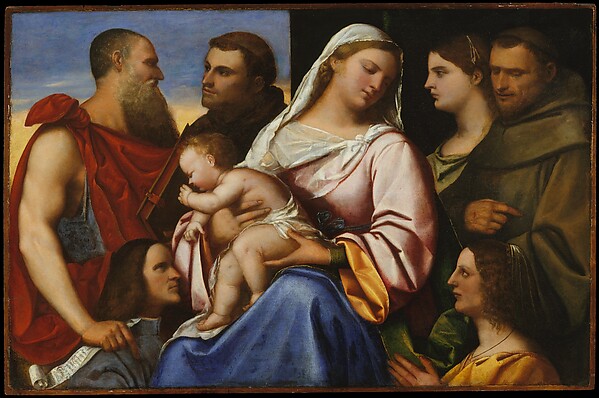
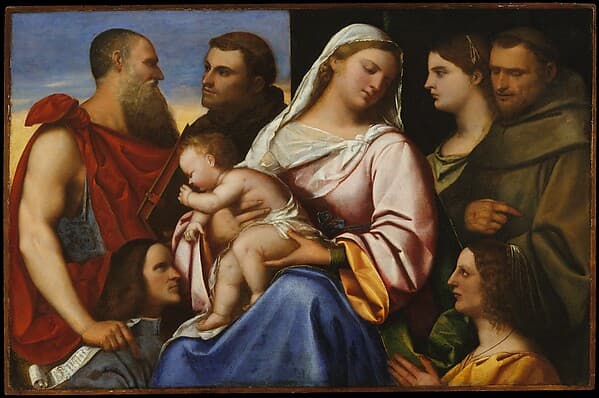
Madonna and Child with Saints and Donors, painted by Sebastiano del Piombo around 1505 in his early Venetian years before his move to Rome and now in the Metropolitan Museum of Art in New York, depicts the iconographic subject of the enthroned Virgin and Christ Child attended by saints with a kneeling donor figure in formal devotional grouping. Sebastiano stages the scene in a small architectural niche: the seated Virgin holds the Christ Child upright on her lap in the center; two attendant saints stand on either side; a small kneeling donor figure occupies the lower foreground in formal devotional posture. The chromatic palette of saturated rose, ultramarine, and warm flesh against the deep architectural shadow is characteristic of the early Sebastiano Venetian manner before his transformative Roman move of 1511 brought him into the Michelangelo-Raphael generation that would shape his mature style.
Bible scenes Sebastiano del Piombo painted
Luke