Painter of the Bible
Vincenzo Foppa
Vincenzo Foppa was the leading Lombard painter of the late fifteenth century and the principal stylistic ancestor of the Lombard pictorial tradition that ran through Bergognone and Bramantino into the early sixteenth-cen…

Their faith
Why Vincenzo Foppa painted Christ
Vincenzo Foppa, a prominent Lombard painter of the late fifteenth century, dedicated his artistic life to creating works that reflect his deep Christian faith. Active primarily in Brescia, Pavia, and Milan, Foppa was known for his altarpieces and fresco cycles that often depicted sacred themes. His training in the Paduan workshop of Squarcione, which emphasized a disciplined approach to figural representation, laid a strong foundation for his religious art. Foppa's connection to the Sforza ducal court in Milan during the 1460s and 1470s further solidified his role as a leading artist of his time, allowing him to create works that resonated with the spiritual aspirations of the church and its patrons. His commitment to his faith is evident in the reverence he brought to his subjects, as he sought to embody the divine through his artistry.
Foppa's faith profoundly influenced his artistic output, particularly in masterpieces like the "Virgin and Child with Two Angels" and the "Adoration of the Magi." In these works, the warmth of his color palette and the sculptural quality of his figures invite viewers into a sacred experience, encouraging contemplation of the divine mysteries. The frescoes in the Portinari Chapel of Sant'Eustorgio, depicting the life of Saint Peter Martyr, further showcase his ability to blend narrative depth with spiritual significance. Foppa's art not only reflects his personal devotion but also serves as a bridge to the viewer's own faith journey, inviting all who encounter his work to experience the beauty and grace of Christ's presence in their lives. His legacy, rooted in a profound love for God, continues to inspire and uplift those who engage with his sacred imagery.
Life & work
Vincenzo Foppa was the leading Lombard painter of the late fifteenth century and the principal stylistic ancestor of the Lombard pictorial tradition that ran through Bergognone and Bramantino into the early sixteenth-century Lombard-Leonardesque school of Boltraffio, Solario, and the early Andrea Solario. Born in Brescia around 1430, trained almost certainly in Padua in the orbit of Squarcione (the same Paduan workshop that produced Andrea Mantegna), and active in Brescia, Pavia, and Milan for his entire career, he was the principal painter at the Sforza ducal court in Milan in the 1460s and 1470s. He died in Brescia in 1515.
His Christian religious work is concentrated in altarpieces and fresco cycles in his characteristic combination of Paduan figural discipline (descending from Squarcione and through Mantegna) and the soft chromatic warmth that defined the Lombard pictorial tradition. The Virgin and Child with Two Angels (Brera, 1480), the Polyptych of San Cristoforo in Vigevano, the Saint Sebastian altarpiece (Brera), the Adoration of the Magi (London), and the great series of frescoes in the Portinari Chapel of Sant'Eustorgio in Milan (1468 — depicting the life of the Dominican Saint Peter Martyr, the cycle that secured Foppa's mature reputation in the Sforza ducal capital) anchor the painted corpus.
His personal style — combining sculptural figural drawing with the soft warm Lombard chromatic palette and an unusual atmospheric handling of cool grey-green light — was the principal late-Quattrocento Lombard pictorial signature and shaped the entire next generation of Lombard painters who would absorb Leonardo da Vinci's Milanese workshop manner in the early sixteenth century. Leonardo arrived in Milan in 1482 — when Foppa was at the height of his Sforza-court career — and the two painters certainly knew of each other, though no documented direct contact between them survives.
He returned to Brescia in his late years and produced his final altarpieces for the Brescian churches and confraternities. His son Stefano Foppa briefly continued the workshop after his death; the major Lombard pictorial inheritance, however, passed not through his immediate family but through the next Milanese generation of Leonardesques.
Notable works in detail
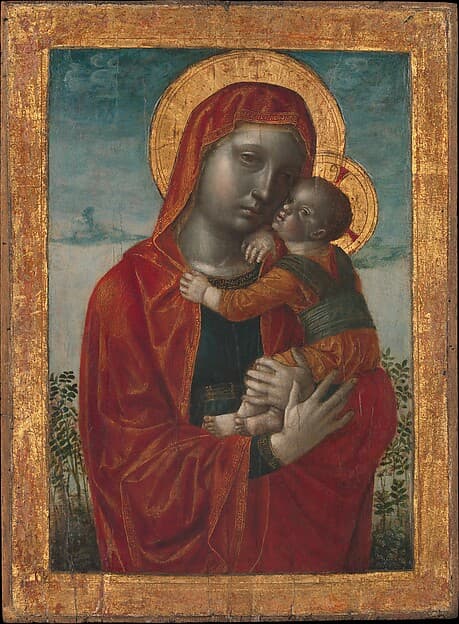
Madonna and Child, painted by Vincenzo Foppa around 1475 in tempera and oil on panel and now in the Metropolitan Museum of Art in New York, is a small intimate Marian devotional panel from his mature Lombard workshop years. The Virgin sits in three-quarter view holding the Christ Child upright on her lap; the chromatic palette of warm flesh, deep crimson, and the unmistakable Foppa cool grey-green that defines the Lombard pictorial tradition is characteristic of his mature manner. The panel demonstrates Foppa's characteristic combination of Paduan figural discipline (descending from Squarcione and through Mantegna) and the soft chromatic warmth that defined the Lombard pictorial tradition before Leonardo's Milanese workshop years would transform it in the early sixteenth century.
Bible scenes Vincenzo Foppa painted
Luke
