Who was Jael in the Bible?
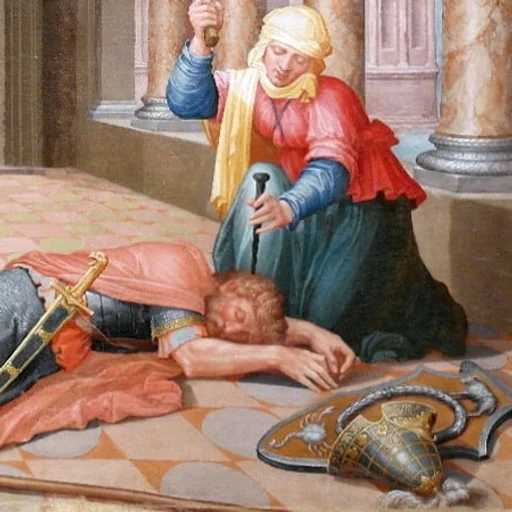
Jael was a woman who killed the enemy commander Sisera by driving a tent peg through his head while he slept in her tent.
Deliverer Who Slew Sisera
Period of the Judges
Jael was a woman who killed the enemy commander Sisera by driving a tent peg through his head while he slept in her tent.
Follow the reading trailBEYOND THE NAME
Jael, the wife of Heber the Kenite, gave shelter to Sisera, the fleeing commander of the Canaanite army. When he fell asleep, exhausted and trusting her hospitality, she drove a tent peg through his temple and killed him, ending the threat to Israel. Deborah’s victory song praised her above all women for the deed.
FOLLOW THE PASSAGES
These are chapter studies associated with this record. Their order follows the books and chapters, rather than a reconstructed timeline of the person’s life.
wife of Heber who kills Sisera with a tent peg while he sleeps
After Ehud dies, Israel turns away from the Lord again. Jabin king of Canaan oppresses them for twenty years. His commander Sisera has 900 iron chariots. The Israelites cry out to the LORD.
Chapter overview from the authored study guide.praised above all women for slaying Sisera
Some scholars date the Song of Deborah to the twelfth century BC. Deborah and Barak sing it after the LORD delivers Israel from Sisera, whose iron chariots had helped hold Israel under Jabin for twenty years.
Chapter overview from the authored study guide.THE PEOPLE AROUND THE PERSON
Recorded spouses
Relationships follow the source graph. Some are interpretive or uncertain, and individual verse citations are not yet available for every connection.
STUDY & INTERPRETATION
Jael appears at the climax of the battle against Sisera, turning the tide far from the field, in the quiet of a tent. Her act fulfilled Deborah’s earlier word that the honor of the day would fall to a woman, overturning every expectation of who would bring deliverance. The song of Deborah lifts her up with startling praise, placing a tent-dwelling outsider at the center of Israel’s rescue. Her story belongs to the long pattern in which God works salvation through unlikely hands, lifting the lowly to confound the mighty and pointing toward a deliverance that would come from where no one thought to look.
From the Learn of Christ person commentary. Read alongside the linked Scripture passages.KEEP SCRIPTURE CLOSE
2 authored chapter guides feature this person. This is guide coverage, not an exhaustive count of biblical mentions.
ASK A BETTER QUESTION
Identity, story, early-life sources, family, and where to read.
Jael was a woman who killed the enemy commander Sisera by driving a tent peg through his head while he slept in her tent.
Jael, the wife of Heber the Kenite, gave shelter to Sisera, the fleeing commander of the Canaanite army. When he fell asleep, exhausted and trusting her hospitality, she drove a tent peg through his temple and killed him, ending the threat to Israel. Deborah’s victory song praised her above all women for the deed.
The individualized passage index associates this Jael record with Judges. There are 6 distinct indexed verse references in the 66-book Bible. Browse the book-by-book list below; it separates this identity from other people who share the name. Source assignments and textual identifications can require interpretation.
A separate childhood account for Jael is not provided in our current authored profile sources. Begin with Judges 4:17 and the passages linked here for the evidence that is available. The first indexed reference to a name is not a birth record. This profile does not establish a birth date, schooling, or childhood events beyond what its sources state.
Jael’s source record lists Heber (spouse). These are source-graph relationships; legal family, uncertain identifications, and ancestral language require the cautions below. Individual verse evidence is not yet retained for every family edge.
Jael appears at the climax of the battle against Sisera, turning the tide far from the field, in the quiet of a tent. Her act fulfilled Deborah’s earlier word that the honor of the day would fall to a woman, overturning every expectation of who would bring deliverance.
Answers draw on our existing authored biography and linked chapter studies. Where supplied, verse assignments come from the individualized STEP Bible index. Childhood answers distinguish documented events from gaps in the available sources.
FIND THE PERSON IN THE TEXT
6 distinct verse references in the source’s 66-book index. These are indexed name assignments, rather than every indirect allusion to this person. A name may also refer to descendants, a tribe, or a nation; read each passage to distinguish that usage from the individual.
“Howbeit Sisera fled away on his feet to the tent of Jael the wife of Heber the Kenite: for there was peace between Jabin the king of Hazor and the house of Heber the Kenite.”
Judges 4:17 · King James Version
“Then Jael Heber’s wife took a nail of the tent, and took an hammer in her hand, and went softly unto him, and smote the nail into his temples, and fastened it into the ground: for he was fast asleep and weary. So he died.”
Judges 4:21 · King James Version
“And, behold, as Barak pursued Sisera, Jael came out to meet him, and said unto him, Come, and I will shew thee the man whom thou seekest. And when he came into her tent, behold, Sisera lay dead, and the nail was in his temples.”
Judges 4:22 · King James Version
“Blessed above women shall Jael the wife of Heber the Kenite be, blessed shall she be above women in the tent.”
Judges 5:24 · King James Version
References are adapted from STEP Bible / Tyndale House TIPNR (CC BY 4.0). Deduplicated, matched to this identity, and checked against the bundled KJV’s verse bounds. Interpretive assignments and translation/versification differences may remain. This index is separate from evidence for individual family relationships.
YOUR OWN OBSERVATIONS
Notes, saved people, and study marks stay in this browser. They do not sync to your account.
KEEP EXPLORING
People featured in the same study guides. Sharing a chapter does not establish a family relationship.