Judges 5
People in this chapter
Judges 5 is one of the oldest poems in the Bible - some scholars date its composition to the 12th century BC, earlier than almost anything else in Hebrew Scripture. It is a victory song that Deborah and Barak sang after their battle against Sisera, the Canaanite general whose iron chariots had terrorized Israel for twenty years.
Tap any highlighted phrase to jump to the commentary that unpacks it.
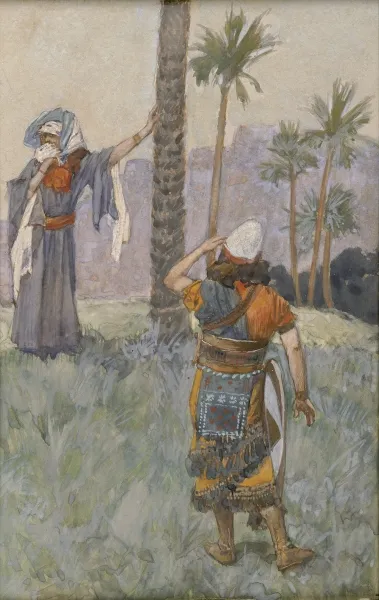
Judges 5:1-5God Marching from Sinai
1Then sang Deborah and Barak the son of Abinoam on that day, saying, 2Praise ye the LORD for the avenging of Israel, when the people willingly offered themselves. 3Hear, O ye kings; give ear, O ye princes; I, even I, will sing unto the LORD; I will sing praise to the LORD God of Israel. 4LORD, when thou wentest out of Seir, when thou marchedst out of the field of Edom, the earth trembled, and the heavens dropped, the clouds also dropped water. 5The mountains melted from before the LORD, even that Sinai from before the LORD God of Israel.
Deborah1 sings the victory - not Barak alone. Throughout Judges 4 and 5, it is clear that Deborah is the leader, the prophetess, the one who knows God's mind. Barak refuses to go to battle unless she goes with him. Her song proclaims what she has lived: that a woman can stand at the front of God's purposes.
The word avenging here carries the force of mishpat, justice, the vindication of the oppressed - far deeper than the settling of a personal score. Israel had been enslaved to Canaan's iron chariots; the victory frees them. The song begins by naming who God actually is in His oldest self-revelation: the God who hears His people's cry and acts.
The poet starts with Sinai - the moment God first marched out to rescue Israel at the exodus. The earth trembling, the heavens dropping rain, the mountains melting - these are the signature of God himself entering history, carried here as living memory into this newer battle. Every earthly victory echoes that cosmic moment.
Judges 5:6-8When the Highways Were Unsafe
6In the days of Shamgar the son of Anath, in the days of Jael, the highways were unoccupied, and the travellers walked through byways. 7The inhabitants of the villages ceased, they ceased in Israel, until that I Deborah arose, that I arose a mother in Israel. 8They chose new gods; then was war in the gates: was there a shield or spear seen among forty thousand in Israel?
Shamgar is mentioned only here and in Judges 3:31, where he killed 600 Philistines with an ox goad. Yet even his small victory could not break the cycle of oppression. The point is: this is what Israel was living in. No safe roads. No open villages. Economic collapse. Spiritual paralysis.
Deborah calls herself a mother in Israel - a title of leadership and care, rooted in protection and seeing, drawn from nothing like rank. She is the one who sees her people's danger and rises to protect them. The feminine imagery here is crucial: the leader who sees what her people need and acts from that seeing.
Israel had turned to other gods - the Canaanite fertility deities that promised easy answers. And with that spiritual drift came military defeat. The connection is moral, not incidental. A people divided in their loyalty, uncertain of their God, cannot stand against determined enemies. Spiritual paralysis produces practical paralysis.
Judges 5:9-18Who Came and Who Stayed
9My heart is toward the governors of Israel, that offered themselves willingly among the people. Bless ye the LORD. 11They that are delivered from the noise of archers in the places of drawing water, there shall they rehearse the righteous acts of the LORD, even the righteous acts toward the inhabitants of his villages in Israel: then shall the people of the LORD go down to the gates. 14Out of Ephraim was there a root of them against Amalek; after thee, Benjamin, among thy people; out of Machir came down governors, and out of Zebulun they that handle the pen of the writer.
Deborah1 sings the victory after the battle. Poetry follows action. What the prose told, the song celebrates - with emotion, with names, with the people's own voice.
15And the princes of Issachar were with Deborah; even Issachar, and also Barak: he was sent on foot into the valley. For the divisions of Reuben there were great thoughts of heart. 16Why abodest thou among the sheepfolds, to hear the bleatings of the flocks? For the divisions of Reuben there were great searchings of heart. 17Gilead abode beyond Jordan: and why did Dan remain in ships? Asher continued on the sea shore, and abode in his breaches. 18Zebulun and Naphtali were a people that jeoparded their lives unto the death in the high places of the field.
The word governors here means leaders or nobles - the ones who could have stayed safe but chose to come. Deborah honors them because they risked. The blessing falls on those who see a call and answer it, even when the outcome is unclear.
Reuben had great thoughts of heart - a phrase that means they deliberated, searched, debated with themselves. But thinking fell short of acting. The poem is plainspoken: in the moment when Israel needed to move, Reuben sat in the sheepfolds, listening to the bleating of flocks. Spiritual paralysis often dresses itself up as deep thought.
Zebulun and Naphtali came from the north, where the battle would be fiercest. They jeoparded - literally, put in danger - their very lives. The poem saves its highest praise for those who acted from willingness to risk everything.
Judges 5:19-23The Stars Fight from Heaven
19The kings came and fought, then fought the kings of Canaan in Taanach by the waters of Megiddo; they took no gain of money. 20They fought from heaven; the stars in their courses fought against Sisera. 21The river of Kishon swept them away, that ancient river, the river Kishon. O my soul, thou hast trodden down strength. 22Then were the horsehoofs broken by the means of the pransings, the pransings of their mighty ones. 23Curse ye Meroz, said the angel of the LORD, curse ye bitterly the inhabitants thereof; because they came not to the help of the LORD, to the help of the LORD against the mighty.
The poem moves from earthly battle to cosmic war. The stars in their courses fought against Sisera - this is not just metaphor. It is claiming that heavenly powers, earthly weather, and human courage are all converging toward one end. The battle was won because heaven and earth moved together.
The river Kishon likely rose in a sudden flood - perhaps triggered by the rain the poem mentions earlier. Sisera's iron chariots, so terrifying on dry ground, became useless in mud. What looked like an overwhelming advantage dissolved in water. The ancient historian Josephus corroborates this, noting that the chariots sank in the mire.
Meroz is a town that refused to come to Israel's aid. The curse is severe - the only place in the poem where the poet pronounces judgment. The logic is stark: in God's war, neutrality is itself opposition. You cannot stand on the sidelines and claim innocence. The stakes are too high.
Judges 5:24-27The Woman Who Drove the Nail
24Blessed above women shall Jael the wife of Heber the Kenite be, blessed shall she be above women in the tent. 25He asked water, and she gave him milk; she brought forth butter in a lordly dish. 26She put her hand to the nail, and her right hand to the workmen’s hammer; and with the hammer she smote Sisera, she smote off his head, when she had pierced and stricken through his temples. 27At her feet he bowed, he fell, he lay down: at her feet he bowed, he fell: where he bowed, there he fell down dead.
Jael is blessed above women - the highest praise in the song. She was a woman of the tent, no military leader, and no Israelite. Sisera, fleeing the battle, came to her in desperation, and she killed him - giving the victory its final punctuation. The poem lifts her up as a woman of courage, of quick thinking, of deadly resolve.
The detail of the hammer and nail is specific and unglamorous. An act of calculated violence in a tent - Jael offers hospitality and then kills her guest. The Bible does not soften it. She is blessed for it anyway, because the victim was an oppressor and the act ended a reign of terror.
Judges 5:28-30The Mother Waiting
28The mother of Sisera looked out at a window, and cried through the lattice, Why is his chariot so long in coming? why tarry the wheels of his chariots? 29Her wise ladies answered her, yea, she returned answer to herself, 30Have they not sped? have they not divided the prey; to every man a damsel or two; to Sisera a prey of divers colours, a prey of divers colours of needlework, of divers colours of needlework on both sides, meet for the necks of them that take the spoil?
This is one of the most arresting moments in Hebrew poetry. The poet, having just celebrated Jael's courage and Israel's victory, turns to the mother of the enemy and shows her full humanity. She is waiting, hoping, afraid. Every delay of the chariot wheels brings dread. The poem makes her human - and that is more powerful than contempt.
The mother and her wise ladies are already dividing the spoils in their minds - the colored needlework that was part of the plunder of war. It is such a vivid, ordinary detail. She is sitting in lamplight, gossiping with her friends about the goods they will share. And then her son does not come home.
Judges 5:31So Let All Thine Enemies Perish
31So let all thine enemies perish, O LORD: but let them that love him be as the sun when he goeth forth in his might. And the land had rest forty years.
The song closes with a vision: those who love God shining like the sun in its strength. Forty years of rest follow. In the Old Testament, forty years often marks a full generation - the time it takes for the old to pass away and something new to take root. This victory is spiritual as well as military. The land itself has breath again.
Research trail
Sources & further study
These references support the historical, linguistic, manuscript, and contextual notes in this chapter. Scripture remains the primary text; external sources are provided so readers can inspect the research directly.
- Victory Songs: Miriam to DeborahThe pattern of women leading in song and worship, from Miriam's song at the Red Sea to Deborah's celebration of victory.
- Ancient Victory Songs and Deborah's PsalmThe Song of Deborah as an ancient victory hymn, celebrating God's power and the courage of those who responded to the call.