Judges 6
People in this chapter
Israel has sinned and fallen into the pattern the book of Judges repeats like a drum: they do evil, God gives them over to enemies, they cry out, God sends a deliverer, the cycle breaks for a time, then begins again. Now Midian has crushed them for seven years. Crops disappear. The people hide in caves. And then God sends an angel to a man named Gideon - and tells him something that will haunt and define him: he is a mighty man of valor.
Tap any highlighted phrase to jump to the commentary that unpacks it.
Judges 6:1-6Israel Under Midian
1And the children of Israel did evil in the sight of the LORD: and the LORD delivered them into the hand of Midian seven years. 2And the hand of Midian prevailed against Israel: and because of the Midianites the children of Israel made them the dens which are in the mountains, and caves, and strong holds.
The pattern in Judges runs like a wheel: Israel does evil, God delivers them to their enemies for a season, then they cry out and He raises a deliverer. Seven years is a full cycle in biblical time - a complete, hard measure of consequence. The people are not merely conquered; they are driven underground12.
An entire people hiding in mountain caves. This is what the Bible shows us at the low point - Israel has lost not just security but dignity, forced into dens and shadows while Midianite raiders strip the land3.
3And so it was, when Israel had sown, that the Midianites came up, and the Amalekites, and the children of the east, even they came up against them; 4And they encamped against them, and destroyed the increase of the earth, till thou come unto Gaza, and left no sustenance for Israel, neither sheep, nor ox, nor ass. 5For they came up with their cattle and their tents, and they came as grasshoppers for multitude; for both they and their camels were without number: and they entered into the land to destroy it. 6And Israel was greatly impoverished because of the Midianites; and the children of Israel cried unto the LORD.
Israel is "greatly impoverished" - the crop, the livestock, the means of survival itself has been systematically destroyed. They are not just losing battles; they are losing the ability to live.
Judges 6:7-10The Prophet's Word
7And it came to pass, when the children of Israel cried unto the LORD because of the Midianites, 8That the LORD sent a prophet unto the children of Israel, which said unto them, Thus saith the LORD God of Israel, I brought you up from Egypt, and brought you forth out of the house of bondage; 9And I delivered you out of the hand of the Egyptians, and out of the hand of all that oppressed you, and drave them out from before you, and gave you their land; 10And I said unto you, I am the LORD your God; fear not the gods of the Amorites, in whose land ye dwell: but ye have not obeyed my voice.
Before the angel comes, before Gideon appears, God sends a prophet. The prophet's job is to remind Israel of the covenant - to say, "I rescued you once; I am the one who made you a promise." God's first word to them in their oppression is a memory, a calling back to who He has always been.
The prophet's word is stark: "You have not obeyed my voice." This is the diagnosis. Israel chased the protection of the gods around them and abandoned the one God who had already proven Himself.
Judges 6:11-16The Angel Calls Gideon
11And there came an angel of the LORD, and sat under an oak which was in Ophrah, that pertained unto Joash the Abiezrite: and his son Gideon threshed wheat by the winepress, to hide it from the Midianites.
Gideon is threshing wheat - work that is usually done in the open, in the wind - but he is doing it in hiding, by the winepress, where the Midianites cannot see him. This is a man terrified. And this is the man the angel is about to call "mighty man of valor."
12And the angel of the LORD appeared unto him, and said unto him, The LORD is with thee, thou mighty man of valour.
The angel speaks a name Gideon does not yet own. This is calling into being what God sees and promises. In Scripture, to name something is to declare what it is becoming, the forward claim of what God intends.
13And Gideon said unto him, Oh my Lord, if the LORD be with us, why then is all this befallen us? and where be all his miracles which our fathers told us of, saying, Did not the LORD bring us up from Egypt? but now the LORD hath forsaken us, and delivered us into the hands of the Midianites.
Gideon argues. If God is with us, why are we crushed? Where are the miracles our fathers knew? This is not arrogance - this is the honest cry of a man who has seen only silence and defeat. And God does not rebuke him for it.
14And the LORD looked upon him, and said, Go in this thy might, and thou shalt save Israel from the hand of the Midianites: have not I sent thee?
God's answer is a commission: "Go in this thy might." But Gideon has no might. That is the point. God sends him out on the basis of sentness alone. "Have not I sent thee?" The authority belongs to the One doing the sending.
15And he said unto him, Oh my Lord, wherewith shall I save Israel? behold, my family is poor in Manasseh, and I am the least in my father’s house.
Gideon lists his credentials for failure: poor family, least son. In human terms, he has nothing to recommend him. God is looking for obedience.
16And the LORD said unto him, Surely I will be with thee, and thou shalt smite the Midianites as one man.
The promise stands: "because I am with you." The one thing Gideon needs to know is that he will not do it alone.
Judges 6:17-24Jehovah-Shalom
17And he said unto him, If now I have found grace in thy sight, then shew me a sign that thou talkest with me. 18Depart not hence, I pray thee, until I come unto thee, and bring forth my present, and set it before thee. And he said, I will tarry until thou come again.
Gideon asks for a sign. This is not the famous fleece story yet - this is something simpler. Gideon is asking God to wait while he brings food. He is stalling, thinking. He needs to know this is real.
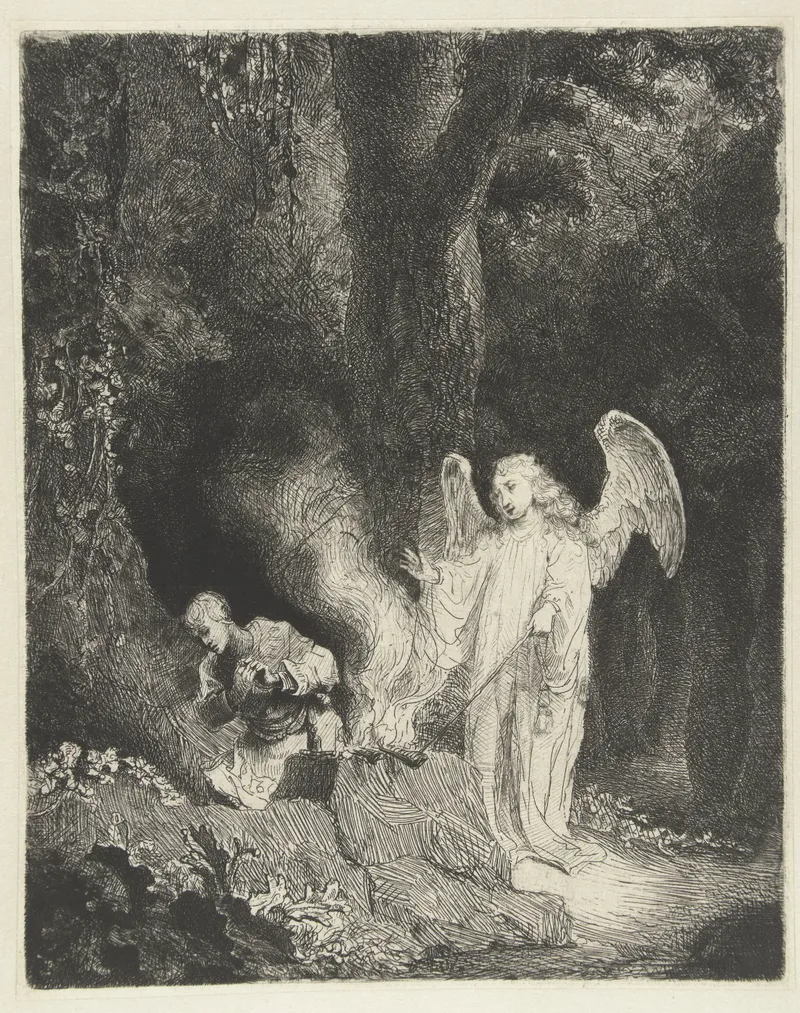
19And Gideon went in, and made ready a kid, and unleavened cakes of an ephah of flour: the flesh he put in a basket, and he put the broth in a pot, and brought it out unto him under the oak, and presented it. 20And the angel of God said unto him, Take the flesh and the unleavened cakes, and lay them upon this rock, and pour out the broth. And he did so.
21Then the angel of the LORD put forth the end of the staff that was in his hand, and touched the flesh and the unleavened cakes; and there rose up fire out of the rock, and consumed the flesh and the unleavened cakes. Then the angel of the LORD departed out of his sight.
Fire rises from the rock and consumes the offering. This is the sign: divine presence made visible. The angel is revealing power, and fire consuming a sacrifice is how God accepts worship. Gideon has just met the living God.
22And when Gideon perceived that he was an angel of the LORD, Gideon said, Alas, O LORD God! for because I have seen an angel of the LORD face to face. 23And the LORD said unto him, Peace be unto thee; fear not: thou shalt not die.
Gideon recognizes what he has encountered. In the ancient Near East, to see the face of God was to die. Gideon expects judgment. Instead, he receives peace.
24Then Gideon built an altar there unto the LORD, and called it Jehovahshalom: unto this day it is yet in Ophrah of the Abiezrites.
Judges 6:25-32Breaking the Altar of Baal
25And it came to pass the same night, that the LORD said unto him, Take thy father’s young bullock, even the second bullock of seven years old, and throw down the altar of Baal that thy father hath, and cut down the grove that is by it:
God does not give Gideon a year to prepare. The command comes the same night Gideon has seen the fire and the angel. He must tear down his father's altar to Baal - a violation of family honor in the culture of the day.
26And build an altar unto the LORD thy God upon the top of this rock, in the ordered place, and take the second bullock, and offer a burnt sacrifice with the wood of the grove which thou shalt cut down. 27Then Gideon took ten men of his servants, and did as the LORD had said unto him: and so it was, because he feared his father’s household, and the men of the city, that he could not do it by day, that he did it by night.
Gideon gathers ten men and works in darkness. He is still afraid of his own father and the city. Yet he does the thing anyway. Faith is obedience in the face of fear.
28And when the men of the city arose early in the morning, behold, the altar of Baal was cast down, and the grove was cut down that was by it, and the second bullock was offered upon the altar that was built. 29And they said one to another, Who hath done this thing? And when they enquired and asked, they said, Gideon the son of Joash hath done this thing. 30Then the men of the city said unto Joash, Bring out thy son, that he may die: because he hath cast down the altar of Baal, and because he hath cut down the grove that was by it.
The people of the city move to kill Gideon. In a culture where your father's honor is your life, to destroy his altar is to demand your own death. The city sees only sacrilege. They do not see Gideon's obedience.
31And Joash said unto all that stood against him, Will ye plead for Baal? will ye save him? he that will plead for him, let him be put to death whilst it is yet morning: if he be a god, let him plead for himself, because one hath cast down his altar.
Joash, Gideon's father, turns on the crowd with logic they cannot answer. If Baal is a god, let him defend himself. The silence that follows is the sound of idolatry losing its grip.
32Therefore on that day he called him Jerubbaal, saying, Let Baal plead against him, because he hath thrown down his altar.
Judges 6:33-40The Fleece
33Then all the Midianites and the Amalekites and the children of the east were gathered together, and went over, and pitched in the valley of Jezreel. 34But the Spirit of the LORD came upon Gideon, and he blew a trumpet; and Abiezer was gathered after him.
The enemy has gathered in the valley. But before Gideon acts, the Spirit of the Lord comes upon him. The power belongs to God, given for the moment. He blows the trumpet, and the tribes come.
35And he sent messengers throughout all Manasseh; who also was gathered after him: and he sent messengers unto Asher, and unto Zebulun, and unto Naphtali; and they came up to meet them. 36And Gideon said unto God, If thou wilt save Israel by mine hand, as thou hast said,
The troops are gathering. The armies are ready. And Gideon still needs to ask. Even now, with the Spirit of the Lord upon him and the tribes gathered, he doubts.
37Behold, I will put a fleece of wool in the floor; and if the dew be on the fleece only, and it be dry upon all the earth beside, then shall I know that thou wilt save Israel by mine hand, as thou hast said. 38And it was so: for he rose up early on the morrow, and thrust the fleece together, and wringed the dew out of the fleece, a bowl full of water.
God grants the first sign. Dew on the fleece alone, dry ground everywhere else. It is an impossible reversal of nature. And Gideon has the answer he asked for.
39And Gideon said unto God, Let not thine anger be hot against me, and I will speak but this once: let me prove, I pray thee, but this once with the fleece; let it now be dry only upon the fleece, and upon all the ground let there be dew. 40And God did so that night: for it was dry upon the fleece only, and there was dew on all the ground.
Gideon asks again. This time the opposite: dry fleece, wet ground. And God does it again. Some commentators see this as weak faith requiring more proof; others see it as careful confirmation, a man making sure before he asks his people to risk their lives. Either way, God accommodates.
Research trail
Sources & further study
These references support the historical, linguistic, manuscript, and contextual notes in this chapter. Scripture remains the primary text; external sources are provided so readers can inspect the research directly.
- Judges 6 - Hebrew + classical Jewish commentaryThe Hebrew text of Gideon's call from the threshing floor and the angel of the Lord's appearance.
- GideonSBL entry on Gideon as the reluctant warrior whose strength was God's choosing of the weak.
- Judges 6 - Hebrew + classical Jewish commentaryThe Hebrew text of Judges 6 alongside Rashi, Ibn Ezra, and other classical commentators.