1 Kings 21
People in this chapter
There is a moment in every person's life when they want something that is not theirs. A possession, a role, a place in another's life. The tenth commandment forbids coveting because coveting, unchecked, breeds lies, theft, and murder. Ahab, the king of Israel, encounters such a moment. And what begins as a simple, reasonable request becomes a cascade of injustice.
Tap any highlighted phrase to jump to the commentary that unpacks it.
1 Kings 21:1-4The Vineyard and the Refusal
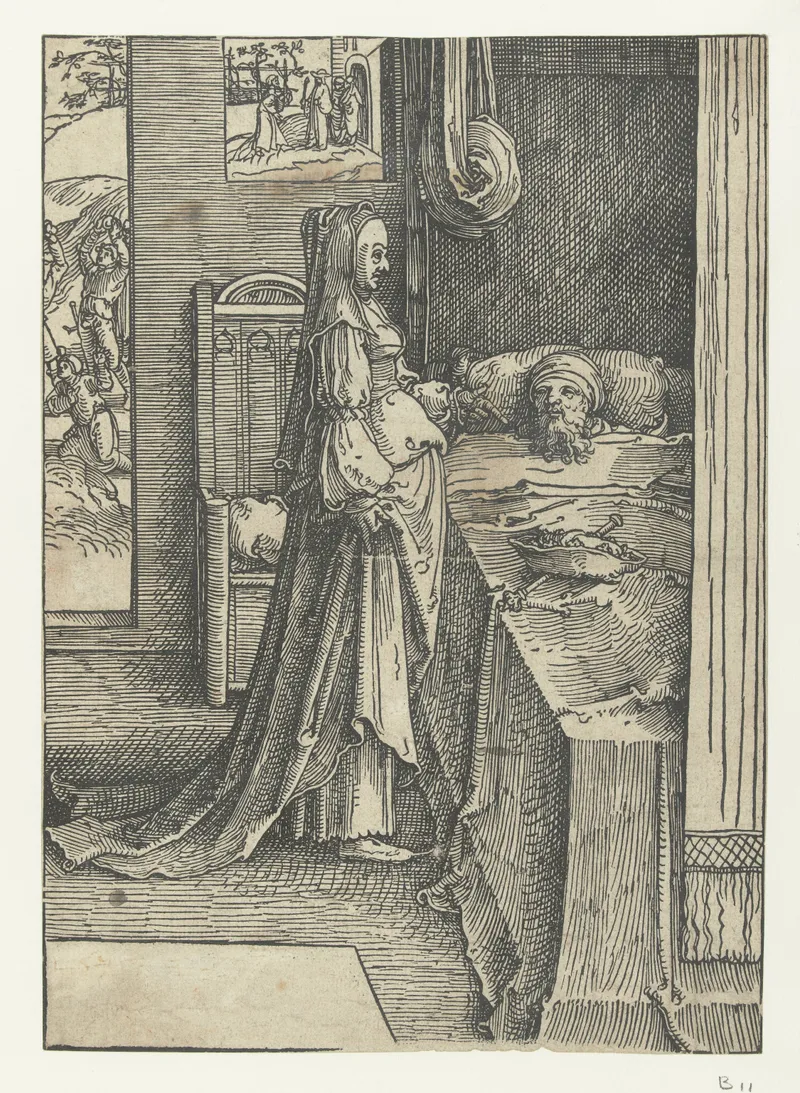
1And it came to pass after these things, that Naboth the Jezreelite had a vineyard, which was in Jezreel, hard by the palace of Ahab king of Samaria. 2And Ahab spake unto Naboth, saying, Give me thy vineyard, that I may have it for a garden of herbs, because it is near unto my house: and I will give thee for it a better vineyard than it; or, if it seem good to thee, I will give thee the worth of it in money. 3And Naboth said to Ahab, The LORD forbid it me, that I should give the inheritance of my fathers unto thee. 4And Ahab came into his house heavy and displeased because of the word which Naboth the Jezreelite had spoken to him: for he had said, I will not give thee the inheritance of my fathers. And he laid him down upon his bed, and turned away his face, and would eat no bread.
Ahab's offer is not unreasonable by worldly standards. He is a king; he sees something he wants. He offers compensation, a better vineyard or its monetary value. It is the language of commerce, of fair dealing. He is willing to pay.
But Naboth refuses. His answer is rooted in law. Under the Mosaic law, the inheritance of the fathers - the land given to each family - could not be permanently sold. Leviticus 25:23 states: "The land shall not be sold for ever: for the land is mine." Naboth is bound by a covenant older than the crown. His refusal is an act of faithfulness to God's law.
Ahab, the king, cannot accept refusal. He withdraws to his chamber, turns away his face, refuses food. It is the behavior of a child denied a toy - except this child commands armies and claims the throne of Israel. His inability to accept "no" reveals the spiritual sickness at the heart of his reign. He has much. He has power. Yet he wants what is not his, and the wanting poisons his peace.
1 Kings 21:5-7Jezebel's Question
5But Jezebel his wife came to him, and said unto him, Why is thy spirit so sad, that thou eatest no bread? 6And he said unto her, Because I spake unto Naboth the Jezreelite, and said unto him, Give me thy vineyard for money; or else, if it please thee, I will give thee another vineyard for it: and he answered, I will not give thee my vineyard. 7And Jezebel his wife said unto him, Dost thou now govern the kingdom of Israel? arise, and eat bread, and let thine heart be merry: I will give thee the vineyard of Naboth the Jezreelite.
Jezebel asks a seemingly innocent question: Why are you sad? But her question is a test. She is testing to see if Ahab still has a grip on reality, or if she can reshape it for him. She is a Phoenician princess, raised in the courts where kings are gods and their word is law. The notion that a subject might refuse the king would be absurd in her world. She sees Ahab's sulking as weakness, an opening.
Jezebel's promise is chilling in its simplicity: I will give you the vineyard. Not "I will try," not "I will ask." I will give it. She knows exactly how to solve a problem. She will use the mechanisms of the state - law, witnesses, the courts - to take what Ahab wants. She will make legality serve her will.
1 Kings 21:8-14Judicial Murder
8So she wrote letters in Ahab’s name, and sealed them with his seal, and sent the letters unto the elders and to the nobles that were in his city, dwelling with Naboth. 9And she wrote in the letters, saying, Proclaim a fast, and set Naboth on high among the people: 10And set two men, sons of Belial, before him, to bear witness against him, saying, Thou didst blaspheme God and the king. And then carry him out, and stone him, that he may die.
The letters go out under Ahab's own seal, and the plan they carry is precise: proclaim a fast, seat Naboth up front where everyone can see him, then plant two men to accuse him of cursing God and the king. A stoning is being arranged with all the paperwork of a fair trial. What the next verses describe is that plan being carried out to the letter.
11And the men of his city, even the elders and the nobles who were the inhabitants in his city, did as Jezebel had sent unto them, and as it was written in the letters which she had sent unto them. 12They proclaimed a fast, and set Naboth on high among the people. 13And there came in two men, children of Belial, and sat before him: and the men of Belial witnessed against him, even against Naboth, in the presence of the people, saying, Naboth did blaspheme God and the king. Then they carried him forth out of the city, and stoned him with stones, that he died. 14Then they sent to Jezebel, saying, Naboth is stoned, and is dead.
Jezebel writes letters in Ahab's name. She seals them with his seal. This is the language of authority, of state power. The letters are not demands; they are instructions disguised as letters from the king himself. The elders and nobles receive them and obey. None of them question. None of them resist. This is what happens when power goes unchecked and authority is separated from justice.
A fast is proclaimed. This is the language of ritual, of repentance, of seeking the Lord. To the people of Naboth's city, a fast suggests that something grave has happened, that something must be atoned for. The form of religion is weaponized. The sacred is used to accomplish the profane. The very appearance of holiness makes the evil acceptable.
Two men, "sons of Belial," are set as witnesses. Belial means "without worth" or "worthless." These are not just false witnesses; they are worthless men, debased men, men for whom lying is a trade. And they testify that Naboth has blasphemed God and the king. In the law, two witnesses are required to confirm a death sentence (Deuteronomy 19:15). Jezebel uses the very structure of justice to pervert it.
Naboth is stoned. He dies. The sentence is carried out in the name of justice, in the name of God. The people of his city, the elders, the nobles - they participate in the murder. And when it is done, word is sent back to Jezebel: the deed is accomplished. Naboth is stoned and dead.
1 Kings 21:15-21Elijah Confronts Ahab
15And it came to pass, when Jezebel heard that Naboth was stoned, and was dead, that Jezebel said to Ahab, Arise, take possession of the vineyard of Naboth the Jezreelite, which he refused to give thee for money: for Naboth is not alive, but dead. 16And it came to pass, when Ahab heard that Naboth was dead, that Ahab rose up to go down to the vineyard of Naboth the Jezreelite, to take possession of it. 17And the word of the LORD came to Elijah the Tishbite, saying,
Word reaches Ahab that Naboth is dead, and he rises at once to go down and take the vineyard he wanted. He believes the matter is finished. But at that very moment the word of the Lord is going out to Elijah, sending him to meet the king in the vineyard. Ahab thinks he has closed the case; God has just reopened it.
18Arise, go down to meet Ahab king of Israel, which is in Samaria: behold, he is in the vineyard of Naboth, whither he is gone down to possess it. 19And thou shalt speak unto him, saying, Thus saith the LORD, Hast thou killed, and also taken possession? And thou shalt speak unto him, saying, Thus saith the LORD, In the place where dogs licked the blood of Naboth shall dogs lick thy blood, even thine. 20And Ahab said to Elijah, Hast thou found me, O mine enemy? And he answered, I have found thee: because thou hast sold thyself to work evil in the sight of the LORD. 21Behold, I will bring evil upon thee, and will take away thy posterity, and will cut off from Ahab him that pisseth against the wall, and him that is shut up and left in Israel,
God sends Elijah to confront Ahab. The prophet finds him in the vineyard - already taking possession of what he coveted. And Elijah speaks the Word of the Lord with devastating clarity: "Hast thou killed, and also taken possession?" The charge is plain fact. In God's sight, the deed is done. Naboth is dead, and Ahab is his killer.
Elijah's word reaches deeper than the external act. Ahab has "sold himself to work evil in the sight of the Lord." He has made a covenant with his own desire. He wanted something he could not have, and when the boundary held, he allowed his wife to break it for him. He became complicit. He sold his soul - the integrity of the Lord's anointed - for a garden.
The judgment is delivered with poetic precision: In the place where dogs licked the blood of Naboth shall dogs lick thy blood. The innocent victim's blood cries out from the ground. And the same ground will drink the blood of the king. Justice is not delayed. The innocent are vindicated. God hears what the courts deny.
1 Kings 21:22-29Ahab Repents - and God Answers
22And will make thine house like the house of Jeroboam the son of Nebat, and like the house of Baasha the son of Ahijah, for the provocation wherewith thou hast provoked me to anger, and made Israel to sin. 23And of Jezebel also spake the LORD, saying, The dogs shall eat Jezebel by the wall of Jezreel. 24Him that dieth of Ahab in the city the dogs shall eat; and him that dieth in the field shall the fowls of the air eat. 25But there was none like unto Ahab, which did sell himself to work wickedness in the sight of the LORD, whom Jezebel his wife stirred up.
Verse 25 stops to weigh the man himself: there was none like Ahab, who gave himself over to do evil, urged on by Jezebel his wife. It is one of the heaviest verdicts spoken over any king in Israel. And it is this man, named the worst of them all, who is about to do the one thing no reader expects of him.
26And he did very abominably in following idols, according to all things as did the Amorites, whom the LORD cast out before the children of Israel. 27And it came to pass, when Ahab heard those words, that he rent his clothes, and put sackcloth upon his flesh, and fasted, and lay in sackcloth, and went softly. 28And the word of the LORD came to Elijah the Tishbite, saying, 29Seest thou how Ahab humbleth himself before me? because he humbleth himself before me, I will not bring the evil in his days: but in his son’s days will I bring the evil upon his house.
Elijah speaks a judgment that is final and terrible. Ahab's house will be destroyed like the house of Jeroboam, like the house of Baasha - dynasties that rose and fell. His dynasty will end. And Jezebel, the architect of Naboth's murder, will be eaten by dogs at the wall of Jezreel. The judgment is thorough and complete.
And then Ahab does something unexpected. He hears the Word of the Lord and receives it. He tears his clothes. He puts on sackcloth. He fasts. He goes softly. These are the signs of repentance, of a man broken before God. Ahab, the king, the man who coveted and killed, chooses to humble himself.
God sees this repentance - and though He has spoken judgment, He sees the humbling and relents. Not entirely. The evil will still come upon Ahab's house. But it will not come in Ahab's lifetime. It will fall upon his son. The evil king, the one who "sold himself to work evil," receives mercy because he humbled himself.