Painter of the Bible
Lucas van Leyden
Lucas van Leyden was the most precocious printmaker of the Northern Renaissance and the leading Dutch painter of his generation.

Their faith
Why Lucas van Leyden painted Christ
Lucas van Leyden, a pivotal figure in the Northern Renaissance, was deeply rooted in his Christian faith, which profoundly influenced his artistic journey. Born in Leiden in 1494, he was trained by his father and later by Cornelis Engebrechtsz, both of whom instilled in him a reverence for scripture and its narratives. Lucas's art predominantly reflects biblical themes, showcasing his devotion to the teachings of Christ and the stories of the Old Testament. His engravings and paintings are not merely artistic expressions but are imbued with a spiritual significance that speaks to his commitment to his faith. The meticulous attention to detail in his works suggests a prayerful approach to creation, as he sought to depict the divine in a manner that resonates with viewers on a spiritual level.
This profound faith is evident in masterpieces such as the "Last Judgment" triptych and the "Healing of the Blind Man of Jericho." In the "Last Judgment," Lucas captures the gravity of divine judgment while simultaneously offering a glimpse of hope through the portrayal of salvation. His ability to weave biblical narratives into the fabric of Dutch landscapes not only grounds these stories in a familiar context but also invites viewers to reflect on their own spiritual journeys. Through his art, Lucas van Leyden continues to inspire and uplift, reminding us of the beauty and depth of faith as he faithfully illustrates the timeless truths of scripture, inviting all who encounter his work to engage with the divine narrative he so passionately conveyed.
Life & work
Lucas van Leyden was the most precocious printmaker of the Northern Renaissance and the leading Dutch painter of his generation. Born in Leiden in 1494, trained first by his father Huygh Jacobsz and then by the painter Cornelis Engebrechtsz — and reportedly producing engravings of professional quality before he was fifteen — he ran his own workshop in Leiden for the rest of his short life. He died in Leiden in 1533, in his late thirties.
His engraved Passion series, his individual Old Testament prints (Ecce Homo, the Conversion of Saul, the Adoration of the Magi, the Susanna and the Elders, David Playing the Harp Before Saul), and the great Calvary engravings of his maturity are among the technical landmarks of early sixteenth-century European printmaking. He pioneered the use of progressive lightening of the burin to suggest atmospheric distance — landscapes that recede in plate-tone alone — at the same moment Albrecht Dürer was working out the same problem on the other side of the Rhine. The two met at Antwerp in 1521; Dürer's diary records the visit and a small portrait drawing he made of his Dutch counterpart.
His paintings, fewer in number, include the Last Judgment triptych (Stedelijk Museum De Lakenhal, Leiden, 1526–1527), commissioned for the Pieterskerk; the Healing of the Blind Man of Jericho triptych (Hermitage, 1531); and the Moses Striking Water from the Rock (also Hermitage). The Last Judgment, recovered intact and conserved in the twentieth century, is the principal painted monument of the Northern Renaissance in the Netherlands and the largest surviving altarpiece by his hand.
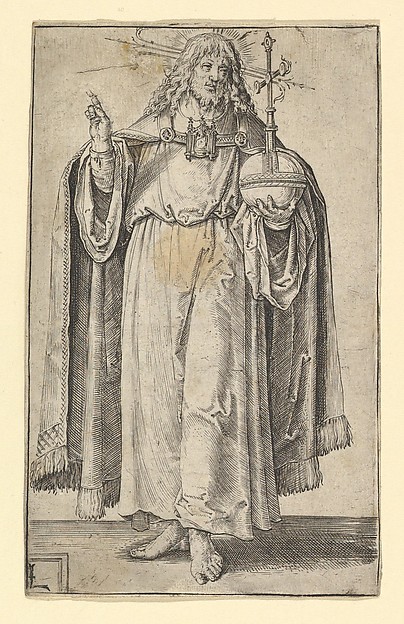
His subject matter was almost entirely biblical — Old Testament narratives in a Northern key, Gospel scenes set against panoramic Dutch coastal landscapes, and a long line of single-figure devotional engravings of the Virgin and the saints. He was a key bridge between the late-medieval painting of Geertgen tot Sint Jans and the new generation of Antwerp Mannerists who would dominate Dutch and Flemish religious art at mid-century.
Notable works in detail
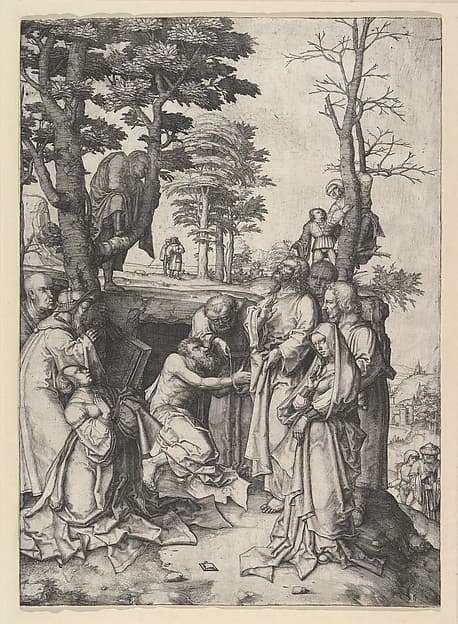
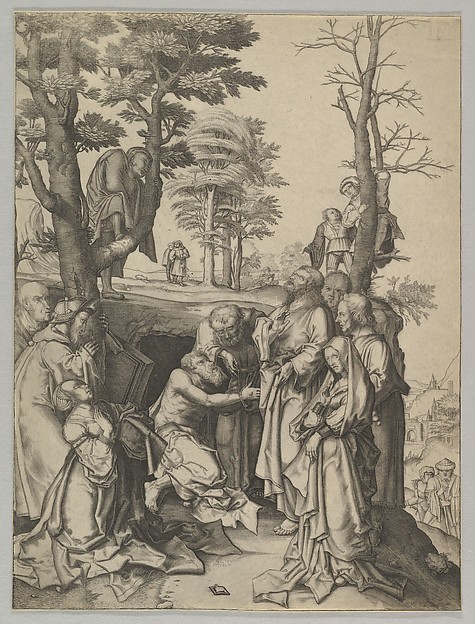
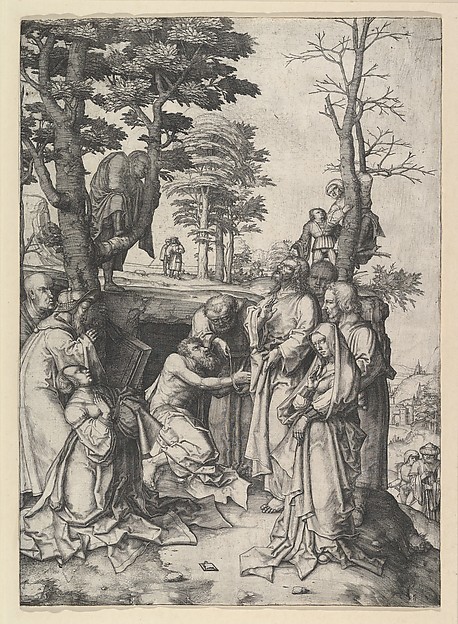
The Raising of Lazarus, engraved by Lucas van Leyden around 1502 — when the artist was about eight years old according to the most generous chronology, or in his early teens according to the more cautious — is one of the earliest dated prints in the Lucas van Leyden corpus and a defining statement of the precocious technical accomplishment that would make him the leading Dutch printmaker of his generation. The composition shows the climactic miracle of John 11: Christ at the right with his arm extended in command; the bound figure of Lazarus emerging upright from the open tomb at the center; the sisters Martha and Mary kneeling between them; a small crowd of witnesses gathered behind. The compositional discipline and the technical mastery of the engraved line — particularly the atmospheric distance achieved through progressive lightening of the burin — mark the print as the work of a fully formed artist regardless of which dating one accepts.
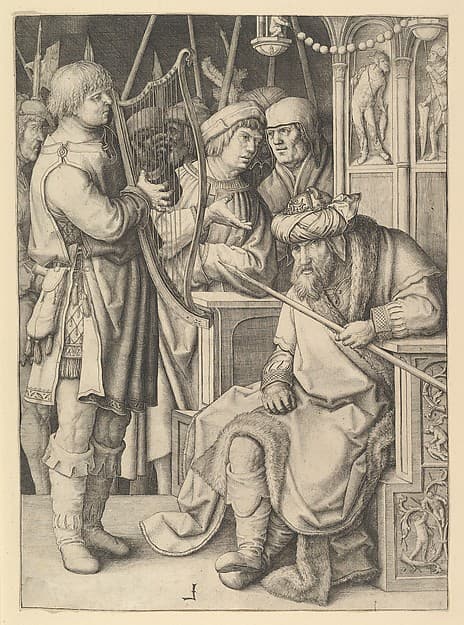
David Playing the Harp Before Saul
David Playing the Harp Before Saul, engraved by Lucas van Leyden around 1503 in his Leiden workshop, illustrates the episode from 1 Samuel 16 in which the young shepherd David is brought to play music for the troubled King Saul — the moment that begins the long Old Testament unfolding of the David narrative. The composition shows Saul seated on his throne in the upper register, his head bowed in contemplation, with David standing in the lower foreground playing his harp; a small crowd of attendant courtiers fills the background. Lucas van Leyden's characteristic combination of dense crowded narrative composition and progressively atmospheric burin work, with figures in the foreground sharply outlined and figures in the back fading into soft tonal grey, marks the print as one of the technical landmarks of early sixteenth-century Northern engraving.
met-364755
Susanna and the Two Elders, engraved by Lucas van Leyden around 1503 in his Leiden workshop, illustrates the deuterocanonical narrative from Daniel 13 in which the chaste Susanna is spied upon while bathing by two elders of her community who later attempt to extort her into adultery and, when she refuses, falsely accuse her of the crime themselves. Lucas van Leyden composes the scene in his characteristic horizontal Northern landscape format — Susanna in the lower right partially undressed beside her bath, the two elders in the bushes at the lower left looking on, a panoramic Dutch coastal landscape stretching into the distance behind. The print is among the most reproduced of his Old Testament treatments and a defining example of the early sixteenth-century Northern interest in the moral and erotic complexities of the Susanna narrative.
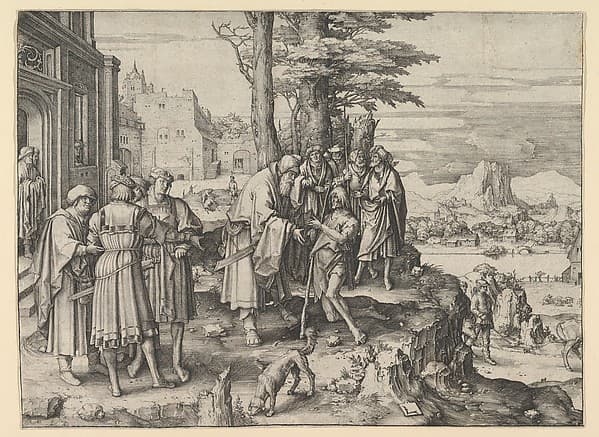
The Return of the Prodigal Son
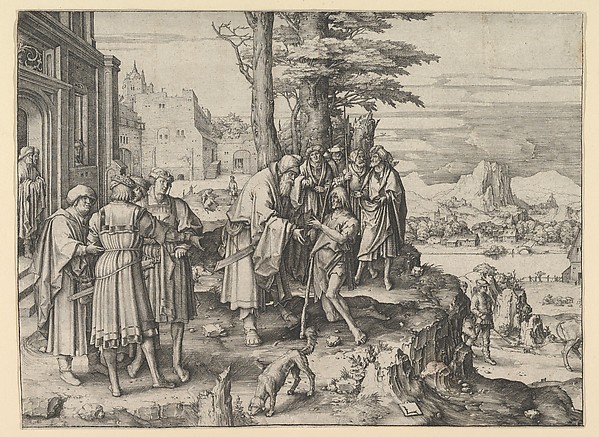
The Return of the Prodigal Son, engraved by Lucas van Leyden around 1505 in his Leiden workshop, illustrates the climactic moment of the Luke 15 parable: the father runs to embrace his returning son who, having squandered his inheritance, has returned home to throw himself at his father's feet. Lucas van Leyden composes the scene as a small intimate group in the foreground — the kneeling son embraced by the standing father — with the elder brother visible in the deeper background tending the household and the fatted calf being prepared for the celebratory meal at the upper left. The print circulated through the early sixteenth-century Dutch and German print collections and shaped the visual treatment of the Prodigal Son parable in Northern Renaissance and Reformation devotional imagery for several generations.
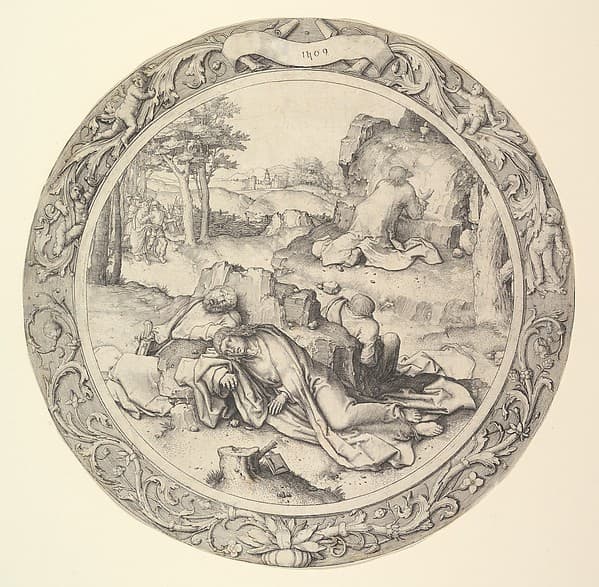
Christ on the Mount of Olives, from the Circular Passion
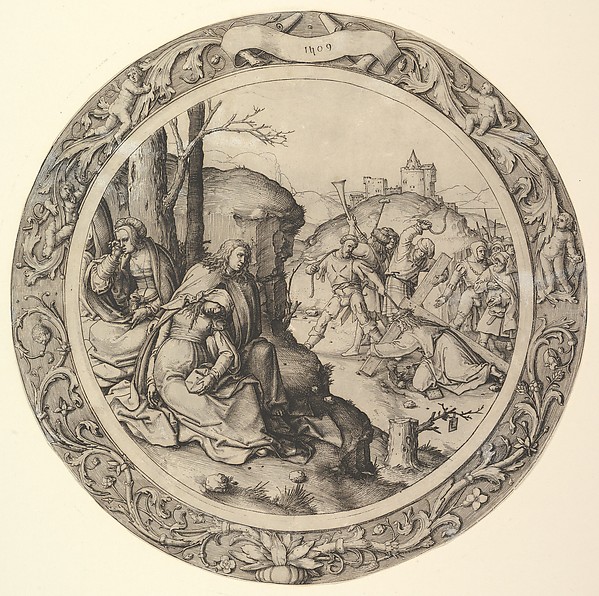
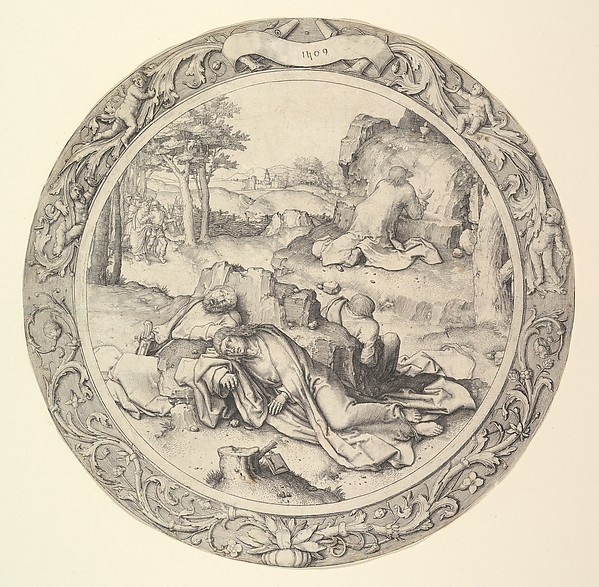
Christ on the Mount of Olives, engraved by Lucas van Leyden around 1509 as one of the small plates from his Circular Passion series in his Leiden workshop, depicts the Agony in the Garden as recorded in the Synoptic Gospels: Christ kneels in prayer before the angel bearing the cup of the Passion, while the three sleeping disciples — Peter, James, and John — are gathered in the lower foreground and Judas with the Roman soldiers approach through the gate at the rear. The Circular Passion was a series of small round-format engravings depicting the principal Passion subjects, designed for binding into prayer books or for distribution at confraternity meetings. Lucas van Leyden's combination of dense crowded composition and atmospheric burin work translated the late-medieval Northern devotional preoccupation with the Passion into the new sixteenth-century engraved format.
Bible scenes Lucas van Leyden painted
Luke
John
Genesis
Matthew
Revelation
Daniel
1 Samuel
Acts
1 Kings
Mark
Esther
Romans



![Solomon's Idolatry [I Kings, 11:1-8] by Lucas van Leyden](https://images.metmuseum.org/CRDImages/dp/web-large/DP819145.jpg)