Esther 5
People in this chapter
Esther 4 closed with the queen's line that has echoed across two and a half millennia of Jewish and Christian memory: I will go in unto the king, which is not according to the law: and if I perish, I perish (4:16). She had asked Mordecai and the Jews of Susa to fast with her for three days and nights. Chapter 5 opens on the morning of the third day. The same third-day motif the Bible uses for Isaac walking up Moriah (Gen. 22:4), Joseph releasing his brothers from prison (Gen. 42:18), Israel meeting God at Sinai (Ex. 19:11, 16), Jonah emerging from the fish (Jon. 1:17), and Hosea's promise that God will raise His people up (Hos. 6:2) - and that Christ will inhabit at its deepest pitch at the empty tomb.
Esther rises on the third day. The chapter is telling the reader, with a single date, what kind of scene this is.
Tap any highlighted phrase to jump to the commentary that unpacks it.
Esther 5:1-4The Third Day, the Scepter, the First Invitation
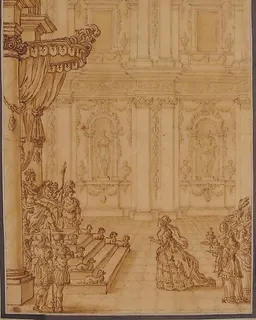
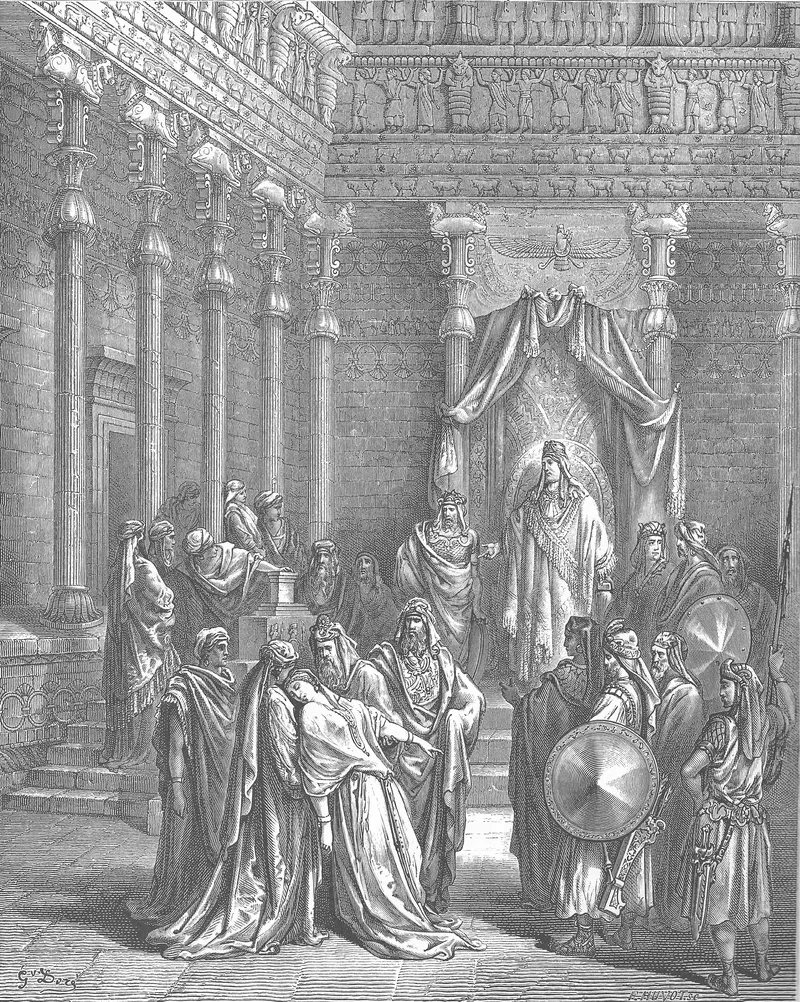
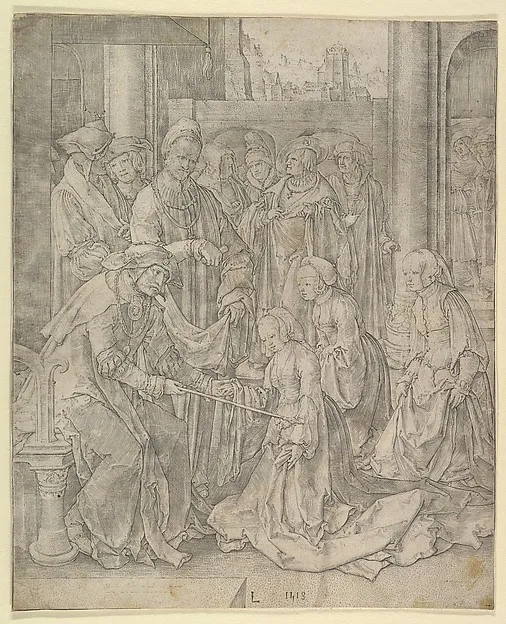
1Now it came to pass on the third day, that Esther put on her royal apparel, and stood in the inner court of the king’s house, over against the king’s house: and the king sat upon his royal throne in the royal house, over against the gate of the house. 2And it was so, when the king saw Esther the queen standing in the court, that she obtained favour in his sight: and the king held out to Esther the golden sceptre that was in his hand. So Esther drew near, and touched the top of the sceptre. 3Then said the king unto her, What wilt thou, queen Esther? and what is thy request? it shall be even given thee to the half of the kingdom. 4And Esther answered, If it seem good unto the king, let the king and Haman come this day unto the banquet that I have prepared for him.
The chapter opens with three words in Hebrew: vayyehi bayyom ha-shelishi - “and it came to pass on the third day.”1 The Old Testament repeats this exact phrase at every great deliverance moment: the third day on Moriah when Abraham raises the knife and the LORD provides the ram (Gen. 22:4); the third day Joseph releases his brothers from prison (Gen. 42:18); the third day God descends on Sinai in fire (Ex. 19:11, 16); the third day Jonah is delivered from the fish (Jon. 1:17); the third day Hosea promises God will raise His people up (Hos. 6:2).
The motif culminates in the resurrection. Christ “rose again the third day according to the scriptures” (1 Cor. 15:4) - and Luke 24:7 names the “according to the scriptures” explicitly. Esther rises on the third day of her fast, walks into a court where she should die, and lives. The chapter is dating the scene with the Bible's favorite date for resurrection deliverance.
The king's offer - even to the half of the kingdom - was a stock Achaemenid royal extravagance, not a literal commitment2. Herodotus records the same kind of formulaic offer at Persian court banquets. What the chapter is doing by repeating it four times across chapters 5-7 is to set up the irony: Esther wants the whole life of her people preserved. The king's grandest offers are too small for what she has actually come to ask.
The literary effect runs forward to Mark 6:23 where Herod, in a bizarre echo, makes the same offer to a dancer he cannot resist - and ends up beheading John the Baptist for it. The biblical narrators know the formula, and they know that the kings who use it rarely understand what they are actually offering.
Esther 5:5-8The First Banquet and the Deferred Request
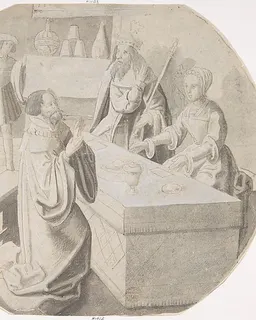
5Then the king said, Cause Haman to make haste, that he may do as Esther hath said. So the king and Haman came to the banquet that Esther had prepared. 6And the king said unto Esther at the banquet of wine, What is thy petition? and it shall be granted thee: and what is thy request? even to the half of the kingdom it shall be performed. 7Then answered Esther, and said, My petition and my request is; 8If I have found favour in the sight of the king, and if it please the king to grant my petition, and to perform my request, let the king and Haman come to the banquet that I shall prepare for them, and I will do to morrow as the king hath said.
Esther defers3. The king has just asked her, twice in two verses, what she wants. She has rehearsed in her head for three days exactly what she needs to say. And she does not say it. She invites them to a second banquet tomorrow. Readers across the centuries have offered many explanations for the deferral: that she lost her nerve, that she was waiting for stronger evidence against Haman, that she sensed the timing was not right.
The chapter does not tell us. What the chapter shows us is what God did with the deferred day. Between this first banquet and the second, chapter 6 happens: the king cannot sleep, the chronicles are read aloud, the rescue Mordecai performed years earlier is rediscovered, Haman arrives early in the morning to ask permission to hang Mordecai and is instead made to honor him publicly. None of that happens if Esther asks tonight. Her patience is the door through which the chapter's decisive providence walks.
The Hebrew names the first banquet mishteh ha-yayin - “the banquet of wine.” The book of Esther repeatedly stages its decisive scenes at wine banquets: the king's 180-day banquet in chapter 1, Vashti's feast for the women in chapter 1, the king's wedding banquet for Esther in chapter 2, Esther's two banquets in chapters 5 and 7, the feasts of Purim that close the book in chapter 9. The chapter is not romanticizing alcohol; the wine is the symbolic medium through which the book's reversals occur.
Every time someone takes a cup in Esther, something is about to turn. The reader is being prepared for the chapter-seven banquet, where Haman will fall on the same couch he is celebrating on tonight.
Esther 5:9-13Haman's Joy Undone by One Man
9Then went Haman forth that day joyful and with a glad heart: but when Haman saw Mordecai in the king’s gate, that he stood not up, nor moved for him, he was full of indignation against Mordecai. 10Nevertheless Haman refrained himself: and when he came home, he sent and called for his friends, and Zeresh his wife. 11And Haman told them of the glory of his riches, and the multitude of his children, and all the things wherein the king had promoted him, and how he had advanced him above the princes and servants of the king. 12Haman said moreover, Yea, Esther the queen did let no man come in with the king unto the banquet that she had prepared but myself; and to morrow am I invited unto her also with the king. 13Yet all this availeth me nothing, so long as I see Mordecai the Jew sitting at the king’s gate.
Haman leaves the queen's first banquet sameach ve-tov lev - “joyful and good of heart.” The exact same Hebrew phrase the Bible used in Esther 1:10 of the king on the seventh day of his garden party, the moment before Vashti's refusal triggered the disaster. The Chronicler-of-Esther is deploying the phrase as a warning marker: every time someone in this book is described as sameach ve-tov lev, the next paragraph is going to undo them. The reader is being told what is about to happen by the very vocabulary the verse uses.
Haman's joy lasts as long as it takes to walk from the queen's apartments to the king's gate. One Jew refusing to stand collapses every external glory the previous verse cataloged. The text wastes no commentary on the irrationality of it. The Bible knows that envy works exactly this way. The thing you have is suddenly worthless because one specific person you cannot touch has refused to validate it.
Esther 5:14The Fifty-Cubit Tree
14Then said Zeresh his wife and all his friends unto him, Let a gallows be made of fifty cubits high, and to morrow speak thou unto the king that Mordecai may be hanged thereon: then go thou in merrily with the king unto the banquet. And the thing pleased Haman; and he caused the gallows to be made.
Fifty cubits is approximately seventy-five feet - about as tall as a six-story building. No tree near a private house would have stood that high; Haman is building a structure designed to be visible from anywhere in Susa. The height is designed for public humiliation. Haman wants Mordecai not just dead, but dead in a way the whole city must look at. The Chronicler-of-Esther records the dimension because the height of the gallows will become a punch-line in chapter 7.
Haman builds the most ostentatious instrument of death in the city and ends up swinging from it himself. The dimensions of the cross he raised against his enemy turn out to be the dimensions of his own grave.
Research trail
Sources & further study
These references support the historical, linguistic, manuscript, and contextual notes in this chapter. Scripture remains the primary text; external sources are provided so readers can inspect the research directly.
- The “Third Day” Motif in ScriptureThe biblical pattern of the third day as a day of deliverance - from Genesis 22 (Isaac on Moriah) through Hosea 6:2 (“in the third day he will raise us up”) to the resurrection of Christ (Luke 24:7).
- Esther's Approach to the KingSBL background on Persian court protocol - the requirement that even queens not approach the king uninvited - and the political weight of the scepter-extending gesture in Achaemenid royal ritual.
- Esther 5 · Hebrew + Jewish commentaryHebrew text with Rashi, Ibn Ezra, and rabbinic commentary on the third-day approach to the king, the golden scepter, the strategic deferral of the request, and the building of the gallows.
Where this echoes in Scripture
The Third Day, the Scepter, the First Invitation
- Hebrews 4:14-16Let us therefore come boldly unto the throne of grace, that we may obtain mercy, and find grace to help in time of need.The chapter's scene rewritten into the gospel posture of the believer.
- Hosea 6:2After two days will he revive us: in the third day he will raise us up, and we shall live in his sight.The Old Testament third-day motif at its most explicit - the day Esther rises into.
- Luke 24:7The Son of man must be delivered into the hands of sinful men, and be crucified, and the third day rise again.The deepest third day - the one all the others were pointing to.
The First Banquet and the Deferred Request
- John 11:5-6Now Jesus loved Martha… When he had heard therefore that he was sick, he abode two days still in the same place where he was.Jesus deferring the rescue at exactly the moment His friends wanted Him to act immediately.
- Galatians 4:4But when the fulness of the time was come, God sent forth his Son.The patience of God Himself - the “tomorrow” the whole Old Testament was waiting for.
Haman's Joy Undone by One Man
- Mark 15:10For he knew that the chief priests had delivered him for envy.The same anatomy Esther 5:13 narrates - written into the death of Christ.
- James 3:14-16Where envying and strife is, there is confusion and every evil work.James diagnosing the same poison.
- Galatians 5:26Let us not be desirous of vain glory, provoking one another, envying one another.Paul on the daily form of Haman's disease.
The Fifty-Cubit Tree
- Esther 7:9-10Then the king said, Hang him thereon. So they hanged Haman on the gallows that he had prepared for Mordecai.The chapter the chapter already knows is coming.
- Psalm 7:15-16He made a pit, and digged it, and is fallen into the ditch which he made… his violent dealing shall come down upon his own pate.The Old Testament naming the principle Esther 5-7 dramatizes.
- Galatians 3:13Christ hath redeemed us from the curse of the law, being made a curse for us: for it is written, Cursed is every one that hangeth on a tree.The etz-language Esther uses, finally fulfilled in Christ's tree.
- Colossians 2:14-15Blotting out the handwriting of ordinances that was against us… having spoiled principalities and powers, he made a shew of them openly, triumphing over them in it.The cross as the cosmic Haman's-gallows.