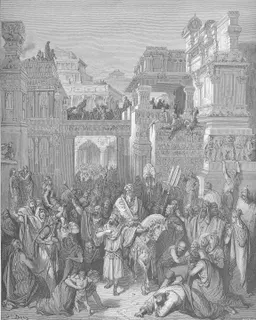
Esther 6
People in this chapter
That night - the night before Esther's second banquet, the night after Haman has ordered a gallows built for Mordecai - could not the king sleep. A sleepless night is the smallest of things, the kind of trivial detail no chronicle bothers to record. But this is the night everything turns on, and it turns on a king who simply cannot close his eyes. Notice that the text gives no reason - no fever, no nightmare, no worry named.
It says only that sleep would not come, and leaves the cause unspoken. The book of Esther never once mentions God; it works instead by letting the “accidents” pile up until the reader feels the hand behind them. This is the first of them.1
Tap any highlighted phrase to jump to the commentary that unpacks it.
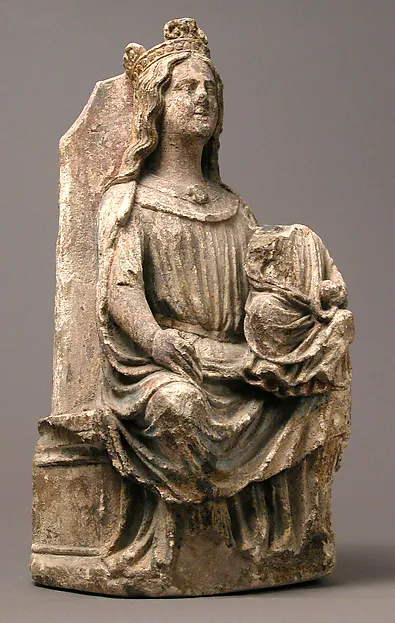
Esther 6:1-3The King Cannot Sleep
1On that night could not the king sleep, and he commanded to bring the book of records of the chronicles; and they were read before the king. 2And it was found written, that Mordecai had told of Bigthana and Teresh, two of the king’s chamberlains, the keepers of the door, who sought to lay hand on the king Ahasuerus. 3And the king said, What honour and dignity hath been done to Mordecai for this? Then said the king’s servants that ministered unto him, There is nothing done for him.
Everything that will save a nation begins with a sentence so small it could be skipped: On that night could not the king sleep. Look at how the text declines to explain it. There is no fever, no troubling dream, no anxiety named - the most powerful man in the empire simply lies awake, and the narrator offers no cause. This silence is deliberate, and it is the whole art of the book of Esther. The name of God is never spoken anywhere in these ten chapters; the author works instead by stacking up “coincidences” until the reader cannot help but sense the hand behind them.
A sleepless king is the first stone in that tower. Of all the nights in a long reign, sleep deserts him on this one - the night after Haman has raised a gallows fifty cubits high for Mordecai, the night before the banquet at which Esther will plead for her people. The timing is everything, and the timing belongs to no one in the room. Consider what hangs on it: had the king slept soundly, as kings usually do, the chronicle would have stayed shut, the debt would have stayed forgotten, and Haman would have walked into the court at dawn to a king with no reason in the world to deny him.
The hinge of the whole book is a king who cannot close his eyes.
Unable to sleep, the king reaches for the dullest remedy a court can offer: he has the book of records of the chronicles read aloud to him - the official annals of the realm, the registry of deeds and decrees.2 One imagines the droning of an attendant through page after page of administrative memory, the very thing to lull a restless man back to sleep. But the reading does not lull him; it lands.
Of all the entries in years of accumulated chronicle, the reader comes upon the account of how Mordecai had told of Bigthana and Teresh - two of the king's own doorkeepers who had conspired to assassinate him. Mordecai had uncovered the plot and reported it, and the king's life had been spared. The reader could have opened to any of a thousand pages; this is the one that is read. Here is the second “accident” laid on the first - a sleepless night in which the chronicle falls open precisely to the one deed in the empire that is about to matter more than any other.
The narrative gives us no scribe choosing the passage on purpose, no plan. It simply happens that this is what gets read. And the more “by chance” it all looks, the more plainly the hand behind the chance is felt.
The king's response betrays a sudden, conscience-stricken arithmetic: What honour and dignity hath been done to Mordecai for this? The man saved my life - what was he given? And the answer comes back flat and damning: There is nothing done for him. Nothing at all. A man had stood between the king and his assassins, and the empire had simply moved on and forgotten him. Years had passed; the debt had gathered dust.
In the ordinary run of things a forgotten kindness stays forgotten - the world is full of loyalties that were never repaid and good deeds that sank without a trace. But this one surfaces, and it surfaces at the one hour when its payment will mean the difference between a gallows and a deliverance. Notice the precision of it: not a week earlier, when the king might have honoured Mordecai quietly and moved on; not a week later, when Haman's decree would already have done its work.
The unpaid debt comes to light in the narrow window where remembering it changes everything. A forgotten deed, an unpaid honour, raised at exactly the moment it can save a life - the timing is too exact to be accident, and the book lets that exactness do its silent preaching.
Esther 6:4-5Haman Arrives to Ask for a Death
4And the king said, Who is in the court? Now Haman was come into the outward court of the king’s house, to speak unto the king to hang Mordecai on the gallows that he had prepared for him. 5And the king’s servants said unto him, Behold, Haman standeth in the court. And the king said, Let him come in.
The timing now tightens to the point of astonishment. In the very moment the king is asking how to honour Mordecai, he asks, Who is in the court? - and the answer is the one man in all the empire who has come to demand Mordecai's death. Haman was come into the outward court of the king's house, to speak unto the king to hang Mordecai on the gallows that he had prepared for him. Sit with the sheer convergence of it.
Haman has risen before dawn, too eager to wait, carrying his single request: leave to execute Mordecai on the fifty-cubit gallows he raised the night before. He arrives at the precise instant the king's heart has been turned toward rewarding the very man he means to destroy. A few minutes earlier, and the king would not yet have read the chronicle. A few minutes later, and Esther's banquet would have intervened. But Haman walks in now - and the man who came to ask for a death will be made to bestow a glory.
The narrative records no orchestration; it simply lays the two facts side by side and lets the reader feel the weight of a timing no human hand arranged. The hunter has walked into the moment of his own undoing, certain he is about to win.
Esther 6:6-7Whom the King Delighteth to Honour
6So Haman came in. And the king said unto him, What shall be done unto the man whom the king delighteth to honour? Now Haman thought in his heart, To whom would the king delight to do honour more than to myself? 7And Haman answered the king, For the man whom the king delighteth to honour,
Before Haman can voice his deadly errand, the king disarms him with a question: What shall be done unto the man whom the king delighteth to honour? And here the chapter opens a window directly into Haman's soul, and what we see there is the engine of his ruin: Now Haman thought in his heart, To whom would the king delight to do honour more than to myself? It does not even occur to him that the honour could be meant for another.
His vanity is so total, so reflexive, that the question can have only one answer - me. Who else could the king possibly mean? This is the precise mechanism of the trap, and the beauty of it is that no one sets it but Haman himself. The king lays no snare; he asks an open question. It is Haman's pride that supplies the fatal assumption, Haman's self-regard that fills in the blank with his own name.
He is about to design, in lavish detail, the very honours he will be forced to heap upon his enemy - and he designs them grandly precisely because he believes they are for himself. The proud man does not need an enemy to dig his pit; his own inflated heart does the digging. Give vanity an ambiguous question, and it will condemn itself with the answer.
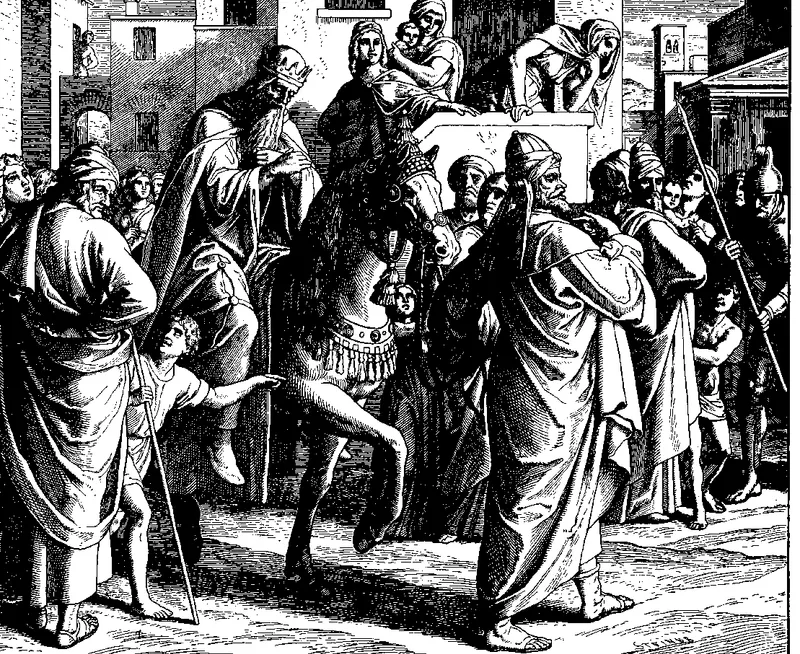
Esther 6:8-9The Robe, the Horse, and the Crown
8Let the royal apparel be brought which the king useth to wear, and the horse that the king rideth upon, and the crown royal which is set upon his head: 9And let this apparel and horse be delivered to the hand of one of the king’s most noble princes, that they may array the man withal whom the king delighteth to honour, and bring him on horseback through the street of the city, and proclaim before him, Thus shall it be done to the man whom the king delighteth to honour.
What Haman asks for tells us exactly what his heart worships. He does not request gold, or land, or office - he requests to be treated, for a day, as though he were the king. Let the royal apparel be brought which the king useth to wear, and the horse that the king rideth upon, and the crown royal which is set upon his head.2 Every item is an emblem of royalty itself: the robe the king has actually worn, the horse the king has actually ridden, the very crown of the realm.
And then the public spectacle - a noble prince to lead the honoured man on horseback through the street of the city, a herald crying before him, Thus shall it be done to the man whom the king delighteth to honour. This is a coronation in all but name, a craving for glory laid bare. Haman wants the whole city to watch, wants the proclamation to ring through the streets, wants to be seen wearing what only the king wears.
It is the appetite of pride in its purest form: to be exalted publicly, visibly, above every other. And every detail he piles on, every lavish stroke he adds to the picture, only deepens the humiliation that is about to fall - because he is describing, with loving precision, the parade in which he himself will walk as the lowest servant, leading the horse of the man he hates.
Esther 6:10-14The Reversal and the Fall Foretold
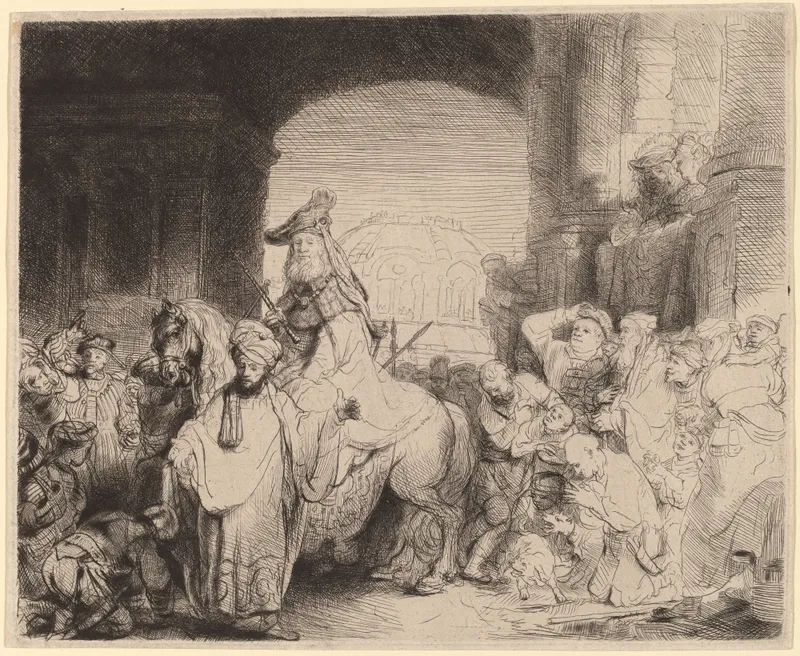
10Then the king said to Haman, Make haste, and take the apparel and the horse, as thou hast said, and do even so to Mordecai the Jew, that sitteth at the king’s gate: let nothing fail of all that thou hast spoken. 11Then took Haman the apparel and the horse, and arrayed Mordecai, and brought him on horseback through the street of the city, and proclaimed before him, Thus shall it be done unto the man whom the king delighteth to honour. 12And Mordecai came again to the king’s gate. But Haman hasted to his house mourning, and having his head covered. 13And Haman told Zeresh his wife and all his friends every thing that had befallen him. Then said his wise men and Zeresh his wife unto him, If Mordecai be of the seed of the Jews, before whom thou hast begun to fall, thou shalt not prevail against him, but shalt surely fall before him. 14And while they were yet talking with him, came the king’s chamberlains, and hasted to bring Haman unto the banquet that Esther had prepared.
The blow falls in a single sentence, and there is no softening of it: Make haste, and take the apparel and the horse, as thou hast said, and do even so to Mordecai the Jew, that sitteth at the king's gate. Every word is a turn of the knife. As thou hast said - the honours are Haman's own design, chosen by his own mouth; he cannot now claim they are too much, for he prescribed every one.
Mordecai the Jew - the very name and people Haman has plotted to annihilate, spoken by the king without the faintest idea that the man before him is the plotter. That sitteth at the king's gate - the lowly post of the man Haman thought beneath contempt. And then the final clamp: let nothing fail of all that thou hast spoken. Not one detail may be omitted. Haman must execute, in full, the lavish coronation he designed for himself - upon his enemy.
The horror of it must have been total: in the space of one sentence he goes from a man certain he is about to receive the kingdom's highest glory to a man commanded to bestow that glory, with his own hands, on the one person he most wants dead. He cannot refuse; the king has spoken. The pit he dug for Mordecai, and the parade he dreamed for himself, have fused into a single instrument of his own undoing.
And so it is done, and the text spares Haman nothing: Then took Haman the apparel and the horse, and arrayed Mordecai, and brought him on horseback through the street of the city, and proclaimed before him, Thus shall it be done unto the man whom the king delighteth to honour. Picture the scene in full. Haman, the second man in the empire, must with his own hands dress Mordecai in the royal robe. He must lead the horse - the king's own horse, bearing his enemy - through the public streets of Susa.
And he must lift his own voice and cry out, again and again before the watching city, the words he had imagined hearing about himself: Thus shall it be done unto the man whom the king delighteth to honour. Every syllable he proclaims is a syllable of his own humiliation. The honour he craved he is now compelled to publish - for another. There is a terrible justice in the precision of it: the very public spectacle Haman designed to glorify himself becomes the very public spectacle that degrades him, and not one detail is altered.
He gets exactly the parade he asked for, down to the herald's cry - only he is the herald, and Mordecai is the king-for-a-day. The reversal is complete, and it is accomplished without a single miracle, without a word from heaven, by nothing but a chain of timing that turns a man's own pride into the rod that beats him.
When the parade ends, the two men return to utterly opposite fates, and the text marks the contrast with quiet economy. Mordecai came again to the king's gate - back to his humble post, unchanged, asking nothing, simply returning to his place. The honour did not go to his head; he received it and went back to the gate. But Haman hasted to his house mourning, and having his head covered. The covered head is the ancient gesture of grief and shame, the posture of a man in mourning - and Haman wears it for a humiliation, fleeing home to hide his face.
Set the two side by side: Mordecai, who sought no glory, walks calmly back to the gate; Haman, who sought all glory, runs home with his head covered like a man at a funeral. The one who grasped at honour is left in shame; the one who grasped at nothing is left in peace. And the deepest irony is that nothing has yet happened to Haman beyond the parade - he has not lost his office, his wealth, or his life.
He has lost only his pride, and the loss of his pride feels to him like death. A man whose whole self is built on being exalted cannot survive being made to exalt another. His mourning is the mourning of vanity wounded - and it is the first sign that the structure of his life is already collapsing.
At home, Haman pours out the whole bitter tale to Zeresh his wife and all his friends - the same circle who, only the night before, had cheerfully advised him to build the gallows and expect a triumph. But the counsel has changed overnight, and the change is ominous. Then said his wise men and Zeresh his wife unto him, If Mordecai be of the seed of the Jews, before whom thou hast begun to fall, thou shalt not prevail against him, but shalt surely fall before him.1 They are reading an omen, and the omen is doom.
Notice the words they choose. They speak of Mordecai as one of the seed of the Jews - a people, they seem to sense, it is fatal to fight. And they frame the day's humiliation as the beginning of a fall already in motion: before whom thou hast begun to fall. The verb is decisive - the falling has started, and it will not stop. Thou shalt not prevail against him, but shalt surely fall before him. Even Haman's own household can see what Haman cannot yet admit: he has set himself against a people he cannot defeat, and the morning's parade was only the first stone of an avalanche.
The book still does not name the God behind that certainty - but Zeresh and the wise men feel His weight pressing on the scene, and they name the outcome without naming the cause. A man does not begin to fall before the seed of the Jews and recover; he falls all the way.
The chapter closes on a final stroke of timing as precise as the one that opened it. And while they were yet talking with him, came the king's chamberlains, and hasted to bring Haman unto the banquet that Esther had prepared. The dark prophecy is not even finished - the words thou shalt surely fall before him are still hanging in the air - when the royal escort arrives to hurry Haman to the very banquet at which his fall will be sealed.
He has no time to absorb the omen, no time to plan, no time to flee. He is swept from the house where his ruin was foretold straight to the table where it will be carried out, propelled by a momentum he can no longer control. Note the word again: the chamberlains hasted. The book's providence does not only arrange events; it sets their pace, hurrying Haman onward before he can catch his breath or change his course.
He goes to Esther's feast believing it an honour - a private banquet with the king and queen - and walks into the place where Esther will name him as the enemy of her people and the king will turn on him in wrath. The man who could not imagine the honour being for anyone but himself cannot now imagine the banquet being anything but his glory. He is wrong about both. The chapter ends with Haman in motion toward a doom he still does not see, carried there, like everything else in this book, by a hand that is never named and never still.
Research trail
Sources & further study
These references support the historical, linguistic, manuscript, and contextual notes in this chapter. Scripture remains the primary text; external sources are provided so readers can inspect the research directly.
- Esther 6 - Translators' NotesThe NET Bible's detailed footnotes on Esther 6 - the impersonal construction behind “could not the king sleep” (v. 1), the idiom of the apparel “which the king useth to wear” (v. 8), the legal sense of the unpaid “honour and dignity” owed Mordecai (v. 3), and the ominous wording of Zeresh's prophecy in verse 13.
- The Achaemenid Persian Empire · Heilbrunn TimelineThe Met's survey of the Persian court of Ahasuerus (Xerxes) at Susa - the royal robes and the king's horse that stood as emblems of sovereign favour (vv. 8-9), the protocol of the inner and outer courts where Haman waited (v. 4), and the imperial record-keeping behind the “book of records of the chronicles” read in verse 1.
- Esther 6 · Hebrew + classical Jewish commentaryThe Hebrew text of Esther 6 with Rashi, Ibn Ezra, and other classical commentators side by side - useful for the force of yeqar (the “honour” that rings through vv. 3, 6, 7, 9, and 11), for the curious passive “could not the king sleep” in verse 1, and for the long discussion of why the chronicle should be read on precisely this night.
- Esther 6 ↔ Proverbs 16 · Luke 1 · Luke 14Traces the threads tying the unnamed providence of Esther 6 to the whole disposing thereof is of the LORD (Prov. 16:33) and the king's heart is in the hand of the LORD (Prov. 21:1), and the great reversal of the proud and the lowly to He hath put down the mighty… and exalted them of low degree (Luke 1:52).
Where this echoes in Scripture
The King Cannot Sleep
- Proverbs 16:33The lot is cast into the lap; but the whole disposing thereof is of the LORD.The hand the book of Esther never names - behind the “chance” of a sleepless night and a chronicle opened to the right page.
- Psalm 121:4Behold, he that keepeth Israel shall neither slumber nor sleep.A king cannot sleep on the night it matters - while the Keeper of His people never sleeps at all.
- Hebrews 6:10For God is not unrighteous to forget your work and labour of love.Mordecai's unrewarded deed, remembered at the right hour - the faithfulness heaven does not forget.
- 1 Samuel 2:30For them that honour me I will honour, and they that despise me shall be lightly esteemed.The true source of yeqar - honour given by God to those He chooses to honour.
The Robe, the Horse, and the Crown
- Proverbs 16:18Pride goeth before destruction, and an haughty spirit before a fall.Haman at the summit of his self-regard, an hour before his humiliation - the proverb made flesh.
- Luke 14:11For whosoever exalteth himself shall be abased; and he that humbleth himself shall be exalted.The fixed law beneath the reversal - the self-exalting Haman abased, the lowly Mordecai lifted up.
- Luke 1:52He hath put down the mighty from their seats, and exalted them of low degree.The signature of God's work in the world - sung at the coming of Christ, enacted in Haman and Mordecai.
- Proverbs 26:27Whoso diggeth a pit shall fall therein: and he that rolleth a stone, it will return upon him.The gallows and the honours Haman prepares - the scheme that recoils onto the head that devised it.
The Reversal and the Fall Foretold
- Proverbs 21:1The king's heart is in the hand of the LORD, as the rivers of water: he turneth it whithersoever he will.The sleepless king's heart turned in the night toward Mordecai - the hand behind the throne the book never names.
- Philippians 2:8-9He humbled himself… wherefore God also hath highly exalted him, and given him a name which is above every name.The great reversal at its deepest - the Lowly One raised to the throne, foreshadowed in Mordecai lifted from the gate.
- Genesis 50:20Ye thought evil against me; but God meant it unto good.The hidden hand that turns a scheme of destruction into deliverance - the same providence at work in Esther.
- Psalm 7:15-16He made a pit… and is fallen into the ditch which he made. His mischief shall return upon his own head.Haman's gallows and parade - the violence of the proud recoiling, by an unseen hand, onto themselves.