Esther 7
People in this chapter
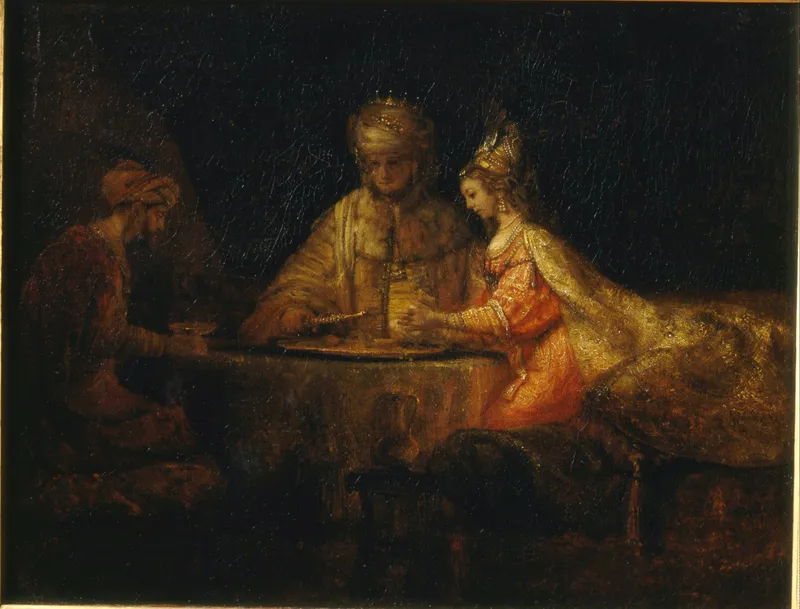
The whole book of Esther moves toward this room. Twice now the king has promised the queen anything she asks, even to half his kingdom; twice he has waited at her table. Behind one wine cup sits Haman, who has bought from the king, with ten thousand talents of silver, a decree to destroy every Jew in a hundred and twenty-seven provinces - not knowing that the queen across the table is herself a Jew.
The reader knows what the king does not, and what Haman cannot imagine. And so the second banquet is a reckoning waiting to happen, a quiet room in which the fate of a whole people, and of the man who plotted their death, hangs on the words a queen is about to say.1
Tap any highlighted phrase to jump to the commentary that unpacks it.
Esther 7:1-4Let My Life Be Given Me at My Petition
1So the king and Haman came to banquet with Esther the queen. 2And the king said again unto Esther on the second day at the banquet of wine, What is thy petition, queen Esther? and it shall be granted thee: and what is thy request? and it shall be performed, even to the half of the kingdom. 3Then Esther the queen answered and said, If I have found favour in thy sight, O king, and if it please the king, let my life be given me at my petition, and my people at my request: 4For we are sold, I and my people, to be destroyed, to be slain, and to perish. But if we had been sold for bondmen and bondwomen, I had held my tongue, although the enemy could not countervail the king’s damage.
For the third time in the story the king holds out his open hand: What is thy petition, queen Esther? and it shall be granted thee… even to the half of the kingdom. The phrase is the lavish hyperbole of an eastern court - no king literally meant to surrender half his empire - but it carries a real weight all the same: there is nothing, the king is saying, that he will refuse her.2 He has asked this once before and watched her defer, inviting him instead to a second banquet.
Now the question comes again, and the air has changed. Esther has spent these days in fasting; she has steadied herself for a moment she knows may cost her everything. The king imagines he is granting a queen some pleasant favor. He has no idea that the answer about to come will name a traitor at his own table and overturn a decree sealed with his own ring. The open hand is extended in ignorance; what it is about to receive will shake the kingdom.
And now Esther speaks, and the shape of her speech is everything. She begins with herself laid low before the king - If I have found favour in thy sight, O king, and if it please the king - the language of a petitioner who knows she has no claim but the king's goodwill. And then comes the petition itself: life. Let my life be given me at my petition, and my people at my request. The most powerful woman in the empire pleads, in the end, for nothing more than to be allowed to live - and not even that, alone.
She cannot ask for her own life without, in the same breath, asking for theirs. The two requests are made as one because to her they are one.
Esther names the crime without yet naming the criminal: For we are sold, I and my people, to be destroyed, to be slain, and to perish. The verb sold is deliberate and bitter - it reaches back to the ten thousand talents of silver Haman had weighed out to buy the decree (Esther 3:9). Her people have been treated as merchandise, their lives bartered for the king's treasury. And the three verbs that follow do not soften the matter: destroyed… slain… to perish. This is the exact wording of the murderous edict itself, now read back to the king from the lips of his own queen.
Then she adds a stroke of shrewd restraint: But if we had been sold for bondmen and bondwomen, I had held my tongue, although the enemy could not countervail the king's damage.1 She means: had it been mere slavery, she would have borne it in silence rather than trouble the king - the loss would not have been worth his disturbance. This is annihilation, a thing no compensation could ever balance, and a loss the king himself would suffer.
She has made her people's destruction the king's problem, and done it with a dignity that asks nothing it does not need.
Esther 7:5-7The Adversary and Enemy Is This Wicked Haman
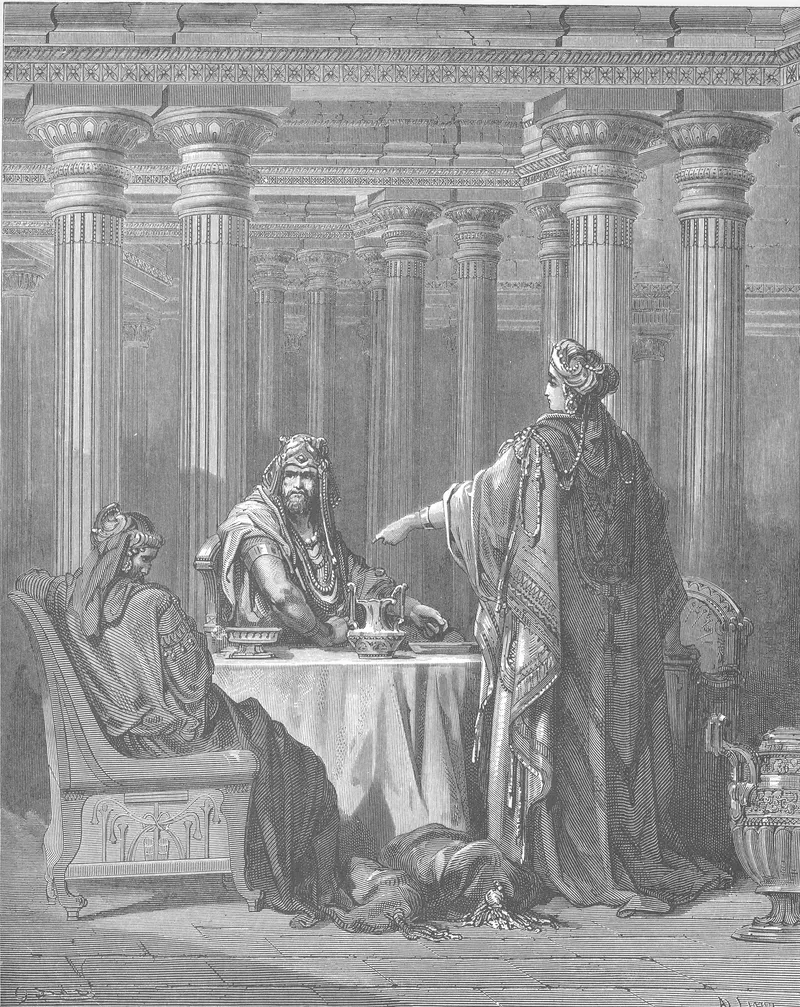
5Then the king Ahasuerus answered and said unto Esther the queen, Who is he, and where is he, that durst presume in his heart to do so? 6And Esther said, The adversary and enemy is this wicked Haman. Then Haman was afraid before the king and the queen. 7And the king arising from the banquet of wine in his wrath went into the palace garden: and Haman stood up to make request for his life to Esther the queen; for he saw that there was evil determined against him by the king.
The king's response is a burst of indignation: Who is he, and where is he, that durst presume in his heart to do so? The question is almost comic in its blindness, for the man he is hunting sits at his own table, and the decree he is enraged by bears his own seal. The king does not yet grasp that he himself authorized this destruction; in his mind some unknown villain has dared to threaten his queen and her people.
But the force of the question is real. Durst presume in his heart - who would have the audacity, the swollen arrogance, to plot such a thing? The king demands a name and a location, a culprit to set his wrath upon. And in asking, he unknowingly hands Esther the opening she has waited for. The accuser of her people is about to become the accused, and the king's own anger, now fully kindled, will be the instrument that turns.
Then comes the sentence the whole book has been moving toward, and Esther does not flinch from it: The adversary and enemy is this wicked Haman. Three words of accusation - adversary, enemy, wicked - and then the name, and then, surely, her hand or her eyes turning toward the man reclining a few feet away. There is no hedging, no softening, no diplomatic circling. She names him to his face, in the presence of the king, as the author of genocide.
And the effect is instantaneous: Then Haman was afraid before the king and the queen. The man who had built a fifty-cubit gallows in his pride, who had paraded through the city in fury at a single Jew who would not bow, who had weighed out a fortune to erase an entire people - that man is suddenly afraid. The naming has done it. The plot that lived in the dark, in sealed letters and private councils, has been dragged into the light of the king's table, and in the light it loses all its power.
Haman, exposed, can only tremble.
The king storms out into the garden, and in that charged interval the whole order of the court inverts. A moment ago Haman was the second man in the empire, dining with the king and queen; now Haman stood up to make request for his life to Esther the queen. The man who would not bow to Mordecai now rises to beg a Jew for mercy. The one who held the power of death over a whole people now pleads for his own breath.
And he turns, tellingly, to Esther - for he saw that there was evil determined against him by the king, the very woman whose people he had condemned. He has read the king's face and knows the verdict is already settled there; his only hope is the queen he has wronged. The reversal is now complete in everything but its execution. The accuser begs the accused. The destroyer pleads with the one marked for destruction.
The proud man grovels. And he does not know that even this desperate act of supplication is about to seal the doom he is trying to escape.
Esther 7:8-10Hanged on the Gallows He Built
8Then the king returned out of the palace garden into the place of the banquet of wine; and Haman was fallen upon the bed whereon Esther was. Then said the king, Will he force the queen also before me in the house? As the word went out of the king’s mouth, they covered Haman’s face. 9And Harbonah, one of the chamberlains, said before the king, Behold also, the gallows fifty cubits high, which Haman had made for Mordecai, who had spoken good for the king, standeth in the house of Haman. Then the king said, Hang him thereon. 10So they hanged Haman on the gallows that he had prepared for Mordecai. Then was the king’s wrath pacified.
The timing is merciless. At the exact moment the king returns from the garden, his eyes fall on Haman fallen upon the bed whereon Esther was - the couch on which, in the manner of a Persian banquet, the queen reclined. Haman has thrown himself down in desperate supplication, clutching at Esther to beg for his life. But to the king, stepping back into the room in the full heat of his wrath, the scene reads as something else entirely: an assault on the queen, in the palace, in his own presence.
Will he force the queen also before me in the house?1 The word also is devastating - as if to say, he plots to destroy my queen's people, and now he dares lay hands on her under my own roof? Whether the king truly believed it or simply seized the pretext, the verdict is sealed in an instant. As the word went out of the king's mouth, they covered Haman's face - the covering of the face was the mark of a man already condemned, as good as dead.
The very act by which Haman hoped to save himself became the final proof of his ruin. Reaching for mercy, he laid hold of his own death sentence.
And now the last piece falls into place, spoken by a servant who has, until this instant, played no part at all. Harbonah, one of the chamberlains, said before the king, Behold also, the gallows fifty cubits high, which Haman had made for Mordecai, who had spoken good for the king, standeth in the house of Haman. Fifty cubits is some seventy-five feet - a monstrous, towering thing, built to display and broadcast Haman's triumph over the man who would not bow.
Harbonah's words do three things at once. They remind the king that Haman had targeted not just any man but Mordecai, who had spoken good for the king - the very man who had once exposed an assassination plot and saved the king's life. They reveal that the instrument of death already stands ready, waiting, in Haman's own house. And they hand the king the perfect and fitting sentence. Then the king said, Hang him thereon. Three words to answer the three words of accusation.
The gallows built for the savior of the king will become the scaffold of the king's betrayer.
The sentence is carried out at once: So they hanged Haman on the gallows that he had prepared for Mordecai. Read that line slowly, for the whole book has been bending toward it. Every cubit of that scaffold was raised by Haman's own pride; every nail was driven for an innocent man's death; and now, by a reversal so exact it can only be called justice, the architect hangs on his own architecture.
The device prepared for the righteous becomes the doom of the wicked. He is destroyed by the very engine of destruction he himself designed and built and set up in his own courtyard. There is something almost unbearably fitting in it - the snare-maker caught in his own snare, the hunter taken in his own trap, the man who measured out a fifty-cubit death for another made to climb it himself. The book of Esther will not say the word God. But it does not have to.
The reader watches the gallows turn, and knows.
The chapter closes on a single, quiet clause: Then was the king's wrath pacified. The burning anger that drove him from the table is, at last, put out by the fall of justice on the guilty man. The same word that kindled in verse 7 is quenched in verse 10, and only the death of the destroyer could quench it. There is resolution here, but it is sober resolution. A man has died on a scaffold of his own making; an empire has been turned by the courage of a queen and the timing of a servant's memory; a people sentenced to annihilation have, in a single afternoon, watched their executioner take their place.
And through all of it the One whose deliverance it truly is has remained unnamed, unseen, working in the heat of a king's anger and the chance of a returning step and the sudden recollection of a chamberlain. The book of Esther teaches its readers to see a hand they cannot point to - to read providence in the quiet, exact turning of events that no one in the room could have arranged. The wrath is pacified; the people are spared; and the God who is never mentioned has, once again, kept His own.
Research trail
Sources & further study
These references support the historical, linguistic, manuscript, and contextual notes in this chapter. Scripture remains the primary text; external sources are provided so readers can inspect the research directly.
- Esther 7 - Translators' NotesThe NET Bible's detailed footnotes on Esther 7 - the force of “sold” in verse 4, the difficult clause “the enemy could not countervail the king's damage,” the ambiguity of Haman “fallen upon the bed,” and the height of the gallows “fifty cubits.”
- The Achaemenid Persian Empire · Heilbrunn TimelineThe Met's survey of the Persian world of Esther - the royal banqueting and the “banquet of wine” (vv. 2, 7-8), the absolute reach of a king who could promise “to the half of the kingdom,” and the court setting in which a queen's word could overturn a sealed decree.
- Esther 7 · Hebrew + classical Jewish commentaryThe Hebrew text of Esther 7 with Rashi, Ibn Ezra, and other classical commentators side by side - useful for she'elah (the “petition” Esther makes for her life and her people's, vv. 2-3), for the doubled baqqashah (“request”), and for the long discussion of how a book that never names God can be so plainly about His deliverance.
- Esther 7 ↔ Psalm 7 · Psalm 9 · Romans 8Traces the threads tying Haman's death on his own gallows to the psalms of the snare turned back - he is fallen into the ditch which he made (Ps. 7:15-16); in the net which they hid is their own foot taken (Ps. 9:15) - and Esther's plea for her people to the intercession language of Romans 8 and Hebrews 7.
Where this echoes in Scripture
Let My Life Be Given Me at My Petition
- Esther 4:14Who knoweth whether thou art come to the kingdom for such a time as this?The charge that brought Esther to this table - her place near the throne understood as the appointed moment to plead for her people.
- Romans 8:34Who is even at the right hand of God, who also maketh intercession for us.The intercessor who pleads at the throne - the greater pattern of the queen who would not be saved without her people.
- John 15:13Greater love hath no man than this, that a man lay down his life for his friends.The love that risks death for others - the measure Esther reached toward in binding her life to the condemned.
- Exodus 32:32Yet now, if thou wilt forgive their sin - ; and if not, blot me, I pray thee, out of thy book.Moses pleading to be counted with his people - the same refusal to be spared apart from those under judgment.
The Adversary and Enemy Is This Wicked Haman
- Psalm 7:15-16He made a pit, and digged it, and is fallen into the ditch which he made.The accuser exposed and overthrown - the wrong-doer's own scheme turning back on him, as Haman's now begins to.
- Proverbs 26:27Whoso diggeth a pit shall fall therein: and he that rolleth a stone, it will return upon him.The proverb the chapter enacts - the trap set for another closing on the one who set it.
- Ephesians 5:13But all things that are reproved are made manifest by the light.The power of the plot broken by exposure - the hidden thing losing its strength once dragged into the light.
- Esther 3:5-6And when Haman saw that Mordecai bowed not… he thought scorn to lay hands on Mordecai alone.The pride that started it all - the man who would not be defied now trembling before the queen and begging for his life.
Hanged on the Gallows He Built
- Psalm 9:15-16The heathen are sunk down in the pit that they made: in the net which they hid is their own foot taken.The snare turned back - the exact pattern of Haman hanged on the gallows he raised for Mordecai.
- Colossians 2:15Having spoiled principalities and powers, he made a shew of them openly, triumphing over them in it.The adversary's own device undone - the instrument raised against the Righteous One becoming the means of the enemy's defeat.
- Romans 12:19Vengeance is mine; I will repay, saith the Lord.The justice Esther and Mordecai did not seize for themselves - the reversal left in the hand of the One who turns the snare.
- Proverbs 11:8The righteous is delivered out of trouble, and the wicked cometh in his stead.The whole chapter in a sentence - the righteous spared, and the wicked taking the place prepared for the innocent.