Esther 8
People in this chapter
It is the same day. In the chapter just behind us, Haman's plot was unmasked at Esther's banquet and he was hanged that very hour on the gallows he had built for Mordecai. The enemy is gone. But the chapter opens on a sobering truth: the enemy's word is not gone. The letters Haman sealed in the king's name - ordering that on the thirteenth day of Adar every Jew, young and old, women and children, be destroyed - have already gone out to all hundred twenty and seven provinces.
And the law of the Medes and Persians is unbending: a writing sealed with the king's ring may no man reverse. Not even the king who wrote it. The death-sentence stands, written and sealed, and there is no power in the empire that can unwrite it.1
Tap any highlighted phrase to jump to the commentary that unpacks it.
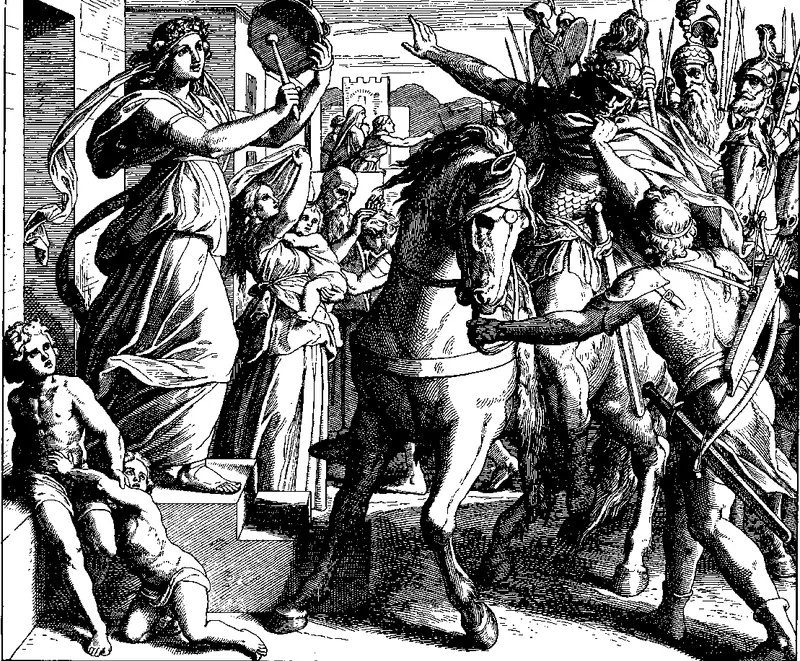
Esther 8:1-4The Ring Given, the Sceptre Held Out
1On that day did the king Ahasuerus give the house of Haman the Jews’ enemy unto Esther the queen. And Mordecai came before the king; for Esther had told what he was unto her. 2And the king took off his ring, which he had taken from Haman, and gave it unto Mordecai. And Esther set Mordecai over the house of Haman. 3And Esther spake yet again before the king, and fell down at his feet, and besought him with tears to put away the mischief of Haman the Agagite, and his device that he had devised against the Jews. 4Then the king held out the golden sceptre toward Esther. So Esther arose, and stood before the king,
The chapter opens on a transfer of property that is really a reversal of fortunes. On that day - the very day Haman was hanged - the king gives the house of Haman the Jews' enemy unto Esther the queen. The estate of the man who had plotted her people's annihilation now passes into the hands of the woman he meant to destroy. And the phrase the narrator chooses for Haman is pointed: he is named, even in death, the Jews' enemy. His whole identity has collapsed into that one thing.
Then Mordecai, the cousin who raised Esther as his own and who had refused to bow, came before the king - for now the secret is out; Esther has told the king what he was unto her. The two who had stood at the margins, the orphaned girl and the gatekeeper in sackcloth, are now inside the palace, before the throne, receiving what the enemy had hoarded. The wheel has turned, and it has turned without anyone in the story naming the hand that turned it.
Then comes a small act freighted with enormous weight: the king took off his ring, which he had taken from Haman, and gave it unto Mordecai. Follow that ring through the book. In chapter 3 the king had drawn it from his own hand and given it to Haman, and with it the authority to write death across the empire. After Haman's fall the king took it back. Now the same signet - the very instrument of the death-decree - is placed on Mordecai's finger.2 The authority that had been bent toward destruction is handed, intact, to the one who will bend it toward deliverance.
Nothing about the ring has changed; what has changed is whose hand wears it. And Esther, given Haman's house, set Mordecai over it - the deliverer installed in the very seat the destroyer had occupied. The reader who has been waiting for the reversal feels it click into place: the power is now where it needs to be, though no decree has yet been written.
Esther is not finished. The enemy is dead and she has been enriched, but her people are still under sentence - and so she spake yet again before the king, and fell down at his feet, and besought him with tears. This is her third approach to the throne in the book, and it is the most undefended. The first time she came uninvited and risked her life; now, secure in his favour, she does not stand on her standing - she falls down, she weeps, she begs.
Her petition is not for herself: it is to put away the mischief of Haman… and his device that he had devised against the Jews. And the king answers with the gesture that has come to define his mercy toward her: the king held out the golden sceptre toward Esther. The same sceptre that spared her life in chapter 5 now invites her to speak words that will save a nation. When she rises and frames her plea, she does it with exquisite courtesy - if it please the king… if I have found favour… if the thing seem right - and then lets the cry beneath the courtesy break through: For how can I endure to see the evil that shall come unto my people? The advocate who has gained the king's ear will not use it for herself.
Esther 8:5-8What Cannot Be Reversed Can Be Answered
5And said, If it please the king, and if I have found favour in his sight, and the thing seem right before the king, and I be pleasing in his eyes, let it be written to reverse the letters devised by Haman the son of Hammedatha the Agagite, which he wrote to destroy the Jews which are in all the king’s provinces: 6For how can I endure to see the evil that shall come unto my people? or how can I endure to see the destruction of my kindred? 7Then the king Ahasuerus said unto Esther the queen and to Mordecai the Jew, Behold, I have given Esther the house of Haman, and him they have hanged upon the gallows, because he laid his hand upon the Jews. 8Write ye also for the Jews, as it liketh you, in the king’s name, and seal it with the king’s ring: for the writing which is written in the king’s name, and sealed with the king’s ring, may no man reverse.
The king's reply names the wall the whole chapter runs into: the writing which is written in the king's name, and sealed with the king's ring, may no man reverse.1 This is the iron law of the Medes and Persians, and the book has reminded us of it before. Once a royal word is sealed, it is fixed - not even the king who spoke it can call it back.
Haman's decree of death is therefore permanent; it cannot be unwritten, cannot be cancelled, cannot be made to have never been. Notice that the king does not even attempt it. He does not pretend the first word away. Instead he opens a door that the law itself leaves open: Write ye also for the Jews… in the king's name. If the first sealed word cannot be revoked, a second sealed word, of equal and irreversible authority, can be written to answer it.
The sentence of death will stand on the page - but it will not stand alone. A greater word is about to be written over it, with the same ring, the same name, the same unbreakable force. What cannot be reversed can be answered.3
Esther 8:9-11To Stand for Their Life
9Then were the king’s scribes called at that time in the third month, that is, the month Sivan, on the three and twentieth day thereof; and it was written according to all that Mordecai commanded unto the Jews, and to the lieutenants, and the deputies and rulers of the provinces which are from India unto Ethiopia, an hundred twenty and seven provinces, unto every province according to the writing thereof, and unto every people after their language, and to the Jews according to their writing, and according to their language. 10And he wrote in the king Ahasuerus’ name, and sealed it with the king’s ring, and sent letters by posts on horseback, and riders on mules, camels, and young dromedaries: 11Wherein the king granted the Jews which were in every city to gather themselves together, and to stand for their life, to destroy, to slay, and to cause to perish, all the power of the people and province that would assault them, both little ones and women, and to take the spoil of them for a prey,
The scribes are summoned, and the narrator dates the moment with care: the third month, that is, the month Sivan, on the three and twentieth day thereof. Haman's decree had gone out in the first month (Esther 3:12); roughly seventy days later, the answering decree goes out. And the manner of its writing is striking in its reach: it is written unto every province according to the writing thereof, and unto every people after their language. The word of life is not issued in a single imperial tongue to be puzzled over at the margins; it is translated, sent to each people in the script and speech they can read for themselves.
No one is left to misunderstand the offer of deliverance. Where Haman's machinery had been turned to make the death-sentence intelligible in every corner, that same machinery now carries the counter-word with the same thoroughness. The empire's vast apparatus of couriers and scribes and tongues, once bent toward annihilation, is now wholly given over to broadcasting life.
The decree runs from India unto Ethiopia, an hundred twenty and seven provinces.2 The phrase is the book's own way of saying the whole known world - the eastern edge of the empire to its far southwestern reach, a hundred and twenty-seven provinces spanning the breadth of the earth as Esther's readers understood it. It is the same span across which the death-decree had gone; now the word of life is sent to match it, province for province, nation for nation.
There is something deliberate in the scale. The deliverance is not a local pardon quietly granted in the capital; it is a public proclamation flung to the ends of the earth, reaching every people under the king's dominion. A word that began at a throne in Susa is carried outward until there is no corner of the empire it has not touched. The reader is meant to feel the sheer expanse of it - that the good news is going everywhere.
What the new decree grants is precisely shaped: the Jews in every city may gather themselves together, and… stand for their life.1 This is the heart of the counter-word. Haman's decree had made them passive targets, marked for slaughter with no recourse. The new decree does not erase the appointed day - it still falls on the thirteenth of Adar - but it transforms what the Jews may do when it comes.
They are no longer victims awaiting the blade; they are granted the right to gather, to defend, to stand for their life against any power that would assault them. The language deliberately mirrors Haman's own decree - to destroy, to slay, and to cause to perish - turning the very words of the death-sentence back as the terms of self-defense. The condemned are given standing. The day that was meant for their destruction becomes the day they may stand and live.
Notice what the decree does not do: it does not change the date, does not undo the threat, does not promise that no enemy will come. It changes the standing of the threatened - from those who could only die to those who may live.
Esther 8:12-14The New Decree Sped to Every Province
12Upon one day in all the provinces of king Ahasuerus, namely, upon the thirteenth day of the twelfth month, which is the month Adar. 13The copy of the writing for a commandment to be given in every province was published unto all people, and that the Jews should be ready against that day to avenge themselves on their enemies. 14So the posts that rode upon mules and camels went out, being hastened and pressed on by the king’s commandment. And the decree was given at Shushan the palace.
Speed runs all through these verses, and it is not incidental. The posts ride on horseback, and riders on mules, camels, and young dromedaries - the fastest mounts the empire could muster, the relay system built for urgent royal word.2 And they go out being hastened and pressed on by the king's commandment. Why the urgency? Because the word of life is racing the word of death. Haman's decree had a head start of more than two months; it has already reached the provinces, already cast its shadow.
The counter-decree must overtake it - must reach every city before the thirteenth of Adar, so the threatened people have time to gather, to ready themselves, to know that a stronger word now stands over them. There is a kind of holy haste here: good news that cannot afford to be slow, because lives hang on its arrival. The same roads that carried the sentence of death are now pounded by couriers carrying life, urged to ride faster than they have ever ridden, so that no city learns of the danger without also learning of the deliverance.
Esther 8:15-17Light, and Gladness, and Joy, and Honour
15And Mordecai went out from the presence of the king in royal apparel of blue and white, and with a great crown of gold, and with a garment of fine linen and purple: and the city of Shushan rejoiced and was glad. 16The Jews had light, and gladness, and joy, and honour. 17And in every province, and in every city, whithersoever the king’s commandment and his decree came, the Jews had joy and gladness, a feast and a good day. And many of the people of the land became Jews; for the fear of the Jews fell upon them.
The man who comes out of the king's presence is the same Mordecai who, only chapters ago, had torn his clothes and put on sackcloth and ashes and gone out into the midst of the city crying with a loud and bitter cry (Esther 4:1). Now he went out from the presence of the king in royal apparel of blue and white, and with a great crown of gold, and a garment of fine linen and purple.2 Every color named is a color of royalty - the blue and white of the Persian court, the purple of kings, the fine linen of honour, and a great crown of gold.
The wardrobe tells the whole reversal at a glance: from sackcloth to royal robes, from the dust at the gate to the colors of the throne. And the city responds in kind - the city of Shushan rejoiced and was glad. Earlier, when Haman's decree went out, the same city had been perplexed (Esther 3:15), thrown into confusion. Now it rejoices. The change in the man who walks its streets in royal apparel is the change that has come over everything: the one who mourned is honoured, and the city that was bewildered is glad.
Then comes the verse the whole chapter has been climbing toward, and it lands in four short words: The Jews had light, and gladness, and joy, and honour.1 After the long sentence of legal detail, after the dating and the provinces and the couriers, the narrator stops and simply names what the deliverance felt like - and he does it not with one word but with four, piling them up like the swelling of a great relief.
Light first - the dawn after the dark of the death-decree. Then gladness, the inward lifting of a weight. Then joy, its outward overflow. Then honour, the dignity restored to a people who had been marked for slaughter. Each word adds to the last, and together they describe a complete reversal of the mourning Haman's decree had brought. There had been fasting and weeping and wailing in every province where the death-sentence came (Esther 4:3); now in every province where the word of life comes, there is light and gladness and joy and honour.
The sorrow has not merely been relieved - it has been turned, point for point, into its opposite.
The chapter closes on a remarkable scene rippling outward across the empire. In every province, and in every city, whithersoever the king's commandment and his decree came, the Jews had joy and gladness, a feast and a good day. The joy is not confined to the capital; it travels with the decree itself, breaking out wherever the word arrives, so that the whole map of the empire lights up city by city as the couriers reach it.
And then a turn no one could have planned: many of the people of the land became Jews; for the fear of the Jews fell upon them. The reversal is so complete, so unmistakably a sign that this people stands under a protection no decree could overcome, that outsiders are drawn to join them. The word translated fear here is awe before something evidently more than human - a recognition that the tide had turned by a power the onlookers could not name but could not deny.
People who had watched the Jews marked for death now watch them clothed in light and joy and honour, and conclude that to belong to this people is to stand on the side of whatever unseen hand has so plainly turned the day. The God who is never named in all of Esther is, in this last verse, so manifestly at work that strangers cast in their lot with His people.
Research trail
Sources & further study
These references support the historical, linguistic, manuscript, and contextual notes in this chapter. Scripture remains the primary text; external sources are provided so readers can inspect the research directly.
- Esther 8 - Translators' NotesThe NET Bible's detailed footnotes on Esther 8 - the legal idiom behind a writing that “no man may reverse,” the wording of the counter-decree granting the Jews leave to “stand for their life” in verse 11, the swift-courier vocabulary of verse 10, and the four-fold “light, and gladness, and joy, and honour” of verse 16.
- Art of the Achaemenid Persian Empire · Heilbrunn TimelineThe Met's survey of the Persian world of Esther - the royal seals and signet rings that turned a king's word into binding law (vv. 8, 10), the relay roads and mounted couriers that could carry a decree from Susa to the edges of an empire reaching from India unto Ethiopia, and the court regalia of blue and purple and fine linen that clothes Mordecai in verse 15.
- Esther 8 · Hebrew + classical Jewish commentaryThe Hebrew text of Esther 8 with Rashi, Ibn Ezra, and other classical commentators side by side - useful for orah (v. 16, the “light” of the delivered), for the legal force of a decree that may no man reverse in verse 8, and for the long discussion of how a sentence already sealed could be answered rather than annulled.
- Esther 8 ↔ Colossians 2 · Psalm 30 · Romans 10Traces the threads tying the death-decree answered by a greater word (vv. 5-8) to the handwriting blotted out… nailing it to his cross (Col. 2:14), the mourning turned to light (Ps. 30:5, 11), and the good news sped to every province as a sign of glad tidings carried to all nations (Rom. 10:15).
Where this echoes in Scripture
What Cannot Be Reversed Can Be Answered
- Colossians 2:14Blotting out the handwriting of ordinances that was against us, which was contrary to us, and took it out of the way, nailing it to his cross.The writing against us - not merely overwritten but taken away, borne by Christ on the cross.
- Romans 8:1There is therefore now no condemnation to them which are in Christ Jesus.The new word that stands over the old sentence - the verdict of life with a higher authority behind it.
- Esther 3:10And the king took his ring from his hand, and gave it unto Haman the Agagite, the Jews' enemy.The same ring - once given to write death, now drawn off the enemy and given to the deliverer in 8:2.
- Esther 4:14Who knoweth whether thou art come to the kingdom for such a time as this?The hidden purpose behind Esther's place - the advocate who weeps at the king's feet for her people.
The New Decree Sped to Every Province
- Romans 10:15How beautiful are the feet of them that preach the gospel of peace, and bring glad tidings of good things!The couriers beautiful for the news they bear - the deliverance that must be carried out to all.
- Matthew 24:14And this gospel of the kingdom shall be preached in all the world for a witness unto all nations.The reach of the proclamation - good news sped to every province, anticipating the word carried to every nation.
- Isaiah 52:7How beautiful upon the mountains are the feet of him that bringeth good tidings, that publisheth peace.The image behind Romans 10 - the runner whose feet are beautiful because of the deliverance he announces.
- Psalm 112:4Unto the upright there ariseth light in the darkness.The orah of verse 16 - light breaking over those who had sat under the shadow of the death-decree.
Light, and Gladness, and Joy, and Honour
- Psalm 30:5Weeping may endure for a night, but joy cometh in the morning.The turn of the chapter in a single line - the night of the death-decree giving way to the morning of light.
- Psalm 30:11Thou hast turned for me my mourning into dancing; thou hast put off my sackcloth, and girded me with gladness.Sackcloth put off, mourning turned to dancing - Mordecai's royal apparel and the Jews' gladness, foretold.
- John 16:20Ye shall weep and lament, but the world shall rejoice: and ye shall be sorrowful, but your sorrow shall be turned into joy.The pattern bound to Christ - the sorrow of His own turned to a joy no man can take away.
- Matthew 4:16The people which sat in darkness saw great light; and to them which sat in the region and shadow of death light is sprung up.The great Light foreshadowed by the orah of verse 16 - dawn over a people under the shadow of death.