Esther 3
People in this chapter
Esther 3 opens with the king promoting a courtier named Haman the Agagite, son of Hammedatha. The detail of his ancestry is the chapter's most important footnote: Haman is a descendant of Agag, the Amalekite king Saul was commanded to put to death in 1 Samuel 15 and did not. The Amalekites were the people who attacked Israel from behind in the wilderness immediately after the exodus - and the LORD told Moses, I will utterly put out the remembrance of Amalek from under heaven… the LORD will have war with Amalek from generation to generation (Ex. 17:14, 16).
Mordecai, the chapter's other principal, is a Benjamite - descended from Kish (Esth. 2:5), the same Kish whose son Saul should have killed Agag five centuries earlier. The unfinished business between Saul and Agag is being handed to their great-great-great-grandsons.
Tap any highlighted phrase to jump to the commentary that unpacks it.
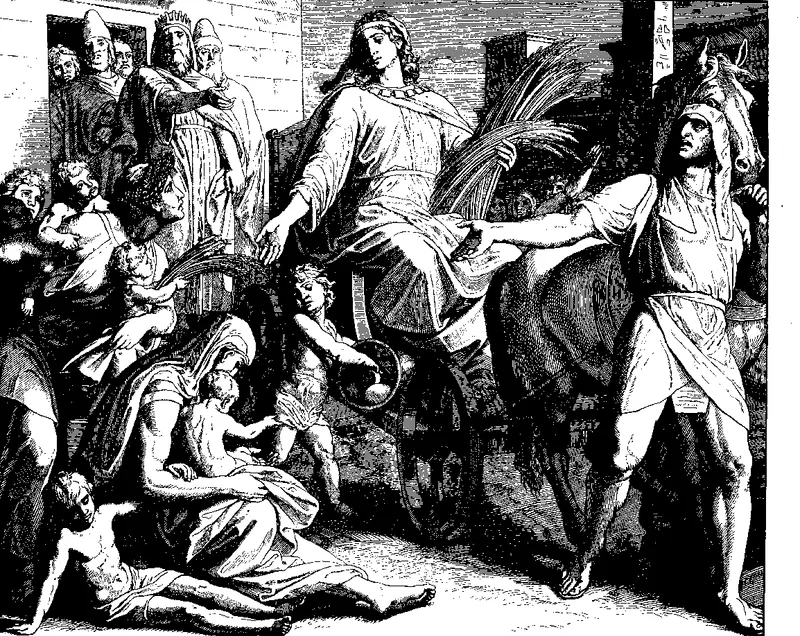
Esther 3:1-3Promoted Above the Princes
1After these things did king Ahasuerus promote Haman the son of Hammedatha the Agagite, and advanced him, and set his seat above all the princes that were with him. 2And all the king’s servants, that were in the king’s gate, bowed, and reverenced Haman: for the king had so commanded concerning him. But Mordecai bowed not, nor did him reverence. 3Then the king’s servants, which were in the king’s gate, said unto Mordecai, Why transgressest thou the king’s commandment?
Mordecai is a Benjamite - “son of Jair, the son of Shimei, the son of Kish, a Benjamite” (Esth. 2:5). The genealogy is not random1. Kish was the father of King Saul (1 Sam. 9:1). Mordecai is therefore from the same tribe - and arguably the same extended family - as the king who was given the chance to end the Amalekite line and didn't. The chapter sets the descendant of Saul face-to-face with the descendant of Agag five hundred years later.
Mordecai will not bow. The work that was left undone in 1 Samuel 15 is being handed back to a son of Kish for completion.
Esther 3:4-6Full of Wrath, Haman Widens the Target
4Now it came to pass, when they spake daily unto him, and he hearkened not unto them, that they told Haman, to see whether Mordecai’s matters would stand: for he had told them that he was a Jew. 5And when Haman saw that Mordecai bowed not, nor did him reverence, then was Haman full of wrath. 6And he thought scorn to lay hands on Mordecai alone; for they had shewed him the people of Mordecai: wherefore Haman sought to destroy all the Jews that were throughout the whole kingdom of Ahasuerus, even the people of Mordecai.
The text never tells us in so many words why Mordecai will not bow2. Jews regularly bowed to rulers in the ancient world (Gen. 23:7; 2 Sam. 14:33; 1 Kgs 1:23); refusing to bow to a man was not, in itself, a violation of any commandment. But bowing to this man - a descendant of Agag, an Amalekite, the chief representative of the people God had said He would utterly blot out - would be, for a Benjamite who knew his Bible, a betrayal his ancestors had already once committed.
The chapter does not explain. It just notes the refusal and then notes the only thing the courtiers needed to know to understand it: for he had told them that he was a Jew.
Esther 3:7The Lot Cast in Passover Month
7In the first month, that is, the month Nisan, in the twelfth year of king Ahasuerus, they cast Pur, that is, the lot, before Haman from day to day, and from month to month, to the twelfth month, that is, the month Adar.
The lot falls eleven months out - on the thirteenth day of Adar. The Chronicler-of-Esther does not say so explicitly, but the gap is the chapter's most providential detail. Haman could have decreed a slaughter for next week. Instead, the date Haman's system of divination produces happens to give God a full eleven months to arrange the answer - eleven months in which Esther will be summoned, the king will discover Mordecai's old service in the chronicles, Haman will build his gallows, and the entire plot will be reversed at a banquet in the queen's quarters.
The hidden God of Esther was already in the lap when Haman cast the lot.
Esther 3:8-11The Bribe and the Signet Ring
8And Haman said unto king Ahasuerus, There is a certain people scattered abroad and dispersed among the people in all the provinces of thy kingdom; and their laws are diverse from all people; neither keep they the king’s laws: therefore it is not for the king’s profit to suffer them. 9If it please the king, let it be written that they may be destroyed: and I will pay ten thousand talents of silver to the hands of those that have the charge of the business, to bring it into the king’s treasuries. 10And the king took his ring from his hand, and gave it unto Haman the son of Hammedatha the Agagite, the Jews’ enemy. 11And the king said unto Haman, The silver is given to thee, the people also, to do with them as it seemeth good to thee.
Haman's petition is a masterclass in genocidal rhetoric. He never names the Jews. He calls them a certain people - anonymous, undefined, easy to dehumanize. He describes them as scattered and dispersed - implying foreign, not rooted, not loyal. He says their laws are diverse - implying threatening, incompatible. He claims they do not keep the king's laws - a flat lie; the diaspora Jews of the Persian period were notoriously loyal subjects. He concludes with it is not for the king's profit to suffer them - reducing the question to a cost-benefit calculation.
Every step of the petition follows a pattern recognizable in every later attempt at the same crime: anonymize, foreignize, criminalize, monetize.
The bribe is staggering3. Ten thousand talents of silver is approximately 330 metric tons. Herodotus (3.95) reports that the total annual tribute of the entire Persian empire under Darius was about 14,560 Babylonian talents of silver. Haman's personal bribe is therefore roughly two-thirds of the empire's annual revenue. Where Haman would get that kind of money is not explained - but the answer becomes obvious at the end of v. 9: the plunder of murdered Jewish households.
He is offering the king a cut of the proceeds before the crime has been committed. The math discloses the motive. The math discloses a motive built around silver.
Notice what the king does not ask. He does not ask which people. He does not ask what they have done. He does not ask where they live or how many they are. He hands Haman his signet ring - the instrument by which royal decrees were sealed and made law - without inquiring into the identity of the people whose annihilation he has just authorized. The careless transfer of power into the hands of a man with personal grievances is the chapter's second great theme.
The system did not fail because the king was evil. It failed because the king did not ask.
Esther 3:12-15The Decree Goes Out; the City Reels
12Then were the king’s scribes called on the thirteenth day of the first month, and there was written according to all that Haman had commanded unto the king’s lieutenants, and to the governors that were over every province, and to the rulers of every people of every province according to the writing thereof, and to every people after their language; in the name of king Ahasuerus was it written, and sealed with the king’s ring. 13And the letters were sent by posts into all the king’s provinces, to destroy, to kill, and to cause to perish, all Jews, both young and old, little children and women, in one day, even upon the thirteenth day of the twelfth month, which is the month Adar, and to take the spoil of them for a prey. 14The copy of the writing for a commandment to be given in every province was published unto all people, that they should be ready against that day. 15The posts went out, being hastened by the king’s commandment, and the decree was given in Shushan the palace. And the king and Haman sat down to drink; but the city Shushan was perplexed.
The vocabulary of v. 13 is unsparing. The Hebrew piles up three verbs of destruction - lehashmid, laharog, ule'abbed: to annihilate, to slaughter, to make perish. And then the qualifying phrase: all Jews, both young and old, little children and women, in one day. Not just soldiers. Not just adult men. Not just resisters. Erasure of a people. The Chronicler-of-Esther refuses to dress the decree in any euphemism; he gives it the unfiltered language of genocide because the chapter knows what genocides actually say when they finally sign the page.
The date of the decree itself is poignant: the thirteenth day of the first month - Passover Eve. The same evening God's people are commanded by the Torah to begin slaughtering the Passover lamb in remembrance of their deliverance from Egypt, the empire's couriers begin riding out with a decree for their slaughter. The chapter does not point the irony out. It does not have to. The Jewish reader hearing the megillah of Esther read aloud on Purim feels the date as a stone in the chest.
Research trail
Sources & further study
These references support the historical, linguistic, manuscript, and contextual notes in this chapter. Scripture remains the primary text; external sources are provided so readers can inspect the research directly.
- Haman, Mordecai, and the Saul-Agag BackstorySBL background on the Amalekite-Israelite ancient enmity that frames Haman's confrontation with Mordecai as the next round of a generations-old conflict.
- Esther 3 · Hebrew + Jewish commentaryHebrew text with Rashi, Ibn Ezra, and Talmudic commentary on Haman's ancestry, Mordecai's refusal to bow, and the casting of pur in the month of Passover.
- The Persian Empire's Annual RevenueHerodotus 3.95 reports the total annual tribute of the Persian empire under Darius at roughly 14,560 Babylonian talents of silver. Haman's bribe of 10,000 talents is therefore roughly two-thirds of the empire's annual revenue - a fortune the chapter does not pause to explain.
- Exodus 17:14-16 · 1 Samuel 15 · Esther 3The intertextual line from God's declaration of war against Amalek in Exodus 17, through Saul's failure to kill Agag in 1 Samuel 15, to Haman the Agagite's confrontation with Mordecai the Benjamite in Esther 3.
Where this echoes in Scripture
Full of Wrath, Haman Widens the Target
- Exodus 17:14-16I will utterly put out the remembrance of Amalek from under heaven… the LORD will have war with Amalek from generation to generation.The original divine declaration of war that Esther 3 is the next chapter of.
- 1 Samuel 15:33Samuel hewed Agag in pieces before the LORD in Gilgal.The work Saul should have done - and Mordecai's family now picks up.
- Revelation 12:17And the dragon was wroth with the woman, and went to make war with the remnant of her seed.The chapter's scale, finally named.
The Lot Cast in Passover Month
- Proverbs 16:33The lot is cast into the lap; but the whole disposing thereof is of the LORD.The theological framework for everything that happens in the next nine chapters of Esther.
- Exodus 12:2This month shall be unto you the beginning of months: it shall be the first month of the year to you.The month Haman cast the lot - already God's month of deliverance.
- 1 Corinthians 5:7For even Christ our passover is sacrificed for us.The deepest fulfillment of Nisan - the month of every deliverance.
The Bribe and the Signet Ring
- Esther 8:2And the king took off his ring, which he had taken from Haman, and gave it unto Mordecai.The reversal already loaded into the chapter - the same ring, the opposite outcome.
- Proverbs 17:15He that justifieth the wicked, and he that condemneth the just, even they both are abomination to the LORD.The Bible on rulers who do not ask which people they are sentencing.
The Decree Goes Out; the City Reels
- Daniel 5:1, 5Belshazzar the king made a great feast… In the same hour came forth fingers of a man's hand, and wrote over against the candlestick.Another Persian-era king drinking while judgment is being written. Same pattern, different room.
- Luke 22:19-20This is my body, which is given for you: this do in remembrance of me… this cup is the new testament in my blood.The King whose drink at the table is the price of the city's redemption.