1 Samuel 15
People in this chapter
The test comes for every person who has been given authority or called to lead: Will you obey God fully, or will you obey God halfway? Will you do what you are told, or will you do what you are told while keeping something back for yourself?
Tap any highlighted phrase to jump to the commentary that unpacks it.
1 Samuel 15:1-3The Command: "Utterly Destroy All That They Have"
1Samuel also said unto Saul, The LORD sent me to anoint thee to be king over his people, over Israel: now therefore hearken thou unto the voice of the words of the LORD.
Samuel calls Saul back to first principles. "Hearken unto the voice of the words of the Lord" - the voice of God above every other. Samuel reminds Saul what made him king in the first place: it was the anointing of the Lord. And an anointed king owes obedience.123
2Thus saith the LORD of hosts, I remember that which Amalek did to Israel, how he laid wait for him in the way, when he came up from Egypt.
Amalek is a people Israel knew from the wilderness wanderings. They attacked Israel without mercy - the old and the weak, those who could not defend themselves (Exodus 17:8-16). Now, after forty years in the wilderness and forty years of peace under the judges, the command comes: it is time to settle that ancient debt. The Lord does not forget. And the Lord does not forget mercy withheld.
3Now go and smite Amalek, and utterly destroy all that they have, and spare them not; but slay both man and woman, infant and suckling, ox and sheep, camel and ass.
The words are plain and unambiguous: "utterly destroy." Everything. And Saul, to whom this command is given, is a king under covenant with the Lord. He is told to obey.
1 Samuel 15:4-9The Destruction - and the Sparing
4And Saul gathered the people together, and numbered them in Telaim, two hundred thousand footmen, and ten thousand men of Judah. 5And Saul came to a city of Amalek, and laid wait in the valley.
Saul musters the armies - two hundred thousand footmen and ten thousand men of Judah. He is thorough in his military preparations. He comes to the Amalekites with overwhelming force. So far, he does well.
6And Saul said unto the Kenites, Go, depart, get you down from among the Amalekites, lest I destroy you with them: for ye shewed kindness to all the children of Israel, when they came up out of Egypt. So the Kenites departed from among the Amalekites.
This is mercy shown rightly. The Kenites, a nomadic people, had shown kindness to Israel. Saul honors that debt. He calls to them to depart before he destroys Amalek. This is the kind of discernment a king should have - to distinguish between those who deserve judgment and those who have shown kindness. In this, Saul shows wisdom.
7And Saul smote the Amalekites from Havilah until thou comest to Shur, that is over against Egypt. 8And he took Agag the king of the Amalekites alive, and utterly destroyed all the people with the edge of the sword.
Saul does most of what the Lord commanded. He sweeps across the land from Havilah to Shur - from east to west, the whole of Amalek's territory. The people are destroyed utterly. But notice: "He took Agag the king of the Amalekites alive." The first small crack in obedience. The king is spared.
9But Saul and the people spared Agag, and the best of the sheep, and of the oxen, and of the fatlings, and the lambs, and all that was good, and would not utterly destroy them: but every thing that was vile and refuse, that they destroyed utterly.
And here is the full measure of the disobedience. Saul and the people spare not just Agag but the best of the flocks. The finest sheep, the best cattle, the finest lambs - all the good things - are spared. Only what is vile and refuse, what is of no value or use, is destroyed utterly. Saul has done most of the work. But he has done it with a reservation. He has kept something back.
1 Samuel 15:10-15"The People Spared the Best" - Blame and Self-Deception
10Then came the word of the LORD unto Samuel, saying, 11It repenteth me that I have set up Saul to be king: for he is turned back from following me, and hath not performed my commandments. And it grieved Samuel; and he cried unto the LORD all night.
The word here is nicham - to repent, to feel regret, to grieve over something. God grieves that Saul has turned back. And the word is spoken in sorrow. God anointed Saul. God saw his potential. And Saul has chosen a different path.
Samuel cries unto the Lord all night. He grieves. Samuel loved Saul. He anointed him. He believed in him. And now Samuel must watch him fall. It is this grief that makes Samuel's words, when they come, carry such weight.
12And when Samuel rose early to meet Saul in the morning, it was told Samuel, saying, Saul came to Carmel, and, behold, he set him up a place, and is gone about, and passed on, and gone down to Gilgal. 13And Samuel came to Saul: and Saul said unto him, Blessed be thou of the LORD: I have performed the commandment of the LORD.
Saul greets Samuel with a blessing - a pious greeting - and announces: "I have performed the commandment of the Lord." He says: "I have performed." And this is the lie Saul is telling himself. He believes, or wants to believe, that what he has done is obedience.
14And Samuel said, What meaneth then this bleating of the sheep in mine ears, and the lowing of the oxen which I hear?
Samuel hears what Saul cannot seem to hear: the bleating of sheep, the lowing of cattle. The animals Saul claimed to have destroyed are alive. The very sound of them is the sound of Saul's disobedience. And Samuel, with one question, calls it out.
15And Saul said, They have brought them from the Amalekites: for the people spared the best of the sheep and of the oxen, to sacrifice unto the LORD thy God; and the rest we have utterly destroyed.
Saul says: "They have brought them." "The people spared the best." He is passing the blame to those under him. But a king cannot hide behind his people's failures. And he cannot hide behind piety either. He dresses the disobedience in the language of sacrifice - "to sacrifice unto the Lord thy God" - as if the act of sparing the best animals somehow makes his disobedience into devotion. It does not.
1 Samuel 15:16-23"To Obey Is Better Than Sacrifice"
16Then Samuel said unto Saul, Stay, and I will tell thee what the LORD hath said to me this night. And he said unto him, Say on. 17And Samuel said, When thou wast little in thine own sight, wast thou not made the head of the tribes of Israel, and the LORD anointed thee king over Israel?
Samuel reminds Saul of who he was. Saul, when he was "little in thine own sight" - humble, not yet grasping for power - was chosen by God and anointed king. The implication is clear: Saul has changed. He was once small in his own eyes. Now he is great. And it is this change - this growing in his own eyes, this growing in his own estimation - that has led him to think he can negotiate with God's command.
18And the LORD sent thee on a journey, and said, Go and utterly destroy the sinners the Amalekites, and fight against them until they be consumed. 19Wherefore then didst thou not obey the voice of the LORD, but didst fly upon the spoil, and didst evil in the sight of the LORD?
The image is striking: Saul "flew upon the spoil" - he rushed at the plunder like a predator rushing at prey. His eyes saw the best sheep, the best cattle, and his will went after them. His eye went to the opportunity, past the command. And that choice - to let the eye for profit override the ear for God - is what Samuel identifies as the core of Saul's sin.
20And Saul said unto Samuel, Yea, I have obeyed the voice of the LORD, and have gone the way which the LORD sent me, and have brought Agag the king of Amalek, and have utterly destroyed the Amalekites. 21But the people took of the spoil, sheep and oxen, the chief of the things which should have been utterly destroyed, to sacrifice unto the LORD thy God in Gilgal.
Saul doubles down. He insists again: "I have obeyed." He redirects the blame: "the people took." And he wraps it all in piety: "to sacrifice unto the Lord thy God." This is the self-deception of a man who is losing ground, who knows in his heart that he has not obeyed, and is therefore clinging harder to the lie.
22And Samuel said, Hath the LORD as great delight in burnt offerings and sacrifices, as in obeying the voice of the LORD? Behold, to obey is better than sacrifice, and to hearken than the fat of rams.
23For rebellion is as the sin of witchcraft, and stubbornness is as iniquity and idolatry. Because thou hast rejected the word of the LORD, he hath also rejected thee from being king.
Stubbornness - the refusal to bend, to listen, to obey - is equated with idolatry. Stubbornness is a form of idolatry: the assertion of one's own will, one's own judgment, as more final than God's word. It is a kind of self-worship. And Samuel names it what it is.
1 Samuel 15:24-31The Torn Mantle - A Kingdom Divided
24And Saul said unto Samuel, I have sinned: for I have transgressed the commandment of the LORD, and thy words: because I feared the people, and obeyed their voice.
Now Saul confesses. "I have sinned." But listen to the reason he gives: "I feared the people, and obeyed their voice." He is saying: "I yielded to the people. I could not resist them." He is still avoiding full responsibility. And the confession, though real in one sense, is incomplete. He names the people's will, not his own.
25Now therefore, I pray thee, pardon my sin, and turn again with me, that I may worship the LORD. 26And Samuel said unto Saul, I will not return with thee: for thou hast rejected the word of the LORD, and the LORD hath rejected thee from being king over Israel.
Samuel's answer is final. There is no negotiation. There is no forgiveness offered here, in this moment. Samuel will not return with Saul to worship. The door has closed. And Samuel speaks a judgment that cannot be undone: "The Lord hath rejected thee from being king."
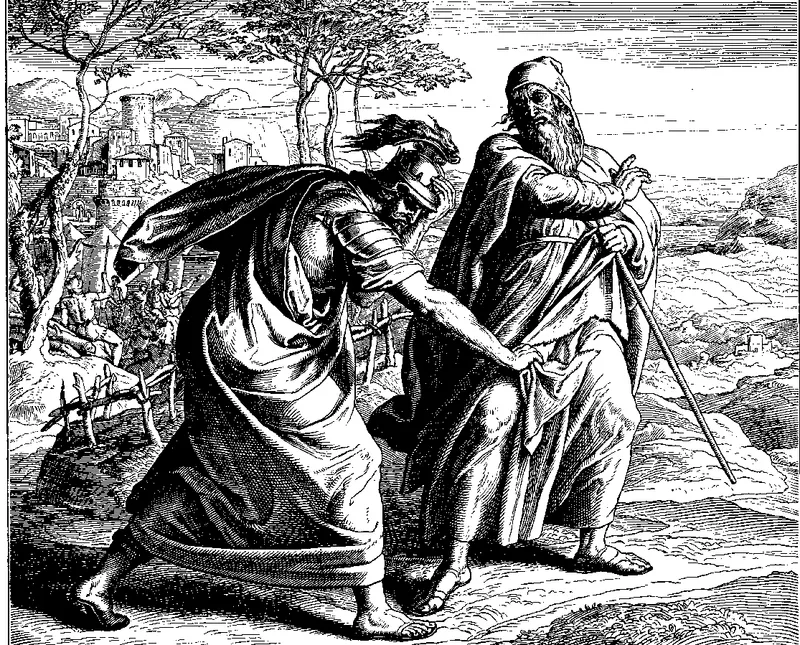
27And as Samuel turned about to go away, he laid hold upon the skirt of his mantle, and it rent. 28And Samuel said unto him, The LORD hath rent the kingdom of Israel from thee this day, and hath given it to a neighbour of thine, that is better than thou.
The torn mantle is a sign-act - a prophecy acted out. Saul grasps Samuel's garment in desperation, and it tears. And Samuel, seeing the torn cloth in his hand, speaks: The kingdom is torn from Saul's hand. The physical sign matches the spiritual reality. What was held is now divided. What was promised is now revoked. And it is done.
29And also the Strength of Israel will not lie nor repent: for he is not a man, that he should repent.
30Then he said, I have sinned: yet honour me now, I pray thee, before the elders of my people, and before Israel, and turn again with me, that I may worship the LORD thy God. 31So Samuel turned again after Saul; and Saul worshipped the LORD.
Saul asks again for Samuel to turn back. And this time his plea is different: "honour me now, I pray thee, before the elders of my people." He is no longer asking for forgiveness in the spiritual sense. He is asking to be honored in front of the people. He wants the appearance of obedience and blessing, even though the reality has changed. And Samuel, with great sorrow, does turn back and worship with him. But the kingdom is not restored. The sentence stands.
1 Samuel 15:32-35The Price of Delay - Agag, and Samuel's Grief
32Then said Samuel, Bring ye hither to me Agag the king of the Amalekites. And Agag came unto him delicately. And Agag said, Surely the bitterness of death is past.
Agag comes before Samuel "delicately" - perhaps fearing death, but hoping he might be spared. He has heard Saul spare him, and now he dares hope that he will live. "Surely the bitterness of death is past," he says - I am safe. The command was never revoked - only delayed.
33And Samuel said, As thy sword hath made women childless, so shall thy mother be childless among women. And Samuel hewed Agag in pieces before the LORD in Gilgal.
Samuel executes the command that Saul refused to execute. He does it in obedience. The command was to utterly destroy Amalek, and Samuel fulfills it. But Agag dies only because Saul delayed. The word that should have been executed at the beginning is executed at the end. The disobedience has made the cost higher.
34Then Samuel went to Ramah; and Saul went up to his house to Gibeah of Saul. 35And Samuel came no more to see Saul until the day of his death: nevertheless Samuel mourned for Saul: and the LORD repented that he had made Saul king over Israel.
Samuel and Saul part ways. Samuel comes no more to see Saul until the day of his death. The relationship is broken. Saul has chosen disobedience, and a prophet cannot walk alongside a king who will not obey the Lord.
But Samuel mourns for Saul. This is the note the chapter ends on: grief. Samuel loved Saul. He believed in him. And he grieves that Saul turned away. The sorrow in this line is the sorrow of watching someone you believed in fail. It is the sorrow of a prophet who must deliver judgment to someone he loves.
Research trail
Sources & further study
These references support the historical, linguistic, manuscript, and contextual notes in this chapter. Scripture remains the primary text; external sources are provided so readers can inspect the research directly.