Genesis 37
People in this chapter
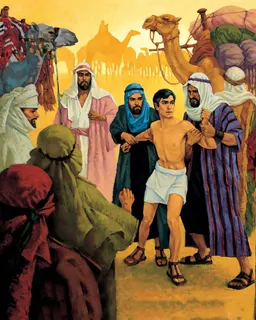
Genesis 37 opens a new arc - the story of Joseph, the favorite son of Jacob, and the fourteen-chapter journey that will reshape Israel itself. It begins with a coat, two dreams, and a hatred so fierce that brothers become merchants of flesh. This is where the text shows you human evil without softening it: the cruelty of the rejected, the casual nature of slavery, the absolute lies told to a father about his son. But it is also where the Bible begins to hide its savior.
Tap any highlighted phrase to jump to the commentary that unpacks it.
Genesis 37:1-4The Favorite Son
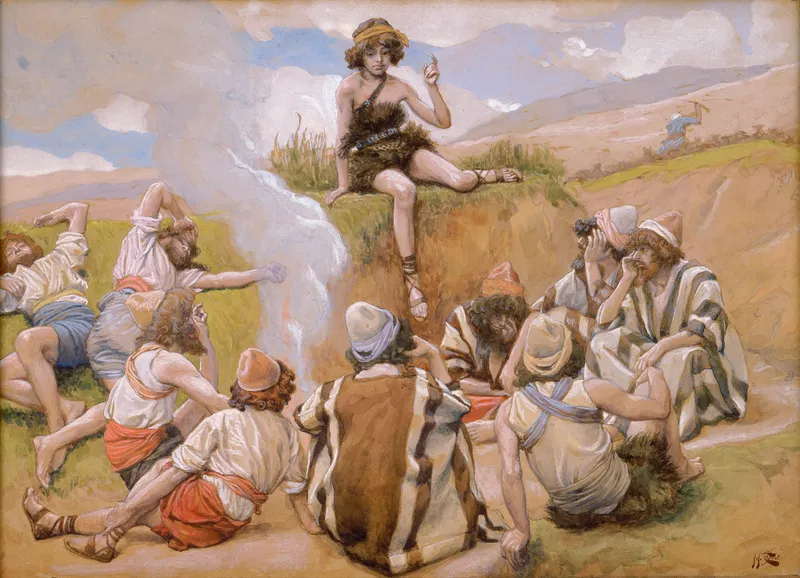
1And Jacob dwelt in the land wherein his father was a stranger, in the land of Canaan. 2These are the generations of Jacob. Joseph, being seventeen years old, was feeding the flock with his brethren; and the lad was with the sons of Bilhah, and with the sons of Zilpah, his father’s wives: and Joseph brought unto his father their evil report. 3Now Israel loved Joseph more than all his children, because he was the son of his old age: and he made him a coat of many colours. 4And when his brethren saw that their father loved him more than all his brethren, they hated him, and could not speak peaceably unto him.
Joseph is seventeen. Not yet a man, still a boy with older brothers whose respect he has not earned. He is keeping sheep with the half-brothers - the sons of Bilhah and Zilpah, Jacob's concubines - and something goes wrong. The text does not say Joseph caused the trouble; it says he brought an evil report to his father. He tells on them.
A single verse, and Joseph's doom is set. A small choice does it: the teenager who goes home and reports his brothers. The brothers will hate him not because of the report itself, but because of what it means. 1 Someone has run to their father. Someone is the favorite.
Joseph is born late. Rachel, Jacob's beloved wife, was barren for years, and Joseph is the first child God gives her. Jacob is in his nineties when Joseph arrives. 2 The boy is literally the fruit of Jacob's love for a dead woman - and Jacob pours that entire ache into his youngest son.
The Hebrew word for “hated” (sane) is absolute. It is not resentment or jealousy - it is hatred. And they could not speak to him in peace. Every conversation was a minefield. The coat, visible every day, was a reminder to ten brothers that their father loved them less.
Genesis 37:5-11The Dreams
5And Joseph dreamed a dream, and he told it his brethren: and they hated him yet the more. 6And he said unto them, Hear, I pray you, this dream which I have dreamed: 7For, behold, we were binding sheaves in the field, and, lo, my sheaf arose, and also stood upright; and, behold, your sheaves stood round about, and made obeisance to my sheaf.
Joseph dreams and speaks openly. His brothers hear arrogance and see threat. Sitting by a well, they plot his death.
8And his brethren said to him, Shalt thou indeed reign over us? or shalt thou indeed have dominion over us? And they hated him yet the more for his dreams, and for his words. 9And he dreamed yet another dream, and told it his brethren, and said, Behold, I have dreamed a dream more; and, behold, the sun and the moon and the eleven stars made obeisance to me. 10And he told it to his father, and to his brethren: and his father rebuked him, and said unto him, What is this dream that thou hast dreamed? Shall I and thy mother and thy brethren indeed come to bow down ourselves to thee to the earth? 11And his brethren envied him; but his father observed the saying.
The text does not moralize Joseph. It does not say he was proud or that he deserved to be hated. It simply names what happened: he dreamed and told the dream, and the hatred grew. The brothers' response is the subject of the chapter, not Joseph's sin.
The brothers understand the dream immediately. In the language of Genesis, “dominion” means rulership - the same word used of humans ruling over creation in Genesis 1:28. The dream is not subtle. A seventeen-year-old boy is claiming authority over men in their thirties and forties. But the text does not say he invented the dream or was ambitious. It says he had it. And he told it.
Jacob rebukes his son for the second dream because it offends him directly. The sun and moon are symbols for mother and father. Jacob hears his youngest son claiming his mother and father will bow to him, and he says so. But the text notes: his father observed the saying. He does not dismiss it. He holds it.
Genesis 37:12-18Sent to Find His Brothers
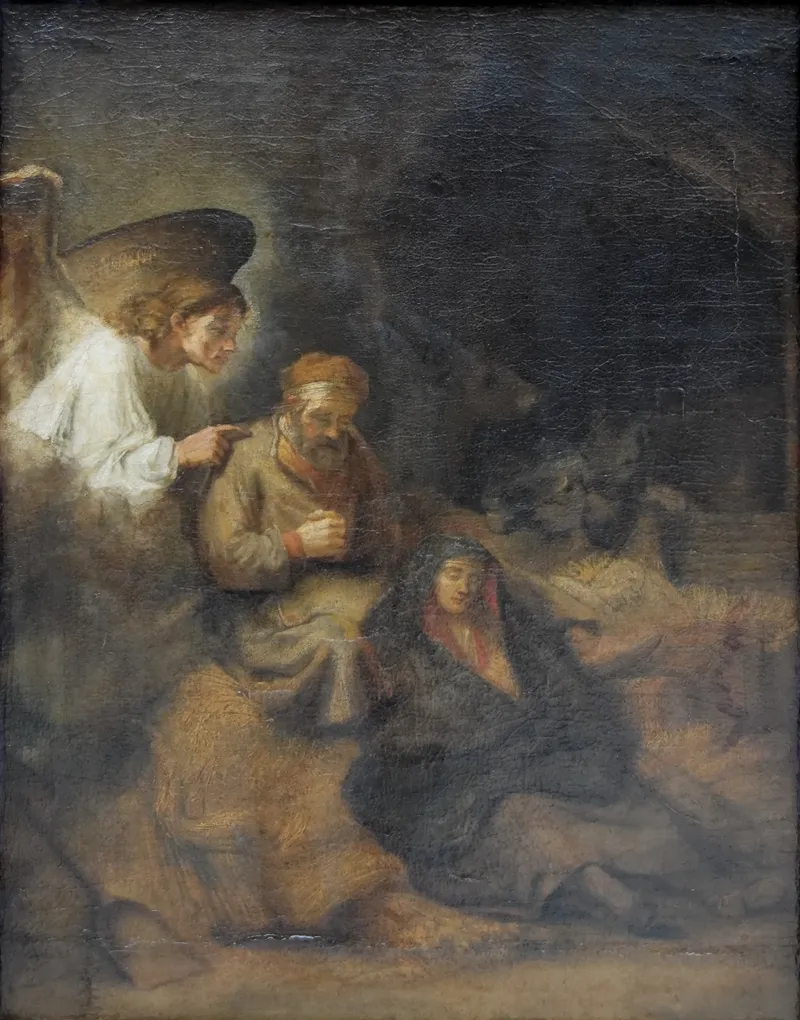
12And his brethren went to feed their father’s flock in Shechem. 13And Israel said unto Joseph, Do not thy brethren feed the flock in Shechem? come, and I will send thee unto them. And he said to him, Here am I. 14And he said to him, Go, I pray thee, see whether it be well with thy brethren, and well with the flocks; and bring me word again. So he sent him out of the vale of Hebron, and he came to Shechem.
They tear off his coat and drop him into a dry well. But profit matters more than rage--they sell him to traders heading to Egypt.
15And a certain man found him, and, behold, he was wandering in the field: and the man asked him, saying, What seekest thou? 16And he said, I seek my brethren: tell me, I pray thee, where they feed their flocks. 17And the man said, They are departed hence; for I heard them say, Let us go to Dothan. And Joseph went after his brethren, and found them in Dothan. 18And when they saw him afar off, even before he came near unto them, they conspired against him to slay him.
Shechem is where Jacob's daughter Dinah was violated (Genesis 34). It is a place of shame for the family. The brothers have moved the flocks to Dothan, which is twelve miles away - at the edge of the wild country. They are as far as they can be while still technically working.
A stranger stops the boy and asks a simple question: What are you looking for? The man is kind - he does not mock the coat or the long journey. He simply points Joseph toward his brothers. All he does is answer a question. And it seals Joseph's fate.
Joseph does not hesitate. His father sends him; he goes. He walks twelve miles through the wilderness looking for men who hate him. The text never says he is afraid. It just says he went. The obedience is absolute.
They see him coming from far away - the coat is visible across the open field. And in that moment, before he arrives, they decide. It is cold premeditation. While he is still yards away, walking toward them in the coat his father made him, they agree: let us kill him. The deliberation is what makes it terrible.
Genesis 37:19-24Reuben Intervenes
19And they said one to another, Behold, this dreamer cometh. 20Come now therefore, and let us slay him, and cast him into some pit, and we will say, Some evil beast hath devoured him: and we shall see what will become of his dreams. 21And Reuben heard it, and he delivered him out of their hands; and said, Let us not kill him. 22And Reuben said unto them, Shed no blood, but cast him into this pit that is in the wilderness, and lay no hand upon him; that he might rid him out of their hands, to deliver him to his father again. 23And it came to pass, when Joseph was come unto his brethren, that they stript Joseph out of his coat, his coat of many colours that was on him; 24And they took him, and cast him into a pit: and the pit was empty, there was no water in it.
They call him “this dreamer” - the word is almost mocking. And their plan is cynical: kill him, throw him away, lie to their father, and “we shall see what will become of his dreams.” They are trying to silence the prophetic voice they believe has wronged them.
Reuben is the oldest. He has lost his inheritance already - he slept with Jacob's wife and forfeited the firstborn's blessing (Genesis 35:22). He has nothing left to lose but his conscience. He cannot stop his brothers from hating Joseph, but he can stop them from murdering him. He does not sound heroic. He sounds like a man trying to minimize damage. But he acts.
The coat comes off. The thing that marked him as favored, the visible sign of Jacob's love, is taken and cast aside. They leave him in the darkness with nothing - no clothes, no name, no station. What Jacob gave him in one instant, his brothers strip away in the next.
Genesis 37:25-28Sold for Twenty Pieces
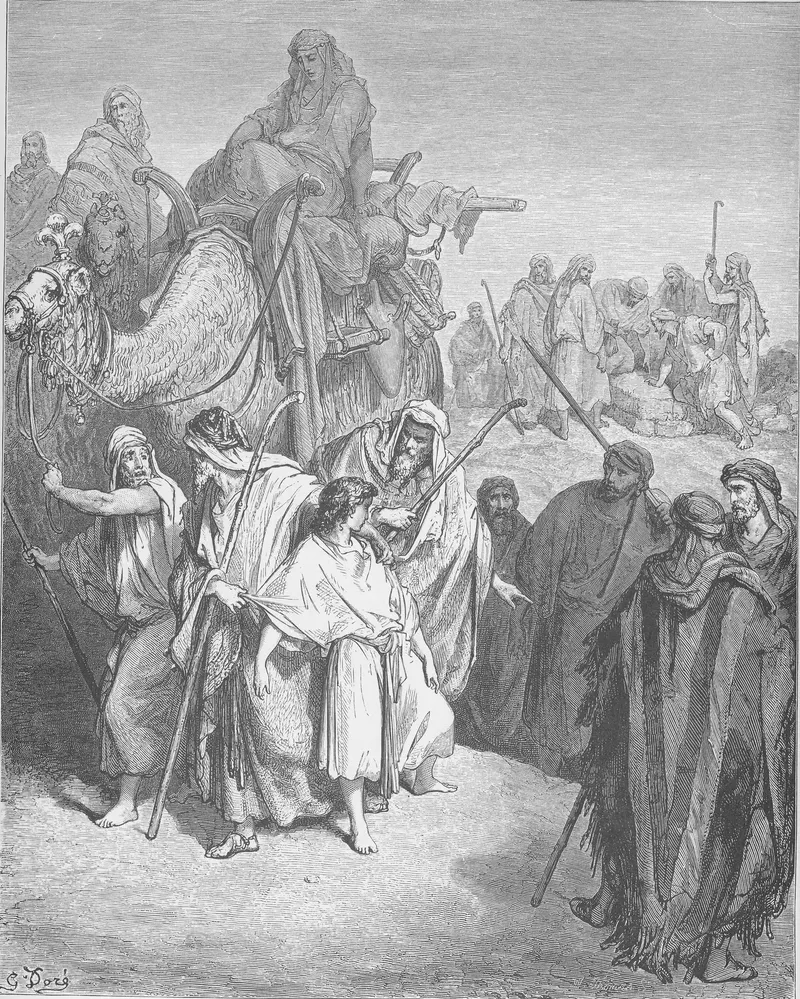
25And they sat down to eat bread: and they lifted up their eyes and looked, and, behold, a company of Ishmeelites came from Gilead with their camels bearing spicery and balm and myrrh, going to carry it down to Egypt. 26And Judah said unto his brethren, What profit is it if we slay our brother, and conceal his blood? 27Come, and let us sell him to the Ishmeelites, and let not our hand be upon him; for he is our brother and our flesh. And his brethren were content. 28Then there passed by Midianites merchantmen; and they drew and lifted up Joseph out of the pit, and sold Joseph to the Ishmeelites for twenty pieces of silver: and they brought Joseph into Egypt.
The timing is almost too perfect. While they are eating - sitting and resting after the crime - merchants appear. Ishmaelites, descendants of Abraham's son. They are bound for Egypt. Centuries later, this route will be well-traveled. For now, it looks like fate.
Judah's voice shifts the story. He is looking to profit from Joseph rather than murder him. What profit is it if we slay him? The math is simple: a corpse is worth nothing. A slave is worth silver. And slavery in Egypt at least gets the brothers out of the conspiracy of murder. They can go home and say he disappeared. They are not killers. They are traders.
Reuben is not present when the choice is made. Later, he will return to the pit, find Joseph gone, and tear his clothes in grief (verse 29). He stopped them from murdering their brother - and while his back was turned, they sold him. The refusal to do one evil thing does not protect against the next one.
Genesis 37:29-36The Lie
29And Reuben returned unto the pit; and, behold, Joseph was not in the pit; and he rent his clothes. 30And he returned unto his brethren, and said, The child is not; and I, whither shall I go? 31And they took Joseph’s coat, and killed a kid of the goats, and dipped the coat in the blood; 32And they sent the coat of many colours, and they brought it to their father; and said, This have we found: know now whether it be thy son’s coat or no.
Joseph disappears to Egypt, but the narrative cuts away. Suddenly, we turn to Judah--his path, his failures, his own blind moment of deception.
33And he knew it, and said, It is my son’s coat; an evil beast hath devoured him; Joseph is without doubt rent in pieces. 34And Jacob rent his clothes, and put sackcloth upon his loins, and mourned for his son many days. 35And all his sons and all his daughters rose up to comfort him; but he refused to be comforted; and he said, For I will go down into the grave unto my son mourning. Thus his father wept for him. 36And the Midianites sold him into Egypt unto Potiphar, an officer of Pharaoh’s, and captain of the guard.
Reuben comes back to the pit and finds it empty. His plan has failed: the brothers moved faster, sold Joseph in his absence, and covered it perfectly. He tears his clothes in genuine grief. And then he has to go tell the others he was caught.
The lie is flawless. They use Joseph's own coat - the very thing that marked him as favored. They dip it in goat's blood. And they present it to Jacob as if they found it, asking: Is this your son's? The cruelty is exquisite. They know. Jacob will know. And there is nothing he can do but die inside, one day at a time.
Jacob does not ask questions. He sees the coat and believes it. The man who loved Joseph most is the one who grieves most deeply. He tears his clothes, puts on sackcloth - the garments of the bereaved - and mourns. Not for a day. For many days. The text returns to this later: he refused to be comforted. His youngest son is gone, and he will never believe otherwise.
Research trail
Sources & further study
These references support the historical, linguistic, manuscript, and contextual notes in this chapter. Scripture remains the primary text; external sources are provided so readers can inspect the research directly.