2 Kings 2
People in this chapter
Elijah's time has come. The Lord is about to take him to heaven, and he knows it. But Elisha, his apprentice and heir, will not let him go. Three times Elijah tells Elisha to stay behind - at Gilgal, at Bethel, at Jericho. Three times Elisha refuses. "As the Lord liveth, and as thy soul liveth, I will not leave thee." The bond between master and student is unbreakable.
Tap any highlighted phrase to jump to the commentary that unpacks it.
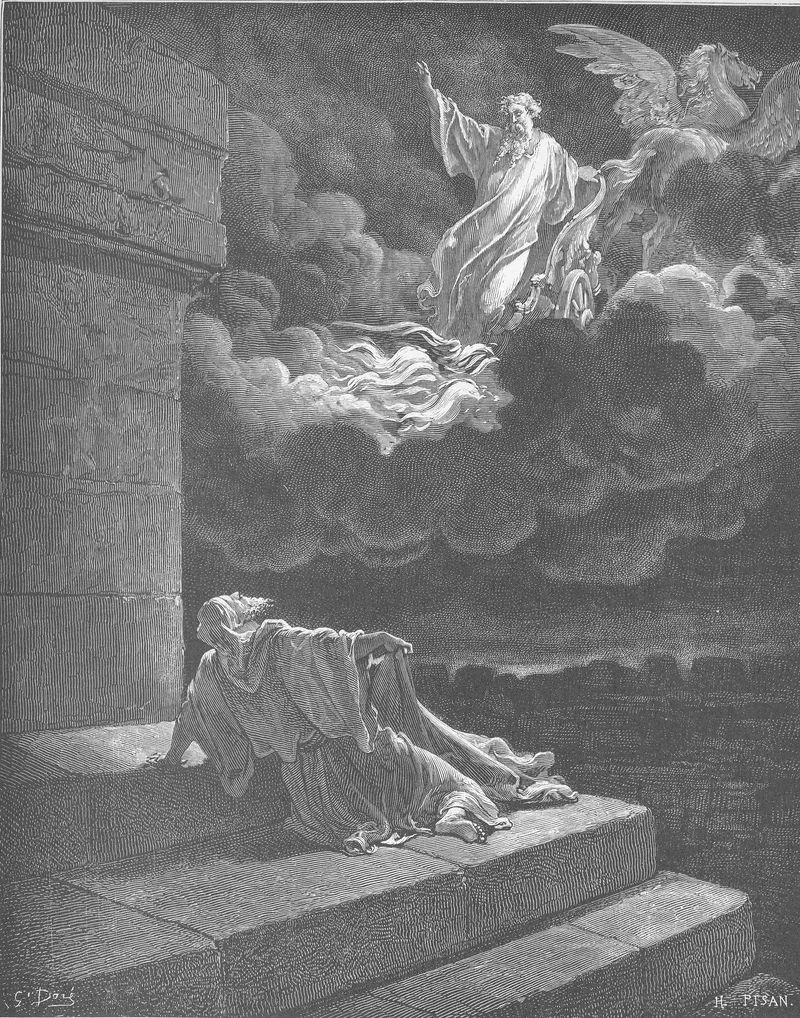
2 Kings 2:1-3Bethel: The Prophets Already Know
1And it came to pass, when the LORD would take up Elijah into heaven by a whirlwind, that Elijah went with Elisha from Gilgal. 2And Elijah said unto Elisha, Tarry here, I pray thee; for the LORD hath sent me to Bethel. And Elisha said unto him, As the LORD liveth, and as thy soul liveth, I will not leave thee. So they went down to Bethel. 3And the sons of the prophets that were at Bethel came forth to Elisha, and said unto him, Knowest thou that the LORD will take away thy master from thy head to day? And he said, Yea, I know it; hold ye your peace.
The narrative opens with the knowledge that Elijah will be taken up - through a whirlwind, not through death. In all of Scripture, only two people leave the earth without dying: Enoch in Genesis 5, and now Elijah. This is a translation, a receiving of the living into heaven. The Greek word used in the Septuagint for Enoch's translation is used by the writer to Hebrews when affirming that "Enoch was not; for God took him" (Hebrews 11:5). To be taken up is to be received by God, to be carried into heaven while still living12.
2 Kings 2:4-6The Journey to Jordan - A Refusal That Will Not Break
4And Elijah said unto him, Elisha, tarry here, I pray thee; for the LORD hath sent me to Jericho. And he said, As the LORD liveth, and as thy soul liveth, I will not leave thee. So they came to Jericho. 5And the sons of the prophets that were at Jericho came to Elisha, and said unto him, Knowest thou that the LORD will take away thy master from thy head to day? And he answered, Yea, I know it; hold ye your peace. 6And Elijah said unto him, Tarry, I pray thee, here; for the LORD hath sent me to Jordan. And he said, As the LORD liveth, and as thy soul liveth, I will not leave thee. And they two went on.
Elijah tells Elisha to stay behind - not once, but three times. At Gilgal, at Bethel, at Jericho. And three times Elisha refuses with a solemn oath: "As the Lord liveth, and as thy soul liveth, I will not leave thee." It is covenantal language. Elisha is clinging because he knows that something is being transferred - the prophetic mantle, the authority, the spirit that empowered his master. To leave would be to miss the inheritance3.
At both Bethel and Jericho, the sons of the prophets greet them with the same knowledge: "The Lord will take away thy master from thy head today." This is known, anticipated, prepared for - no secret announcement. Elisha's answer is quietly authoritative: "Yea, I know it; hold ye your peace." His focus is entirely on what is about to happen.
2 Kings 2:7-10The Mantle and the Double Portion
7And fifty men of the sons of the prophets went, and stood to view afar off: and they two stood by Jordan. 8And Elijah took his mantle, and wrapped it together, and smote the waters, and they were divided hither and thither, so that they two went over on dry ground. 9And it came to pass, when they were gone over, that Elijah said unto Elisha, Ask what I shall do for thee, before I be taken away from thee. And Elisha said, I pray thee, let a double portion of thy spirit be upon me. 10And he said, Thou hast asked a hard thing: nevertheless, if thou see me when I am taken from thee, it shall be so unto thee; but if not, it shall not be so.
Before Elijah ascends, he performs one final act as the leading prophet of Israel: he parts the Jordan. The waters divide, and they cross on dry ground. This is not the first time the Lord has divided water for His people - it echoes the Red Sea crossing, the initial entry into Canaan. By this sign, Elijah confirms that the hand of the Lord is with him to the very end.
Elijah's response is striking: "Thou hast asked a hard thing." It is hard because it is precisely what cannot be granted by the will of a man alone - not even by Elijah. The Spirit of the Lord works through whom He chooses. But Elijah then adds a condition: "If thou see me when I am taken from thee, it shall be so unto thee; but if not, it shall not be so." Elisha must witness the translation. He must see with his own eyes that the prophetic mantle is real, that it belongs to the Lord, not to the man. Only then can it pass to him.
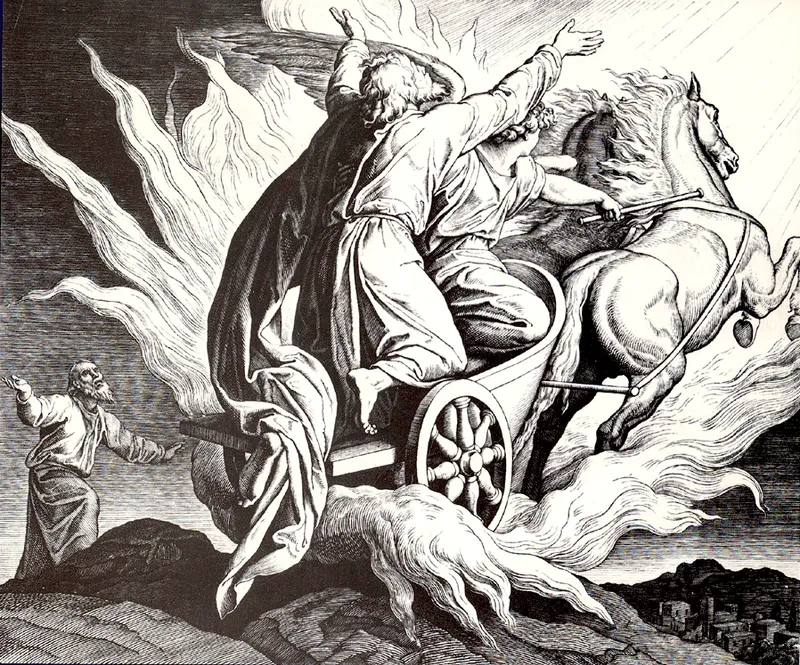
2 Kings 2:11-14The Chariot of Fire - The Office Confirmed, The Mantle Passes
11And it came to pass, as they still went on, and talked, that, behold, there appeared a chariot of fire, and horses of fire, and parted them both asunder; and Elijah went up by a whirlwind into heaven. 12And Elisha saw it, and he cried, My father, my father, the chariot of Israel, and the horsemen thereof. And he saw him no more: and he took hold of his own clothes, and rent them in two pieces. 13He took up also the mantle of Elijah that fell from him, and went back, and stood by the bank of Jordan; 14And he took the mantle of Elijah that fell from him, and smote the waters, and said, Where is the LORD God of Elijah? and when he also had smitten the waters, they parted hither and thither: and Elisha went over.
The appearance of the chariot of fire is sudden, dramatic, and terminal. It does not come as a gentle sign. It comes as a parting - "parted them both asunder." Elijah is taken. The separation is total. And in that moment of cosmic drama, the prophetic succession is sealed. Elisha does not follow. He does not try to hold on. He sees, he grieves, he takes up the mantle that falls, and he turns to do the work.
Elisha cries out, "My father, my father, the chariot of Israel, and the horsemen thereof!" The title "my father" is a title of honor and spiritual lineage. Elijah is not his biological father but his spiritual one. And his cry includes the phrase "the chariot of Israel, and the horsemen thereof" - a phrase that in later tradition comes to refer to the prophets themselves, the spiritual defenders and guides of Israel. In losing Elijah, Elisha feels that Israel has lost a defender. The nation is now left without its prophet.
Elisha tears his clothes - the sign of deepest grief. He has witnessed the translation. He has seen the office leave the earth. And now, in the next moment, he must step into what has been left for him. The tearing is acknowledgment of the weight of what he has inherited.
Then comes the test. Elisha strikes the waters with the mantle of Elijah, and cries out, "Where is the Lord God of Elijah?" The question is both declaration and prayer: "Where is He? Let Him show Himself." And the waters divide. The mantle works because the office is real, the Lord is with it, and the succession is confirmed.
2 Kings 2:15-22Jericho's Bitter Waters Made Sweet
15And when the sons of the prophets which were to view at Jericho saw him, they said, The spirit of Elijah doth rest on Elisha. And they came to meet him, and bowed themselves to the ground before him. 16And they said unto him, Behold now, there be with thy servants fifty strong men; let them go, we pray thee, and seek thy master: lest peradventure the Spirit of the LORD hath taken him up, and cast him upon some mountain, or into some valley. And he said, Ye shall not send. 17And when they urged him till he was ashamed, he said, Send. They sent therefore fifty men; and they sought three days, but found him not. 18And when they came again to him, (for he tarried at Jericho,) he said unto them, Did I not say unto you, Go not?
The prophets at Jericho see Elisha and declare that the spirit of Elijah now rests on him, and they bow before him. Yet they press to send fifty strong men to search the hills and valleys for Elijah, and Elisha at last relents. After three days of searching they return empty-handed, and he reminds them that he had told them not to go.
19And the men of the city said unto Elisha, Behold, I pray thee, the situation of this city is pleasant, as my lord seeth: but the water is naught, and the ground barren. 20And he said, Bring me a new cruse, and put salt therein. And they brought it to him. 21And he went forth unto the spring of the waters, and cast the salt in there, and said, Thus saith the LORD, I have healed these waters; there shall not be from thence any more death or barren land. 22So the waters were healed unto this day, according to the saying of Elisha which he spake.
The first confirmation comes from the sons of the prophets: "The spirit of Elijah doth rest on Elisha." They see it. They know it. The mantle has descended. But Elisha does not accept their praise or act upon it. When they ask to search for Elijah, thinking perhaps the Spirit has taken him to a mountain or valley, Elisha refuses. He knows what happened. He will not allow the prophetic energy to be wasted on searching for the past. The work ahead demands attention.
Elisha's first miracle is a quiet one. He heals the waters of Jericho. The city is pleasant in situation, but the water is poisoned, barren - bringing death to the land. This is precisely the situation when Elisha becomes the leading prophet of Israel: a land that looks good but is slowly dying from corruption at its source.
The healing is done with salt in a new cruse. Salt is a preservative, a sign of covenant, a sign of the Lord's favor ("Ye are the salt of the earth"). A new cruse - new vessel, unblemished - suggests something that has never been used for unclean purposes. The combination of salt, newness, and the word of the Lord produces healing. This is the power of divine speech.
The narrative closes with a remarkable statement: "So the waters were healed unto this day, according to the saying of Elisha which he spake." This suggests that the healing persisted, that the waters of Jericho continued to be pure and life-giving in the time when this account was written. The sign of Elisha's authority was not a one-time marvel but a permanent transformation. The word spoken by the prophet endured.
2 Kings 2:23-25The Youths and the Bears - The Prophet's Authority Defended
23And he went up from thence unto Bethel: and as he was going up by the way, there came forth little children out of the city, and mocked him, and said unto him, Go up, thou bald head; go up, thou bald head. 24And he turned back, and looked on them, and cursed them in the name of the LORD. And there came forth two she bears out of the wood, and tare forty and two children of them. 25And he went from thence to mount Carmel, and from thence he returned to Samaria.
Bethel is not a neutral location. It was once a place where Jacob met the Lord at the ladder (Genesis 28). But by the time of Elisha, Bethel has become a center of idolatry - Jeroboam I set up a golden calf there to keep Israel from returning to Jerusalem for worship (1 Kings 12:29). The mockery of Elisha at Bethel is therefore not merely personal disrespect. It is a deliberate act of rebellion against YHWH and His prophet, in a city that has already turned away from true worship.
Elisha does not respond to personal insult by shaming them or sending them away. Instead, he turns and curses them in the name of the Lord. The judgment that follows - two she bears emerging from the wood and killing forty-two of them - is severe and shocking to modern readers. But it serves a critical function in the narrative: it establishes that the prophetic office is real, that it comes from God, and that those who willfully mock it face judgment. The authority cannot be undermined through ridicule. The name of the Lord defends it.
This passage is deeply troubling to modern sensibilities, and it should be. It represents a hard edge of prophetic authority: those who willfully reject and mock the prophet of the Lord face judgment. This is not a pattern for behavior - it is a historical narrative about the cost of rebellion in Israel. Elisha does not go seeking trouble. The youths come out of the city to mock him deliberately. The judgment falls not because the prophet is thin-skinned or easily offended, but because to mock the Lord's prophet is to mock the Lord Himself. And in a covenant people, that carries consequences.
Research trail
Sources & further study
These references support the historical, linguistic, manuscript, and contextual notes in this chapter. Scripture remains the primary text; external sources are provided so readers can inspect the research directly.
- 2 Kings 2 - Hebrew + classical Jewish commentaryThe Hebrew text of Elijah's ascension by chariot of fire and Elisha's double portion.
- Elijah's Translation ↔ Christ's AscensionCross-references showing how Elijah's ascension prefigures Christ and informs Acts 1.
- 2 Kings 2 - Hebrew + classical Jewish commentaryThe Hebrew text of 2 Kings 2 alongside Rashi, Ibn Ezra, and other classical commentators.