2 Samuel 2
People in this chapter
Saul is dead. David has been anointed. But the kingdom is not yet united. Saul's son Ish-bosheth still lives, and the northern tribes have rallied behind him. Now we watch what happens when a nation divides against itself - when two kings claim the same throne, and the armies that follow them must meet.
Tap any highlighted phrase to jump to the commentary that unpacks it.
2 Samuel 2:1-7David Inquires and Is Anointed
1And it came to pass after this, that David enquired of the LORD, saying, Shall I go up into any of the cities of Judah? And the LORD said unto him, Go up. And David said, Whither shall I go up? And he said, Unto Hebron.
David does not move without asking. Even in a moment of triumph, even when the way seems clear, he pauses to inquire of the Lord. The pattern is set: before any major step, David asks. He seeks guidance before he acts. This is the mark of a man who understands that a kingdom is not built by human strength alone.123
2So David went up thither, and his two wives also, Ahinoam the Jezreelitess, and Abigail Nabal’s wife the Carmelite. 3And his men that were with him did David bring up, every man with his household: and they dwelt in the cities of Hebron.
David brings everyone with him - his wives, his men, their households. He is establishing himself as a king must: with his people around him, with families, with a settled place. Hebron will be his capital in the south.
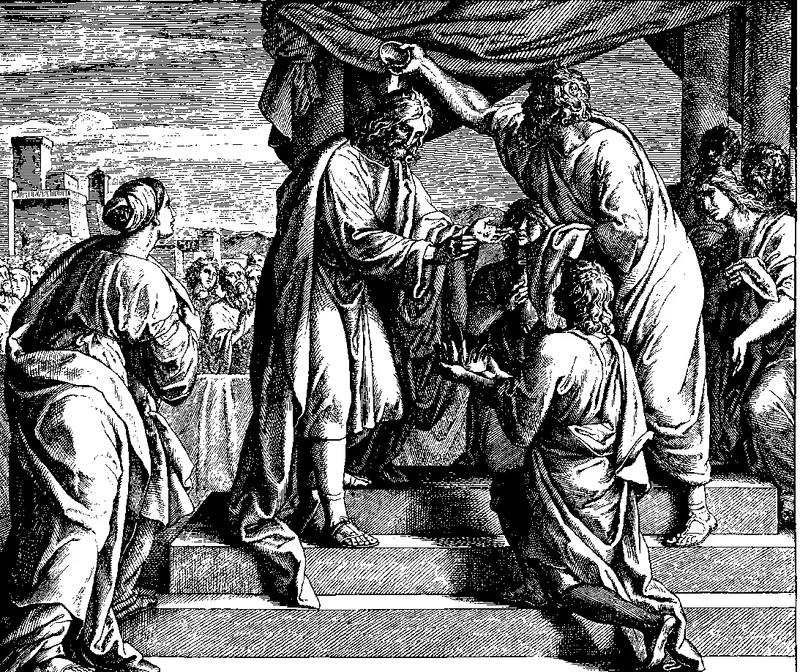
4And the men of Judah came, and there they anointed David king over the house of Judah. And they told David, saying, That the men of Jabeshgilead were they that buried Saul.
The men of Judah gather and anoint David their king. In the same moment, David learns something important: men from Jabesh-gilead risked themselves to give Saul a proper burial. They honored the dead king. David listens.
5And David sent messengers unto the men of Jabeshgilead, and said unto them, Blessed be ye of the LORD, that ye have shewed this kindness unto your lord, even unto Saul, and have buried him. 6And now the LORD shew kindness and truth unto you: and I also will requite you this kindness, because ye have done this thing.
David does something remarkable. He is newly anointed king. His rival is dead. And yet his first royal act is to bless the men who honored his enemy. He does not wait for them to pledge loyalty. He sends them a promise of kindness. This is leadership that sees honor where others see only the spoils of victory.
David understands something deep: a kingdom is built by honoring what was true in the old regime, by showing respect where respect is due, by promising to the people "kindness and truth." The men of Jabesh-gilead did what conscience demanded. David rewards that conscience.
2 Samuel 2:8-11The Kingdom Divides
8But Abner the son of Ner, captain of Saul’s host, took Ishbosheth the son of Saul, and brought him over to Mahanaim; 9And made him king over Gilead, and over the Ashurites, and over Jezreel, and over Ephraim, and over Benjamin, and over all Israel.
10Ishbosheth Saul’s son was forty years old when he began to reign over Israel, and reigned two years. But the house of Judah followed David. 11And the time that David was king in Hebron over the house of Judah was seven years and six months.
The numbers tell the story starkly. Ish-bosheth reigns two years. David, in Hebron, will reign seven and a half years over the south. And the closing word is plain: "The house of Judah followed David." The south is his. The north is divided, weak, held together only by Abner's will. The kingdom cannot stay split. The question is only when.
2 Samuel 2:12-17The Strange Game at Gibeon
12And Abner the son of Ner, and the servants of Ishbosheth the son of Saul, went out from Mahanaim to Gibeon. 13And Joab the son of Zeruiah, and the servants of David, went out, and met together by the pool of Gibeon: and they sat down, the one on the one side of the pool, and the other on the other side of the pool.
Two armies meet at the pool of Gibeon. The text says they "sat down" - not yet in battle, but facing each other across water. The pool is between them. One army on each side. Waiting.
14And Abner said to Joab, Let the young men now arise, and play before us. And Joab said, Let them arise.
Abner proposes something strange: "Let the young men now arise, and play before us." The word "play" is tsachaq in Hebrew - to mock, to jest, to sport violently. It is a choreographed test. Not quite dueling, not quite a real battle. A performance. Joab agrees. The two armies will watch their young men play.
15Then there arose and went over by number twelve of Benjamin, which pertained to Ishbosheth the son of Saul, and twelve of the servants of David. 16And they caught every one his fellow by the head, and thrust his sword in his fellow’s side; so they fell down together: wherefore that place was called Helkathhazzurim, which is in Gibeon.
It is a grim tableau. Twenty-four young men, champions from both sides, engage in ritualized combat. They do not fight in formation. They grapple - head to head, hand to hand - and kill each other. The text says they "fell down together," locked in death. No winner emerges. Both sides have lost equally. The field is named for strength, but it marks a place of waste.
2 Samuel 2:18-32Asahel Pursues, and Abner Warns
18And there were three sons of Zeruiah there, Joab, and Abishai, and Asahel: and Asahel was as light of foot as a wild roe.
19And Asahel pursued after Abner; and in going he turned not to the right hand nor to the left from following Abner. 20Then Abner looked behind him, and said, Art thou Asahel? And he answered, I am.
Asahel sets his course on Abner and does not swerve. He runs with the single focus of a young man who is fast enough to catch his prey. Abner recognizes him. Abner slows enough to see who chases him. And then, strangely, he tries to stop him.
21And Abner said to him, Turn thee aside to thy right hand or to thy left, and lay thee hold on one of the young men, and take thee his armour. But Asahel would not turn aside from following of him.
Abner warns Asahel. It is the first warning: turn aside. Hunt someone your own size. Take armor from another soldier. Let me be. But Asahel does not hear, or does not listen. He is young. He is fast. He is certain. He will not turn aside.
22And Abner said again to Asahel, Turn thee aside from following me: wherefore should I smite thee to the ground? how then should I hold up my face to Joab thy brother?
Abner speaks a second time - and now he appeals to something deeper. He asks Asahel: "Why should I kill you? How would I face your brother Joab after?" Abner does not want this death. He is trying to save Asahel from what will happen if he does not turn aside. It is a plea from a soldier who has seen enough blood.
23Howbeit he refused to turn aside: wherefore Abner with the hinder end of the spear smote him under the fifth rib, that the spear came out behind him; and he fell down there, and died in the same place: and it came to pass, that as many as came to the place where Asahel fell down and died stood still.
Asahel refuses. His refusal costs him. Abner does what he warned he would do. With the butt end of his spear - a desperate killing stroke - he drives it into Asahel's belly. The spear goes through him. He falls. He dies at Gibeon, far from home, because he would not listen when an older soldier told him: turn aside.
Asahel's refusal to hear is what brings him down. Abner warned him twice. He gave the young man a chance to turn aside, to live, to let this war be fought by men meant for it. Asahel's speed was his gift. His refusal to hear was his death. There are things a young person can learn from someone older, if he will listen.
24Joab also and Abishai pursued after Abner: and the sun went down when they were come to the hill of Ammah, that lieth before Giah by the way of the wilderness of Gibeon.
The soldiers stop. The text says they "stood still." Not in victory, not in defeat. Just still. Looking at one of their own, dead. The war has just become real.
2 Samuel 2:24-32"Shall the Sword Devour for Ever?"
24Joab also and Abishai pursued after Abner: and the sun went down when they were come to the hill of Ammah, that lieth before Giah by the way of the wilderness of Gibeon.
The sun is setting. Joab and Abishai pursue Abner into the gathering dark. But Asahel is still lying dead at Gibeon. That body is a marker, a line that has been crossed. The war is no longer a ritual. It is blood for blood.
25And the children of Benjamin gathered themselves together after Abner, and became one troop, and stood on the top of an hill. 26Then Abner called to Joab, and said, Shall the sword devour for ever? knowest thou not that it will be bitterness in the latter end? how long shall it be then, ere thou bid the people return from following their brethren?
Abner speaks the central question of the chapter, perhaps of all civil war: "Shall the sword devour for ever?" He is asking the deeper question beneath any prolonged conflict: When does it end? How many deaths? How much blood? How long will brothers fight brothers before someone says: enough?
Abner has just killed Asahel. He is the victor at Gibeon. He has every reason to drive forward, to crush Joab's forces, to secure the north for Ish-bosheth. But he does not. Instead, he stops and asks: Is this worth it? Will the sword keep devouring? Abner, the general, is asking whether the general's answer - more fighting, more pressure, more blood - is the right one. He is asking if there is another way.
27And Joab said, As God liveth, unless thou hadst spoken, surely then in the morning the people had gone up every one from following his brother.
Joab hears the question. He answers with an oath: "As God liveth, unless thou hadst spoken, we would have kept pursuing in the morning." Abner's words are what stop the war - because someone asked the right question. Joab blows a trumpet. The fighting stops. They stand still.
28So Joab blew a trumpet, and all the people stood still, and pursued after Israel no more, neither fought they any more. 29And Abner and his men walked all that night through the plain, and passed over Jordan, and went through all Bithron, and they came to Mahanaim. 30And Joab returned from following Abner: and when he had gathered all the people together, there lacked of David’s servants nineteen men and Asahel.
The count is written in blood. David lost 19 men. Abner lost 360. David's army is the victor. But the war does not end in a triumph at Mahanaim. It ends in a question - and a choice to stop.
31But the servants of David had smitten of Benjamin, and of Abner’s men, so that three hundred and threescore men died.
Asahel is buried in his father's tomb at Bethlehem. His body comes home. Joab and his men march through the night back to Hebron. The day is over. The kingdom is still divided. But the sword has stopped devouring - for now.
Research trail
Sources & further study
These references support the historical, linguistic, manuscript, and contextual notes in this chapter. Scripture remains the primary text; external sources are provided so readers can inspect the research directly.
- David as King of IsraelDavid's consolidation of power and establishment of monarchy over united Israel.
- City of David ExcavationsContinuous excavation revealing David-era structures and urban development in Jerusalem.
- Jerusalem CapturedDavid's capture of the Jebusite city and establishment as Israel's capital.