2 Samuel 1
People in this chapter
The man who hunted David for years is dead. The crown is loose and the throne empty. Everyone expects the exile to exhale, maybe to gloat. Instead a runner arrives from the battlefield with Saul's diadem and a story tuned to win a reward, and David tears his clothes. He weeps. He fasts until evening. The runner had stretched out his hand against the Lord's anointed, by his own confession, and for that he dies.1
Tap any highlighted phrase to jump to the commentary that unpacks it.
2 Samuel 1:1-3The Messenger Arrives
1Now it came to pass after the death of Saul, when David was returned from the slaughter of the Amalekites, and David had abode two days in Ziklag; 2It came even to pass on the third day, that, behold, a man came out of the camp from Saul with his clothes rent, and earth upon his head: and so it was, when he came to David, that he fell to the earth, and did obeisance. 3And David said unto him, From whence comest thou? And he said unto him, Out of the camp of Israel am I escaped.
David has just returned from raiding the Amalekites - a campaign against the very people he will soon encounter through this messenger. The text opens with layers of irony: David is resting in Ziklag, a city in Philistine territory where he has been seeking refuge from Saul. He has escaped the pursuit of a king. Now the news comes that the king himself is gone.123
The messenger comes in the manner of one bearing catastrophic news: clothes rent, earth on his head. These are signs of mourning, of disaster. He does obeisance to David - an act of submission and respect that presages what he will tell: that David, not Saul's son, is now the rightful king.
2 Samuel 1:4-10The Amalekite's Story
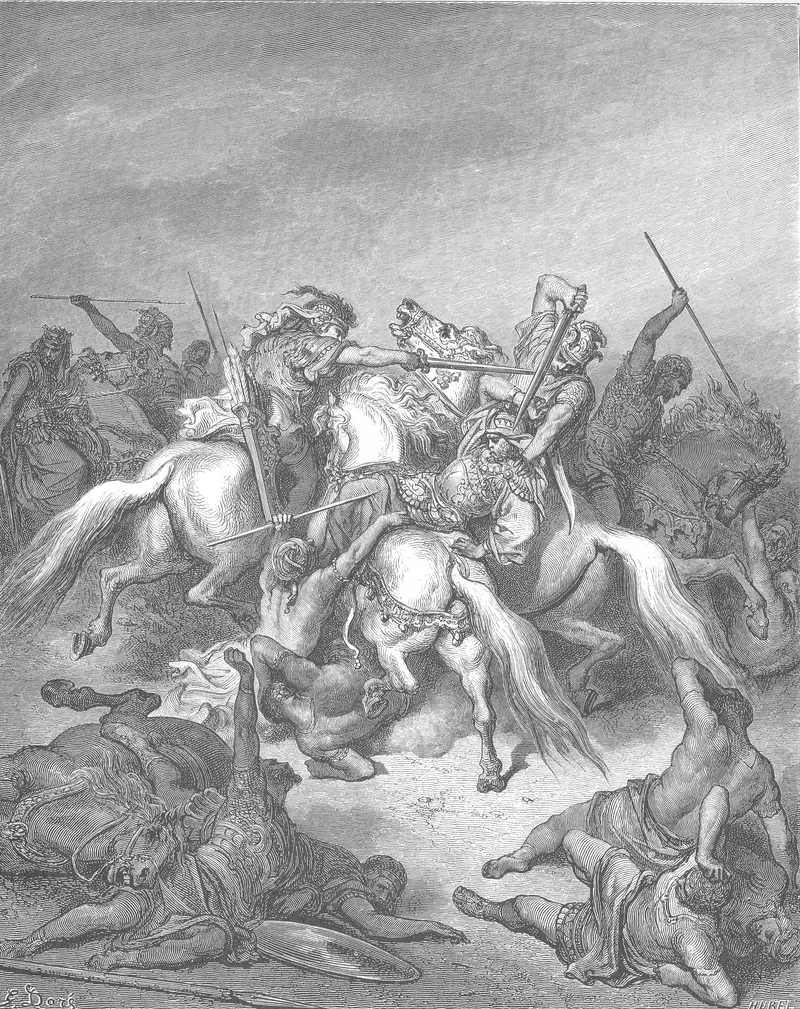
4And David said unto him, How went the matter? I pray thee, tell me. And he answered, That the people are fled from the battle, and many of the people also are fallen and dead; and Saul and Jonathan his son are dead also. 5And David said unto the young man that told him, How knowest thou that Saul and Jonathan his son be dead? 6And the young man that told him said, As I happened by chance upon mount Gilboa, behold, Saul leaned upon his spear; and, lo, the chariots and horsemen followed hard after him.
David does not take the report at face value. He presses for detail, and the young man keeps talking. Every added flourish is a brick in a story built to earn a reward. Notice how willingly the lie elaborates itself.
7And when he looked behind him, he saw me, and called unto me. And I answered, Here am I. 8And he said unto me, Who art thou? And I answered him, I am an Amalekite. 9He said unto me again, Stand, I pray thee, upon me, and slay me: for anguish is come upon me, because my life is yet whole in me. 10So I stood upon him, and slew him, because I was sure that he could not live after that he was fallen: and I took the crown that was upon his head, and the bracelet that was on his arm, and have brought them hither unto my lord.
David's first question is shrewd. How do you know? But the Amalekite's answer is a carefully constructed narrative - one that may or may not be true. The account differs, notably, from what 1 Samuel 31 tells us: that Saul fell on his own sword, that he was discovered dead by the Philistines. This young man's story is convenient. He was there by chance. Saul asked him to kill him. He did, and took the crown as proof. Convenient. And David, listening, seems to understand the danger in such convenience.
Saul, in his final moments, is in agony. He has fallen in battle, his enemies closing in. He asks the young man to kill him - a mercy stroke. But the Amalekite's version of this moment is suspicious. We are not told whether Saul truly asked, or whether the young man saw an opportunity.
2 Samuel 1:11-16David Grieves and Judges
11Then David took hold on his clothes, and rent them; and likewise all the men that were with him: 12And they mourned, and wept, and fasted until even, for Saul, and for Jonathan his son, and for the people of the LORD, and for the house of Israel; because they were fallen by the sword.
David tears his clothes - a sign of such deep grief that all the men with him follow suit. This is not a private sorrow. This is a king mourning, and his mourning sets the tone for everyone around him. The gesture says: something sacred has been lost.
David's grief encompasses Saul, Jonathan, the people, and the house of Israel. He is mourning the death of a king, the death of his beloved friend, and the catastrophe that has befallen his nation. This is a grief that looks outward, that understands the larger wound.
13And David said unto the young man that told him, Whence art thou? And he answered, I am the son of a stranger, an Amalekite. 14And David said unto him, How wast thou not afraid to stretch forth thine hand to destroy the LORD’s anointed? 15And David called one of the young men, and said, Go near, and fall upon him. And he smote him that he died. 16And David said unto him, Thy blood be upon thy head; for thy mouth hath testified against thee, saying, I have slain the LORD’s anointed.
David questions the Amalekite: How could you dare to lay hands on the Lord's anointed? The irony cuts deep - David himself, who has been hunted by Saul for years, refused to kill the king when he had the chance. He would not stretch forth his hand against the Lord's anointed. And now this young foreigner claims he did what David would not.
David's judgment is swift and final. The Amalekite's own mouth has testified against him. Whether his story is true or false, he has confessed to killing the Lord's anointed - and in doing so, has sealed his own fate. "Thy blood be upon thy head" - the consequence follows the confession. David executes him.
2 Samuel 1:17-20The Song of the Bow Begins
17And David lamented with this lamentation over Saul and over Jonathan his son: 18(Also he bade them teach the children of Judah the use of the bow: behold, it is written in the book of Jasher.) 19The beauty of Israel is slain upon thy high places: how are the mighty fallen! 20Tell it not in Gath, publish it not in the streets of Askelon; lest the daughters of the Philistines rejoice, lest the daughters of the uncircumcised triumph.
Watch the word David chooses for his first line: “the beauty of Israel is slain” - splendor, glory, a light put out. From the opening note he lifts the grief clean above palace politics. A nation is what has fallen here, and the wound belongs to everyone who hears the song.
One line returns three times before the song is done, like a bell tolling. There is no victory in it. The mighty are exactly the people you assumed were permanent - the strong, the settled, the ones who would always be there - and they are gone. Those left standing are handed a hard task: to sing the loss out loud rather than hurry past it.
2 Samuel 1:21-27How Are the Mighty Fallen
21Ye mountains of Gilboa, let there be no dew, neither let there be rain, upon you, nor fields of offerings: for there the shield of the mighty is vilely cast away, the shield of Saul, as though he had not been anointed with oil. 22From the blood of the slain, from the fat of the mighty, the bow of Jonathan turned not back, and the sword of Saul returned not empty. 23Saul and Jonathan were lovely and pleasant in their lives, and in their death they were not divided: they were swifter than eagles, they were stronger than lions.
The lament does not airbrush Saul into a hero. It remembers him true: swift, strong, beloved, and fallen, all at once. David can hold the man's real failures and his real worth in the same breath. That is what honest grief looks like.
24Ye daughters of Israel, weep over Saul, who clothed you in scarlet, with other delights, who put on ornaments of gold upon your apparel. 25How are the mighty fallen in the midst of the battle! O Jonathan, thou wast slain in thine high places. 26I am distressed for thee, my brother Jonathan: very pleasant hast thou been unto me: thy love to me was wonderful, passing the love of women. 27How are the mighty fallen, and the weapons of war perished!
David curses the mountains of Gilboa where Saul fell - let them bear no dew, no rain, no fruit. The shield of Saul, the mark of his kingship, lies abandoned. It is "as though he had not been anointed with oil" - as though the sacred anointing meant nothing. This is the language of a man confronting the breakdown of order, the fall of the sacred.
David remembers Saul and Jonathan as warriors - their weapons did not return empty, their bow did not turn back. They were strong. They were effective. And now they are gone. The instruments of war have perished with them.
In this moment, David speaks of Saul as a man - "lovely and pleasant in their lives." He is honoring him. Even in conflict, in rivalry, there was a man worth honoring. And "in their death they were not divided" - Saul and Jonathan died together, at Gilboa. They were bound to each other.
For one verse the public dirge drops to a private address, and David is simply talking to his friend. The love he names “passing the love of women” is covenant love - the bond of two who swore themselves to each other before God, the loyalty of sworn brothers rather than anything romantic in the modern sense. And here is the part that should stop you. Jonathan was the crown prince. The throne was his by birth, and he handed it to David and loved him anyway, with no bitterness and no demand for return.
A chosen one gladly making room for the one who would reign in his place.
Research trail
Sources & further study
These references support the historical, linguistic, manuscript, and contextual notes in this chapter. Scripture remains the primary text; external sources are provided so readers can inspect the research directly.
- David as King of IsraelDavid's consolidation of power and establishment of monarchy over united Israel.
- City of David ExcavationsContinuous excavation revealing David-era structures and urban development in Jerusalem.
- Jerusalem CapturedDavid's capture of the Jebusite city and establishment as Israel's capital.
Where this echoes in Scripture
David Grieves and Judges
- Acts 2:36God hath made that same Jesus, whom ye have crucified, both Lord and Christ.Peter names the crucified Jesus the Anointed - the same office David refuses to let anyone harm.
- Acts 3:14-15But ye denied the Holy One and the Just, and killed the Prince of life.Rejection did not cancel the anointing; it revealed it.
- 1 Samuel 24:6The Lord forbid that I should do this thing unto my master, the Lord's anointed.David spared Saul in the cave - the conviction that here governs his judgment.
- Psalm 105:15Touch not mine anointed, and do my prophets no harm.The principle stated as God's own word.
How Are the Mighty Fallen
- Luke 19:41-42And when he was come near, he beheld the city, and wept over it.The anointed King grieves over the place that is about to reject Him.
- Matthew 5:44Love your enemies, bless them that curse you... pray for them which despitefully use you.David's dirge for his persecutor is this command in song.
- Romans 12:15Rejoice with them that do rejoice, and weep with them that weep.Grief that reaches past your own side of a conflict.
- 1 Samuel 18:1The soul of Jonathan was knit with the soul of David, and Jonathan loved him as his own soul.The covenant friendship David now mourns “passing the love of women.”