1 Samuel 24
People in this chapter
David is a fugitive. The king who once took him into his own house now hunts him with three thousand men. The chase reaches En-gedi, an oasis of springs and caves above the Dead Sea. Then the hunt turns inside out. Saul steps into a cave to relieve himself - and David and his men are crouched in the dark at the back of it. The most powerful man in Israel is suddenly the most exposed.
His men read it as the finger of God: here is the promised day, your enemy delivered into your hand.1
Tap any highlighted phrase to jump to the commentary that unpacks it.
1 Samuel 24:1-7The Cave, and the Hand That Would Not Strike
1And it came to pass, when Saul was returned from following the Philistines, that it was told him, saying, Behold, David is in the wilderness of Engedi. 2Then Saul took three thousand chosen men out of all Israel, and went to seek David and his men upon the rocks of the wild goats. 3And he came to the sheepcotes by the way, where was a cave; and Saul went in to cover his feet: and David and his men remained in the sides of the cave.
En-gedi is an oasis in the wilderness above the western shore of the Dead Sea - a sudden green of springs and waterfalls and caves set in a wall of barren cliff. Fleeing for his life, David has come to this pocket of water and shelter, hiding among the rocks of the wild goats, the high places where the ibex pick their way and few men can follow.1 But Saul's obsession reaches even here.
The moment he hears where David is, he breaks off from the Philistines - the real enemy of his kingdom - and turns the full strength of the nation against one fugitive: three thousand chosen men out of all Israel. The disproportion is staggering and deliberate. A king who should be defending his people from invaders instead spends his crack troops hunting a young man who has done him no wrong. From the opening lines, the chapter sets the scale of Saul's fixation against the smallness of his prey, so that everything that follows is measured against this absurdity: an army on the trail of a single hunted man.
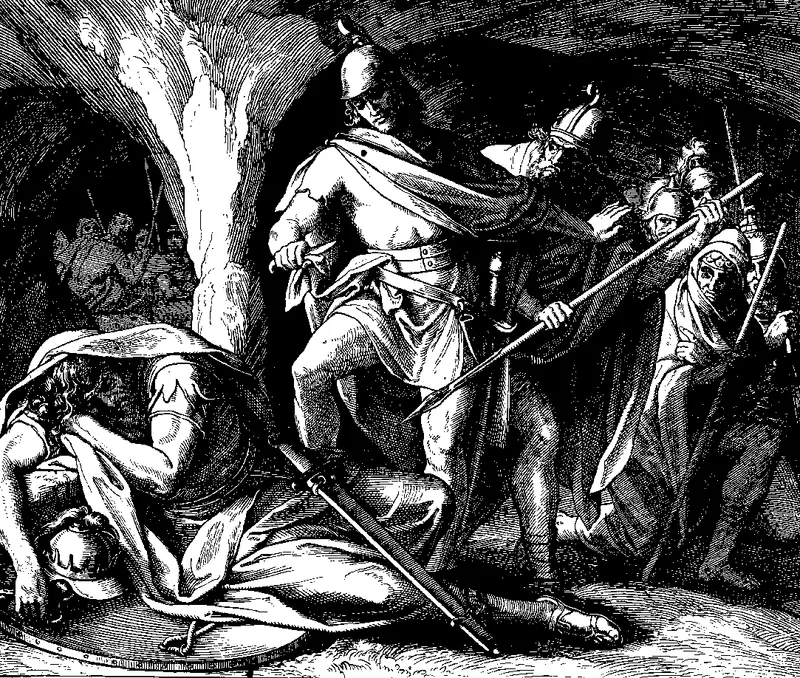
Then the whole pursuit reverses in a single sentence. Saul comes to a cave and goes in to cover his feet - a Hebrew euphemism for relieving himself.1 He is alone, his guard left outside, his robe laid aside, his eyes adjusting to the dark; there is no moment in which a man is more exposed and less able to defend himself. And in the deep shadow at the sides of that very cave sit David and his men, watching the king walk in unarmed and unaware.
The reversal could not be more complete. The hunter has wandered, defenseless, into the lair of the hunted; the man with three thousand soldiers is suddenly the one man with no protection at all. To David's band it can only look like one thing - the hand of God delivering their enemy up. Everything in the situation seems to be saying: now.
4And the men of David said unto him, Behold the day of which the LORD said unto thee, Behold, I will deliver thine enemy into thine hand, that thou mayest do to him as it shall seem good unto thee. Then David arose, and cut off the skirt of Saul’s robe privily. 5And it came to pass afterward, that David’s heart smote him, because he had cut off Saul’s skirt. 6And he said unto his men, The LORD forbid that I should do this thing unto my master, the LORD’s anointed, to stretch forth mine hand against him, seeing he is the anointed of the LORD. 7So David stayed his servants with these words, and suffered them not to rise against Saul. But Saul rose up out of the cave, and went on his way.
David's men speak with the voice of apparent faith, and that is what makes their counsel so dangerous. They do not say merely here is your chance; they wrap it in a word from God: Behold the day of which the LORD said unto thee, Behold, I will deliver thine enemy into thine hand. They take the circumstance - Saul defenseless, delivered up by sheer providence - and read it as a divine command to kill.
The logic is seductive: if God has so plainly handed Saul over, surely God means David to strike. And there is just enough truth in it to make it persuasive, for the LORD had brought Saul into the cave. But circumstance is not the same as command, and an open door is not always a summons to walk through it. David rises - the men must have thought he was rising to do the deed - but he goes only as far as the king's discarded robe, and cut off the skirt of Saul's robe privily, secretly, in the dark, without Saul ever knowing.
Even in defying his men, David takes the very least he can take: not a life, only an edge of cloth.
He has done nothing violent. No one is harmed; a scrap of cloth has been cut in the dark. And yet his heart smites him - his own conscience lands a blow from within over a thing no court would call a crime. That is the mark of a heart tender toward God: the sensitivity that feels the wrongness of overstepping even when no one else would name it wrong. David senses that to lay a blade to the king's robe is already to have reached for something not his to take, already a step toward the very thing he refuses.
Most of us measure our conduct by what we can get away with, or by what others would condemn. David measures his by a line drawn in his own conscience before God, and he feels himself cross it long before any onlooker would. The same alertness that smites him over a hem is what keeps his hand off a life.
Watch how David names Saul as he turns to stop his men. Not “my enemy,” not “the man hunting me,” but my master and the LORD'S anointed. A lesser man would have let the grievance rewrite the title; David will not let his own wound redefine who Saul is before God. Whatever Saul has become toward David, he is still the man God set on the throne, and that standing is not David's to overturn.
So David stayed his servants with these words, and suffered them not to rise against Saul - he restrains not only his own hand but theirs, talking his men down from the deed they were itching to do. And then the moment simply passes: Saul rose up out of the cave, and went on his way, never knowing how near death had been or how freely he had been spared. The most dangerous moment of Saul's life comes and goes, and the only weapon ever drawn was a knife against a hem.
1 Samuel 24:8-15The Skirt Held Up, and the LORD as Judge
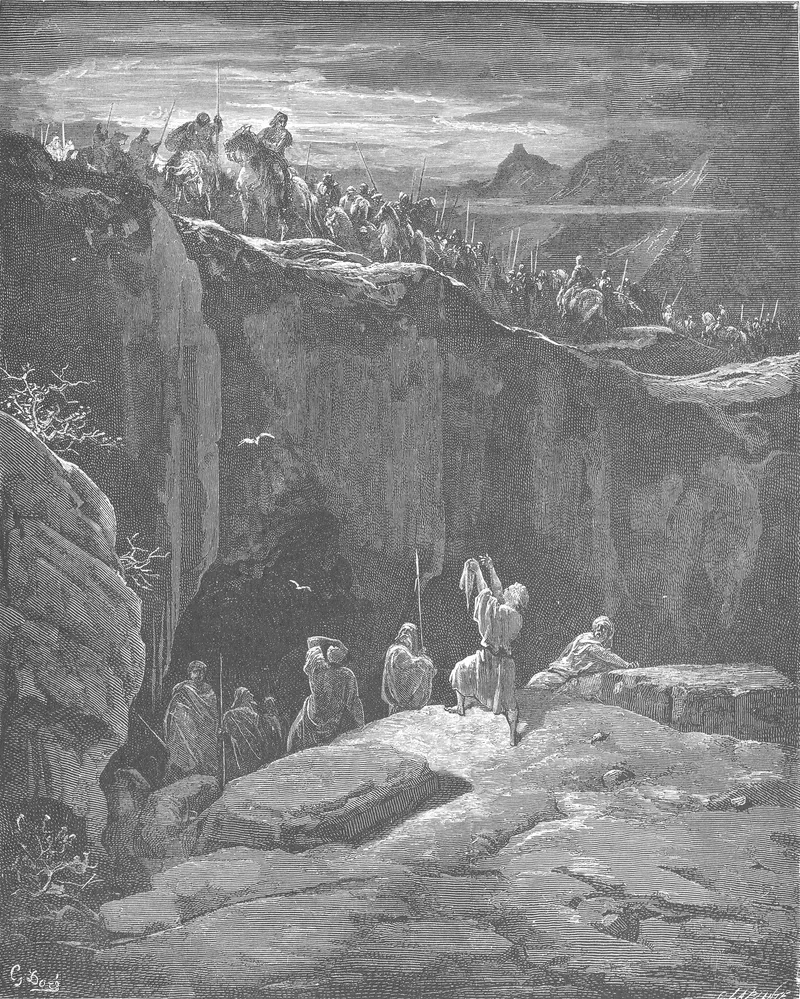
8David also arose afterward, and went out of the cave, and cried after Saul, saying, My lord the king. And when Saul looked behind him, David stooped with his face to the earth, and bowed himself. 9And David said to Saul, Wherefore hearest thou men’s words, saying, Behold, David seeketh thy hurt? 10Behold, this day thine eyes have seen how that the LORD had delivered thee to day into mine hand in the cave: and some bade me kill thee: but mine eye spared thee; and I said, I will not put forth mine hand against my lord; for he is the LORD’s anointed. 11Moreover, my father, see, yea, see the skirt of thy robe in my hand: for in that I cut off the skirt of thy robe, and killed thee not, know thou and see that there is neither evil nor transgression in mine hand, and I have not sinned against thee; yet thou huntest my soul to take it.
David does not slip away while he safely can, and he does not ambush Saul from behind as the king leaves the cave. He does the far harder and braver thing: he steps out into the open, into full view of Saul and his three thousand, and cried after Saul, saying, My lord the king. Then, with the man who has been hunting his life turning to face him, David stooped with his face to the earth, and bowed himself. Consider the courage and the humility folded together here.
David has just spared Saul's life; he holds the proof and the moral high ground; and yet he comes as a subject, prostrate before his king.2 He surrenders the advantage of the cave, choosing to plead his case in daylight rather than hold the power he had in the dark. And his first words go straight to the poison at the root of the whole pursuit: Wherefore hearest thou men's words, saying, Behold, David seeketh thy hurt? Saul's hatred has been fed by whisperers and slanderers, and David appeals past the rumors to the king's own eyes - look at what actually happened today.
David lays the evidence before Saul as plainly as it can be laid: this day thine eyes have seen how that the LORD had delivered thee to day into mine hand in the cave: and some bade me kill thee; but mine eye spared thee. He hides nothing - not that God had handed Saul over, not that his own men had urged the kill. He admits the full opportunity precisely so that the mercy will be unmistakable.
A man who wanted Saul's throne, who “sought his hurt,” would never have let that moment pass; the very fact that David did is the refutation of every rumor. Then he holds up the only thing he took: my father, see, yea, see the skirt of thy robe in my hand. The word father is tender - David appeals to the bond they once had, when he served in Saul's house and married his daughter.
And the severed hem becomes a court exhibit, a piece of physical proof that argues David's whole case in a single object: in that I cut off the skirt of thy robe, and killed thee not, know thou and see that there is neither evil nor transgression in mine hand.2 If David had meant harm, Saul would not be alive to hold a conversation. The cloth in David's hand is the measure of how close death came - and of how deliberately it was withheld.
Yet thou huntest my soul to take it. The contrast hangs in the air: David spared the life he could have taken; Saul hunts the life that spared him.
12The LORD judge between me and thee, and the LORD avenge me of thee: but mine hand shall not be upon thee. 13As saith the proverb of the ancients, Wickedness proceedeth from the wicked: but mine hand shall not be upon thee. 14After whom is the king of Israel come out? after whom dost thou pursue? after a dead dog, after a flea. 15The LORD therefore be judge, and judge between me and thee, and see, and plead my cause, and deliver me out of thine hand.
Now David does the hardest thing in the whole chapter, harder even than sparing the life in the cave: he refuses to be his own judge and avenger, and he hands the entire quarrel to God. The LORD judge between me and thee, and the LORD avenge me of thee: but mine hand shall not be upon thee. This is not resignation, and it is not weakness pretending to be virtue. It is a deliberate transfer of the case out of his own hands and into a higher court.
David has a genuine grievance - he is innocent and hunted - and he could press it himself; he had the means in the cave. Instead he lets God be both judge and avenger, and binds himself by a vow he repeats twice for emphasis: mine hand shall not be upon thee. He quotes an old proverb to make the point - Wickedness proceedeth from the wicked - meaning that what is in a man comes out of him; if David were the wicked, scheming rival Saul fears, vengeance would already have flowed out of his hand in that cave.
The empty hand is its own verdict on David's heart. Then he shrinks himself to nothing before the king's obsession: after whom is the king of Israel come out? after a dead dog, after a flea - a worthless carcass, a speck not worth catching. The self-abasement is real, and it carries a quiet indictment: why has the king of Israel mustered an army against something so small? And David closes by laying it all down once more: The LORD therefore be judge… and plead my cause, and deliver me out of thine hand. He will not be his own deliverer; he leaves both the verdict and the rescue to God.
1 Samuel 24:16-22The King's Tears, and the Parting
16And it came to pass, when David had made an end of speaking these words unto Saul, that Saul said, Is this thy voice, my son David? And Saul lifted up his voice, and wept. 17And he said to David, Thou art more righteous than I: for thou hast rewarded me good, whereas I have rewarded thee evil. 18And thou hast shewed this day how that thou hast dealt well with me: forasmuch as when the LORD had delivered me into thine hand, thou killedst me not. 19For if a man find his enemy, will he let him go well away? wherefore the LORD reward thee good for that thou hast done unto me this day.
When David finishes, something in Saul gives way. Is this thy voice, my son David? - and the king lifted up his voice, and wept. The eyes that have been blinded by suspicion and fear suddenly see, and Saul calls David by a name he has not used through all the long pursuit: my son. It is the language of the old affection, from the days before the spear and the hunt, when David played the harp in his house and married his daughter.
The mercy David showed in the cave has done what no argument could - it has reached through the paranoia and found, for a moment, the man underneath. There is something almost unbearably poignant in a hardened pursuer weeping at the voice of the one he came to kill. David's refusal to repay evil with evil has not been wasted; it has broken Saul open, at least for now. The kindness shown to an enemy has accomplished what violence never could.
Then Saul says the thing he has fought so long and so hard to deny: Thou art more righteous than I: for thou hast rewarded me good, whereas I have rewarded thee evil. It is a stunning confession from a reigning king to the fugitive he was hunting an hour before. Saul does not soften it or excuse himself; he states the contrast in its starkest terms - good for evil, David's mercy against his own malice - and pronounces David the more righteous man.
And he draws the precise lesson the empty hand was meant to teach: when the LORD had delivered me into thine hand, thou killedst me not. Saul now reads the cave exactly as David intended it to be read. He even names the principle that makes David's act so extraordinary: if a man find his enemy, will he let him go well away? The ordinary way of the world is that a man with his enemy in his power finishes him.
David spared him, and Saul knows how rare that is. The slander that David sought his hurt collapses entirely in the face of the life that was spared. For this moment, at least, the rumors are silenced by the evidence, and the king himself becomes a witness to the goodness of the man he hunted.
20And now, behold, I know well that thou shalt surely be king, and that the kingdom of Israel shall be established in thine hand. 21Swear now therefore unto me by the LORD, that thou wilt not cut off my seed after me, and that thou wilt not destroy my name out of my father’s house. 22And David sware unto Saul. And Saul went home; but David and his men gat them up unto the hold.
Now Saul says aloud the very thing his whole pursuit has been trying to prevent: I know well that thou shalt surely be king, and that the kingdom of Israel shall be established in thine hand. The hunt has been, from the start, a war against David's rise; and here the hunter himself confesses that the rise is certain and cannot be stopped. There is a deep vindication of David's restraint in this.
David did not need to seize the kingdom by killing Saul in the cave - God had already settled that the throne would be his, and even Saul can see it. The crown David refused to take by his own hand is the crown God will surely give. Then Saul, with the clear-eyed realism of a man who knows his house is being set aside, asks the one thing left to ask: Swear… that thou wilt not cut off my seed after me, and that thou wilt not destroy my name out of my father's house. It was the common practice of a new dynasty to wipe out the family of the old; Saul begs David to spare his descendants when that day comes.
And David sware unto Saul - the same mercy that withheld the blade in the cave now binds itself by oath to protect Saul's line, an oath David would honor years later in his kindness to Jonathan's son Mephibosheth.
The way the two men part says everything. Saul goes home, back to his house and his throne. David, even now, even after the tears and the confession and the prophecy of his coming reign, does not go down with him or presume on the moment. He gathers his men and climbs back up unto the hold - the stronghold, the fastness where they can be safe. The contrast is the whole point of how the chapter ends.
Saul has wept and confessed, but David is wise enough not to mistake an emotional moment for a changed heart; he keeps his distance, and history will prove him right, for Saul will hunt him again. More than that, the ending shows David still waiting. He had the king in his hand and let him go; he has heard the king himself swear the throne will be his; and still David does not grasp for it.
He goes back to the wilderness and waits for the God who promised the kingdom to give it in His own time. The chapter that began with an army hunting one man ends with that one man, vindicated and unharmed, quietly choosing to wait - which is the very thing that makes him fit to reign.
Research trail
Sources & further study
These references support the historical, linguistic, manuscript, and contextual notes in this chapter. Scripture remains the primary text; external sources are provided so readers can inspect the research directly.
- 1 Samuel 24 - Translators' NotesThe NET Bible's detailed footnotes on 1 Samuel 24 - the geography of En-gedi and “the rocks of the wild goats,” the euphemism behind “to cover his feet,” the legal weight of David cutting and then displaying the skirt, and the language of David committing his cause to the LORD as judge.
- Art of the Ancient Near East · Heilbrunn TimelineThe Met's survey of the ancient Near Eastern world that frames the scene - the royal robe as the mark of a king's standing (vv. 4-5, 11), the hem or skirt as a token that could stand for the whole man, and the conventions of homage that lie behind David bowing his face to the earth before Saul (v. 8).
- 1 Samuel 24 · Hebrew + classical Jewish commentaryThe Hebrew text of 1 Samuel 24 with Rashi, Radak, and other classical commentators side by side - useful for mashiach (vv. 6, 10, the LORD'S “anointed” David will not touch), for shaphat (vv. 12, 15, the LORD as judge between the two men), and for kanaph (vv. 4-5, 11, the “skirt” or wing of the robe that David cut).
- 1 Samuel 24 ↔ Romans 12 · 1 Peter 2 · Matthew 5 · Matthew 26Traces the threads tying David's refusal to avenge himself (v. 12) to avenge not yourselves… Vengeance is mine; I will repay, saith the Lord (Rom. 12:19), his mercy to his hunter to Love your enemies (Matt. 5:44), and his surrender of the matter to God to the One who committed himself to him that judgeth righteously (1 Pet. 2:23) and put up the sword rather than call twelve legions of angels (Matt. 26:53).
Where this echoes in Scripture
The Cave, and the Hand That Would Not Strike
- Matthew 26:52-53Thinkest thou that I cannot now pray to my Father, and he shall presently give me more than twelve legions of angels?The true Anointed in the garden, refusing the sword as David refused it in the cave - power held back, the kingdom not seized by force.
- Psalm 57:1In the shadow of thy wings will I make my refuge, until these calamities be overpast.A psalm titled “when he fled from Saul in the cave” - the same word, kanaph, for the sheltering wings under which David hides while sparing the king.
- Romans 13:1The powers that be are ordained of God.The principle beneath David's refusal - honoring the office God had set in place rather than overthrowing it by his own hand.
- 1 Samuel 26:9Destroy him not: for who can stretch forth his hand against the LORD'S anointed, and be guiltless?David says the same thing a second time, sparing Saul again - proof that the cave was no impulse but a settled conviction.
The Skirt Held Up, and the LORD as Judge
- Romans 12:19Avenge not yourselves, but rather give place unto wrath: for it is written, Vengeance is mine; I will repay, saith the Lord.David's vow put into a command for everyone - the hand taken off the matter, the vengeance left to God.
- 1 Peter 2:23Who, when he was reviled, reviled not again… but committed himself to him that judgeth righteously.David committing his cause to the LORD who judges - the very posture Christ took under unjust suffering.
- Genesis 18:25Shall not the Judge of all the earth do right?The conviction beneath “the LORD judge between me and thee” - trust that the righteous Judge will set every account right.
- Psalm 7:8The LORD shall judge the people: judge me, O LORD, according to my righteousness.David's prayer-language elsewhere - the same handing of his cause to God as judge that he speaks aloud to Saul.
The King's Tears, and the Parting
- Matthew 5:44Love your enemies, bless them that curse you, do good to them that hate you, and pray for them which despitefully use you.The command David lived out in the cave - good returned for evil to the very man who hunted him.
- Luke 23:34Father, forgive them; for they know not what they do.The command lived to its uttermost - Christ from the cross praying for the very men who despitefully used Him.
- Proverbs 25:21-22If thine enemy be hungry, give him bread to eat… for thou shalt heap coals of fire upon his head.The disarming power of kindness to an enemy - the mercy that reached Saul and brought him to tears.
- 2 Samuel 9:7I will surely shew thee kindness for Jonathan thy father's sake.David keeping the oath of verse 22 - sparing Saul's line in his kindness to Mephibosheth, son of Jonathan.
- Romans 12:21Be not overcome of evil, but overcome evil with good.The whole logic of the chapter in one line - David overcoming Saul's evil through mercy, the sword sheathed.