2 Samuel 5
People in this chapter
Chapter 5 marks a turning point in David's story: the moment when a man who has been king over Judah becomes king over all Israel. The tribes come to him at Hebron and say, "Behold, we are thy bone and thy flesh" - and they anoint him. What was divided is now one kingdom. What was scattered is now gathered under a single head.
Tap any highlighted phrase to jump to the commentary that unpacks it.
2 Samuel 5:1-5David Anointed King Over All Israel
1Then came all the tribes of Israel to David unto Hebron, and spake, saying, Behold, we are thy bone and thy flesh. 2Also in time past, when Saul was king over us, thou wast he that leddest out and broughtest in Israel: and the LORD said to thee, Thou shalt feed my people Israel, and thou shalt be a captain over Israel.
The tribes come to David and say, "We are thy bone and thy flesh." This is the language of covenant, of kinship, of a binding that goes back to creation itself. When Adam saw Eve, he said the same words: "This is now bone of my bones, and flesh of my flesh" (Gen. 2:23). The tribes are adopting David as one body. They are not submitting to a foreign king. They are recognizing one of their own as the head of a united people123.
The tribes remember that David, even when Saul was king, was the one who "leddest out and broughtest in Israel." He led them out to battle and brought them back home. He was their shepherd, their protector, their leader in practice long before today. Now the formal anointing aligns with what was already true.
The tribes cite the Lord's own words to David: "Thou shalt feed my people Israel." The language is pastoral - David as shepherd, the people as sheep. A king's job is to feed, guide, and protect the flock entrusted to him. This is what God has promised, and this is what the people now acknowledge.
3So all the elders of Israel came to the king to Hebron; and king David made a league with them in Hebron before the LORD: and they anointed David king over Israel.
The covenant is made "before the Lord." It is a sacred act, done in the sight of God, binding king and people, promising mutual faithfulness - the king to feed the people, the people to accept his rule.
4David was thirty years old when he began to reign, and he reigned forty years. 5In Hebron he reigned over Judah seven years and six months: and in Jerusalem he reigned thirty and three years over all Israel and Judah.
David was thirty years old when he began to reign over all Israel. It is the same age at which Jesus began His ministry (Luke 3:23). The parallel is deliberate - both men began their public work at the threshold of full manhood, both entered into their calling having been set apart and tested in the wilderness, both were anointed by the Spirit to do the work of God.
2 Samuel 5:6-9The Taking of Zion
6And the king and his men went to Jerusalem unto the Jebusites, the inhabitants of the land: which spake unto David, saying, Except thou take away the blind and the lame, thou shalt not come in hither: thinking, David cannot come in hither.
The Jebusites, defenders of Jerusalem, taunt David. They say that even if he tries to enter the city, he would not need to bring warriors - the blind and the lame (the city's weakest) would be enough to keep him out. It is a confidence born of the city's natural stronghold, its high walls, its position on a hill. They believe themselves impregnable. David's answer will be not words, but action.
7Nevertheless David took the strong hold of Zion: the same is the city of David.
David takes the stronghold. It becomes known as the city of David, the city that bears his name. This is the beginning of Jerusalem's transformation into the holy city, the city of God.
8And David said on that day, Whosoever getteth up to the gutter, and smiteth the Jebusites, and the lame and the blind, that are hated of David’s soul, he shall be chief and captain. Wherefore they said, The blind and the lame shall not come into the house.
David speaks of the "lame and the blind that are hated of David's soul." Some scholars see this as David turning the Jebusites' own taunt back against them - invoking their arrogance. Others see it as David's contempt for those who would mock the disabled. Either way, it is Joab who first reaches the gutter (the water shaft) and strikes through. Strategy and courage overcome what seemed impregnable.
The gutter - likely the water shaft or underground passage that brought water into the besieged city - becomes the way in. Joab, David's commander, climbs up through it. The insight that wins is a recognition of weakness in what seems strongest, a turning of strategy into victory through an unexpected angle. Every fortress has a hidden way in. Every stronghold has a vulnerability.
9So David dwelt in the fort, and called it the city of David. And David built round about from Millo and inward. 10And David went on, and grew great, and the LORD God of hosts was with him.
David dwells in the stronghold and rebuilds it, expanding outward from the Millo (the filled-in area or rampart). And the text gives the formula of blessing: "David went on, and grew great, and the Lord God of hosts was with him." The order matters. Because God was with him, David grew great. Not the other way around.
2 Samuel 5:11-16The Cedar House and the Royal Seed
11And Hiram king of Tyre sent messengers to David, and cedar trees, and carpenters, and masons: and they built David an house.
Hiram, the king of Tyre, reaches out to David. He sends cedar, carpenters, masons - everything needed to build a royal palace. Tyre was Israel's neighbor and trading partner to the north, skilled in maritime commerce and building. The gift is a recognition of David's rising power, a seal of alliance between nations that also happens to be practically useful.
12And David perceived that the LORD had established him king over Israel, and that he had exalted his kingdom for his people Israel’s sake.
David "perceived" that the Lord had established him. The word suggests understanding, insight, a deepening knowledge. He sees the hand of God at work in all that has unfolded around him - in the alliance with Hiram, in the building of the house, in the expansion of his kingdom. He understands that his kingdom is the Lord's work.
The Lord has exalted his kingdom "for his people Israel's sake." David's exaltation serves the people. A king is raised up to serve, to feed, to lead the flock. David understands this. His throne is established by God for the sake of the people entrusted to him.
13And David took him more concubines and wives out of Jerusalem, after he was come from Hebron: and there were yet sons and daughters born to David. 14And these be the names of those that were born unto him in Jerusalem; Shammuah, and Shobab, and Nathan, and Solomon,
David takes more wives and concubines in Jerusalem and fathers more children. The text names some of them: Nathan and Solomon among them - names that will echo through history. Solomon will succeed David as king. Nathan will become a prophet who will confront David with his sin (2 Samuel 12). The royal seed is multiplying. A dynasty is being established. But the text simply records it without commentary, neither celebrating nor condemning. The children are born. Their names are written. What they will become remains to be seen.
2 Samuel 5:17-25Two Victories, Two Strategies
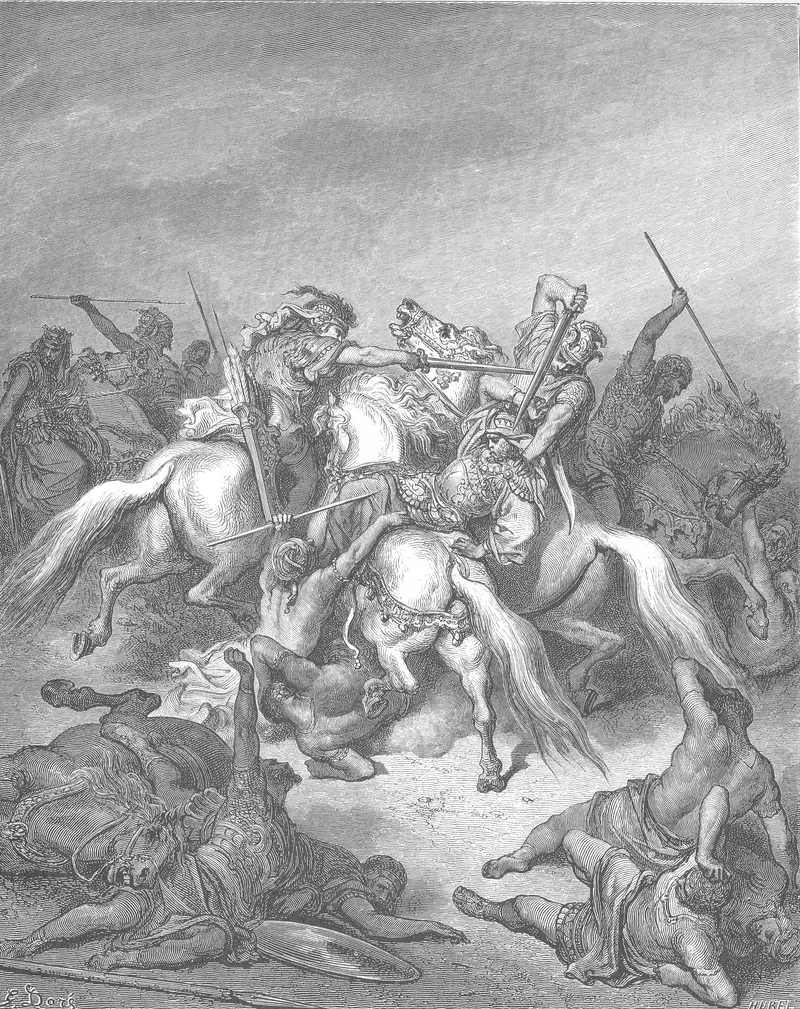
17But when the Philistines heard that they had anointed David king over Israel, all the Philistines came up to seek David; and David heard of it, and went down to the hold.
The Philistines hear that David has been anointed king over all Israel - and they feel the threat. As long as David was king only over Judah, he was one kingdom among others. But now, united, Israel is a force they cannot ignore. They come up to seek David, to destroy him before he can consolidate his power. The test comes quickly.
18The Philistines also came and spread themselves in the valley of Rephaim.
David's first move is to inquire of the Lord. "Shall I go up? Wilt thou deliver them into mine hand?" This is the sign of a man who understands that victory comes from the alignment of human effort with God's will, with strategy and strength both channeled through that inquiry. The Lord answers: "Go up, for I will doubtless deliver them."
19And David enquired of the LORD, saying, Shall I go up to the Philistines? wilt thou deliver them into mine hand? And the LORD said unto David, Go up: for I will doubtless deliver the Philistines into thine hand.
David names the place Baal-perazim - the Lord of Breakthroughs. He does not name it after himself, or after his strategy, or even after the victory in a neutral way. He names it as a witness to God's action. "The Lord hath broken forth upon mine enemies before me, as the breach of waters." The image is of a dam breaking, waters pouring through unstoppably. That is what the presence of God does.
20And David came to Baalperazim, and David smote them there, and said, The LORD hath broken forth upon mine enemies before me, as the breach of waters. Therefore he called the name of that place Baalperazim.
After the victory, David and his men burn the Philistine idols left on the battlefield. It is an act of cleansing, of refusing to be contaminated by the gods the Philistines worship. It is also a declaration: the god of Israel, the God of David, is the only God worth keeping.
21And there they left their images, and David and his men burned them. 22And the Philistines came up yet again, and spread themselves in the valley of Rephaim.
The Philistines come up a second time. And David inquires of the Lord again. This is crucial. David does not assume that the same strategy that worked once will work again. He does not rest on the memory of the first victory. He asks again. And the Lord gives a different answer: "Thou shalt not go up" - not a frontal assault this time - "but fetch a compass behind them, and come upon them over against the mulberry trees."
God's wisdom is fresh each time. The Lord does not repeat Himself. He meets each challenge with a strategy suited to it.
23And when David enquired of the LORD, he said, Thou shalt not go up; but fetch a compass behind them, and come upon them over against the mulberry trees. 24And let it be, when thou hearest the sound of a going in the tops of the mulberry trees, that then thou shalt bestir thyself: for then shall the LORD go out before thee, to smite the host of the Philistines.
The Lord gives David a sign: when he hears a sound in the mulberry trees, he will know that the Lord has gone before him. It is a quiet sign - a sound in the trees, a whisper, perhaps the wind that carries the scent of God's presence. David learns to listen for the subtle sign, to move when the moment is right. He follows the Lord's command exactly, and the victory is complete - from Geba to Gazer, the Philistines are driven back.
Research trail
Sources & further study
These references support the historical, linguistic, manuscript, and contextual notes in this chapter. Scripture remains the primary text; external sources are provided so readers can inspect the research directly.
- City of David ExcavationsExcavations revealing the fortress David captured and transformed into Israel's capital.
- David Captures JerusalemThe strategic capture of the Jebusite stronghold and its transformation into royal city.
- Ancient Jerusalem Water SystemsArchaeological artifacts from Jerusalem's Iron Age monarchy showing urban engineering.