3 Maccabees 5
People in this chapter
Thousands of Jews stand bound in the hippodrome before Alexandria, waiting to die. Ptolemy IV has found his weapon. He orders Hermon, keeper of the elephants, to drug five hundred beasts overnight with frankincense and unmixed wine, work them into a frenzy, and drive them at dawn to trample the helpless people (vv. 1-6). The court that hates the Jews most gathers to watch. The king goes to his feast. Every visible measure says the morning is the end.
Tap any highlighted phrase to jump to the commentary that unpacks it.
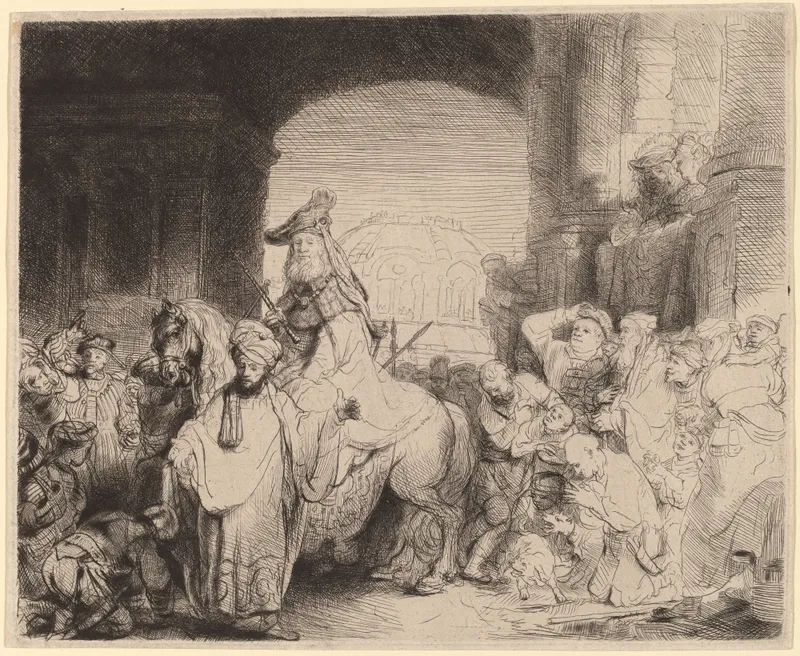
3 Maccabees 5:1-9The Elephants Drugged · The People Cry to Heaven
1Full of rage, altogether fixed in his furious design 2the elephants early on the following day. These five hundred elephants were, when infuriated by the copious draughts of frankincense, to be led up to the execution of death upon the Jews 3 4 5bound the hands of the miserable victims 6 7they invoked the Almighty Lord, and ceaselessly implored with tears their merciful God and Father, Ruler of all, Lord of every power 8 9
The chapter opens on a man at the height of his power and his fury. The king summons Hermon, the officer who keeps his war-elephants, full of rage, altogether fixed in his furious design (v. 1) - and the doubled phrasing is the point. This is a resolve hardened into a settled plan. The instrument he reaches for is calculated for maximum horror: Hermon is to drug five hundred elephants overnight with unmixed wine and handfuls of incense, so that by morning the beasts are out of their minds, infuriated, fit only to be led up to the execution of death upon the Jews (v. 2).
The narrator wants the reader to feel the totality of it. Five hundred animals in a maddened stampede meant to leave no survivor. And then, having set the machine in motion, the king does something chilling in its ordinariness: he went to his feasting, gathering the courtiers and soldiers who hated the Jews the most (v. 3). He can order a massacre and sit down to dinner. The whole apparatus of death is wound tight and the man at the centre of it is entirely at ease.1
The narrator now sets the two sides of the scene against each other with deliberate care. On the one side, the machinery runs smoothly: Hermon fulfilled his commission punctually (v. 4), and the underlings go out about evening to bind the hands of the miserable victims, taking every precaution so that none escape in the night, thinking that the whole race would perish together (v. 5). Every human factor points one way. The Jews are bound, chained, penned, defenceless; the heathen believed the Jews to be destitute of all protection; for chains fettered them about (v. 6).
That last line is the hinge of the whole chapter. By every visible measure the assessment is correct - there is no army to rescue them, no weapon in their hands, no ally with the power to intervene. They are, to all appearances, utterly without help. If you have ever stood where the visible facts all agree that no one is coming, you are standing where they stood. The narrator states the enemy's confident verdict plainly precisely so that he can overturn it.
What looks like total helplessness is about to prove the very stage on which an unseen power displays itself, and the chains that seem to seal the people's doom only sharpen the contrast when the doom does not come.
Against the binding and the chains, the people do the one thing left to them, and the narrator gives it real weight. They invoked the Almighty Lord, and ceaselessly implored with tears their merciful God and Father, Ruler of all, Lord of every power (v. 7). Notice how the prayer names God: the Ruler of all and Lord of every power, the one whose reach is wider than any king's. That naming is itself an act of faith: it confesses that the power arrayed against them, however total it looks, is not the highest power in the scene.
Their petition is exact. They ask God to overthrow the evil purpose and to deliver them by extraordinary manifestation from the death prepared for them (v. 8) - not merely to comfort them in dying but to act, visibly, decisively, in the world. And the narrator records the result of the cry before he records its answer: their litany so earnest went up to heaven (v. 9). The prayer is not lost in the dark of the hippodrome; it rises, it arrives, it is heard.
The chapter has now set its terms. A bound and weeping people with nothing but their voices have appealed to the Lord of every power - and everything that follows is His reply.2
3 Maccabees 5:10-35Sleep, Then Forgetfulness · Two Days Voided
10 11sleep 12he was held fast, and thus his unjust purpose was quite frustrated, and his unflinching resolve greatly falsified 13 14 15 16 17 18 19 20Lose no time, and get ready the elephants against tomorrow, as you did before, for the destruction of these accursed Jews 21 22
The first reversal arrives in the most ordinary form imaginable. Hermon, the beasts duly drugged, came early to the palace to report that all was ready (v. 10) - and the narrator interrupts the machinery with a sentence that is almost a hymn. The Lord, who has sent his good creature sleep from all time by night or by day, thus gratifying whom he wills, diffused a portion thereof now upon the king (v. 11). The deliverance is sleep.
The body's ordinary nightly gift, given now at God's exact appointment. The writer is careful to name sleep a good creature, something God made and dispenses to whom he wills; the same mercy that rests an honest labourer here pins a murderous king to his bed. By this sweet and profound influence of the Lord he was held fast, and the result is stated flatly: his unjust purpose was quite frustrated, and his unflinching resolve greatly falsified (v. 12).
The resolve that seemed unflinching in verse 1 is undone by a gentler force than anyone expected. God does not break the king; He simply lets him sleep, and the appointed hour passes him by.
The reprieve teaches the Jews something, and the narrator marks it. Having escaped the hour which had been fixed, they do not merely sigh in relief; they praised their holy God, and again prayed him who is easily reconciled to display the power of his powerful hand (v. 13). The deliverance deepens their dependence - they have learned where the rescue came from, and they ask for more. Meanwhile the comic indignity of the king's collapse plays out in full.
He cannot be roused until the middle of the tenth hour - late afternoon - when the steward shook the king and gained his attention with difficulty (vv. 14-15). And then the day dissolves into a banquet: the king turns to his potations, seats his guests, and calls for mirth (vv. 16-17). Only over dinner does it occur to him to demand of Hermon why the Jews had been allowed to outlive that day (v. 18) - as though the failure were Hermon's and not heaven's.
Hermon protests, truthfully, that he had done everything the night before (v. 19). The king, with a barbarity exceeding that of Phalaris - the byword tyrant who roasted men alive - brushes it off with a sneer: the Jews might thank his sleep of that day, and the order is simply renewed: get ready the elephants against tomorrow, as you did before (v. 20). He does not perceive the hand on him. He treats his own God-sent sleep as an accident, reschedules the slaughter, and his hateful court goes home to spend the night contriving cruel mockeries for the doomed (vv. 21-22).1
23 24 25stretched forth their hands, and prayed the Greatest God, in mournful strains, again to help them speedily 26 27overwhelmed with a spirit of oblivion about everything, inquired the object of this earnest preparation 28Almighty God who had made him forget all his purpose 29 30by the Providence of God regarding these things, his mind had become entirely confused 31 32 33 34 35
The second morning the machine restarts exactly. The cock crows, Hermon harnesses and goads the beasts in the great colonnade, the city crowds gather to see the hideous spectacle (vv. 23-24), and the Jews, breathless with momentary suspense, again stretched forth their hands and begged God to help them speedily (v. 25). Everything is in place. And then God works a second time, in a register even stranger than sleep. When Hermon comes to tell the king that his desires could now be realized, the king is overwhelmed with a spirit of oblivion about everything and asks, baffled, what all this earnest preparation is for (vv. 26-27).
The narrator will not let it pass as a lapse of memory: this was the working of that Almighty God who had made him forget all his purpose (v. 28). When Hermon and the courtiers explain that the elephants stand ready according to your own strict injunction, the king flies into a rage at Hermon - because by the Providence of God regarding these things, his mind had become entirely confused (vv. 29-30). The reversal is now total and almost ironic.
The man hears his own decree quoted back to him and recoils from it as a monstrous suggestion: were it your parents or children, he tells Hermon, they would deserve the beasts - not these innocent Jews, who me and my forefathers loyally have served (v. 31). God has not merely stayed the king's hand; He has turned the king's own mind against the king's own plan, so that the tyrant becomes, for a moment, the Jews' defender and his faithful officer the one under threat of death (vv. 32-33).
The court empties in confusion, the crowds are sent home (v. 34), and the Jews, hearing of it, praised the glorious God and King of kings, because they had obtained this help, too, from him (v. 35).3
3 Maccabees 5:36-51The Third Rage · The Cry at the Gates of Death
36 37How often, O wretch, must I repeat my orders to you about these same persons? 38 39 40This is the third time that you have ordered their destruction. When the thing is to be done, you change your mind, and recall your instructions 41 42made no account of the changes which his own mind had undergone, issuing in the deliverance of the Jews. He swore a fruitless oath, and determined forthwith to send them to hades, crushed by the knees and feet of the elephants 43
By the third day the cruelty has curdled into something uglier, and the first person to feel it is the king's own officer. The familiar pattern restarts - another banquet, another summons to Hermon - but now the king berates him, How often, O wretch, must I repeat my orders (v. 37), and demands the elephants armed once more… for the extermination of the Jews tomorrow (v. 38). The cruelty of the first day has become a kind of obsessive fury by the third.
And here the narrator does something deft: he lets the king's own court voice the bewilderment the reader feels. The kinsmen reclining with him wondered at his instability and dared to say it aloud: how long do you make trial of us, as of men bereft of reason? This is the third time that you have ordered their destruction. When the thing is to be done, you change your mind, and recall your instructions (vv. 39-40).
They have noticed the pattern but cannot explain it; to them it looks like mere caprice, a king who cannot keep his word, and the whole city is in tumult and on the edge of being plundered because of it (v. 41). What the courtiers read as instability the reader knows to be the hidden hand of God, twice already laid on this man's mind. The same facts that look to the palace like a king losing his grip look to heaven like a decree being held back, again and again, by a power the court cannot see.
The king's response to his own court's warning is to harden. Compared again to Phalaris, the proverbial tyrant, and a prey to thoughtlessness, he made no account of the changes which his own mind had undergone - that is, he refuses to read the meaning of his own repeated failures, the very failures that had been issuing in the deliverance of the Jews (v. 42). This is the spiritual centre of the third scene.
Twice God has turned him aside, and twice he has explained it away - first as an accident of sleep, now as nothing worth considering. A man can be rescued from his own worst act again and again and still refuse to see the hand that keeps staying him. So he escalates to the limit: he swore a fruitless oath - the narrator's adjective already pronouncing its outcome - to send them to hades, crushed by the knees and feet of the elephants, and to go further still: to invade Judea, raze its towns with fire and the sword, and destroy that temple which the heathen might not enter, ending its sacrifices forever (vv. 42-43).
The threat now reaches all the way back to the holy place that opened the book in chapter 1. The king has set himself, with a sworn oath, against not only a people but their God's own house. And the word fruitless, dropped in before the oath is even finished, tells the reader how it will end.1
44 45drenched them with incense and wine, and decked them with frightful instruments 46 47 48 49They gave way, therefore, to lamentations and moans: they kissed each other: those nearest of kin hung about one another's necks: fathers about their sons, mothers their daughters 50 51reveal himself, and have mercy upon those who now lay at the gates of hades
Now everything the king commands actually moves, and the chapter holds its breath. His friends and kinsmen, trusting in his determination, post armed guards through the city (v. 44); Hermon drives the elephants into an almost maniacal state, drenched with incense and wine and fitted with frightful instruments (v. 45); and at first light, the hippodrome packed with spectators, the king himself - his heart teemed with impious rage… with feelings unsoftened, and eyes pitiless - rushes out with the beasts, hungry to gaze at the hard and wretched doom of his victims (vv. 46-47).
This time there is no sleep, no forgetting; the machine is fully in motion and the man is fully awake. And the narrator turns, at last, to the faces of the people inside the arena. Hearing the gate open, seeing the dust raised by the throng and hearing the loud cries of the crowd, they believe they have reached the last moment of their lives (vv. 48-49). What follows is one of the tenderest passages in the book.
They do not riot; they hold each other. They kissed each other; kin hung about one another's necks, fathers clinging to sons and mothers to daughters; nursing women pressed their infants to their breasts which drew what seemed their last milk (v. 49). It is the portrait of love bracing for death: families saying goodbye.
And then, in the very posture of farewell, the people turn the moment into prayer, and the chapter ends on that held note. The pivot is one word: Nevertheless - nevertheless, when they reflected upon the help previously granted them from heaven (v. 50). Memory becomes the seed of hope. They have not forgotten the two days God already stayed the slaughter, and on the strength of that remembered mercy they do something extraordinary in the face of the charging beasts: they prostrated themselves with one accord, even drawing the sucking children from the breasts, and sent up an exceedingly great cry, asking the Lord of all power to reveal himself, and have mercy upon those who now lay at the gates of hades (vv. 50-51).
It is the same appeal with which the chapter began - the cry to the Lord of every power (v. 7) - but now sharpened to its final edge: reveal himself. They are asking God to show His hand openly, to be seen acting, at the literal threshold of death - the gates of hades. The narrator stops the story precisely there, on the unanswered cry, with the elephants bearing down. The deliverance itself waits for the next chapter; chapter 5 ends by gathering the whole people into one upward voice, trapped at the gates of death and casting everything on the God who hears.
And here is the chapter's last word to you: when every human means is spent and you have nothing left but your voice, that cry to the Lord of all power is the truest strength you have.2
Research trail
Sources & further study
These references support the historical, linguistic, manuscript, and contextual notes in this chapter. Scripture remains the primary text; external sources are provided so readers can inspect the research directly.
- 3 Maccabees · introduction, dating, and full textBackground on 3 Maccabees as a Greek work of Hellenistic Judaism - its likely Alexandrian setting, its date, and its theme of a foreign king's assault on Jewish worship answered by divine deliverance - with scholarly notes that help place chapter 5's three thwarted attempts on the people in the hippodrome (vv. 1-51) within the book's own historical world.
- III Maccabees 5 · text with cross-linksThe text of 3 Maccabees 5 in an English translation with links into the wider Jewish library - useful for tracing the order to drug the elephants (vv. 1-6), the people's ceaseless cry (vv. 7-9), the God-sent sleep that voids the first day (vv. 11-12), the forgetfulness that voids the second (vv. 27-30), and the king's third rage met by a final cry from the gates of death (vv. 42-51). (The deep-link to this lesser-printed book may not always resolve; it is included as the standard scholarly reference.)
- 3 Maccabees · overview, canon, and receptionA survey of 3 Maccabees - its contents, authorship, date, and its standing across Christian traditions (received in Eastern Orthodoxy, printed in some Bibles, regarded by others as edifying history) - useful for understanding the legendary elephant episode of chapter 5 (vv. 1-51) as the dramatic centre of a book about Ptolemy IV and the deliverance of the Egyptian Jews.
Where this echoes in Scripture
The Elephants Drugged · The People Cry to Heaven
- Exodus 14:13-14stand still, and see the salvation of the LORD... the LORD shall fight for you, and ye shall hold your peace.The bound people with no power to fight (vv. 5-6) - deliverance promised by God's act, not their strength.
- Psalm 69:33For the LORD heareth the poor, and despiseth not his prisoners.The cry of the chained that goes up to heaven (vv. 7, 9) - the God who does not despise His prisoners.
- Psalm 72:12For he shall deliver the needy when he crieth; the poor also, and him that hath no helper.A people judged to have no helper (v. 6) - exactly those Scripture says God rises to deliver.
- Psalm 75:8in the hand of the LORD there is a cup, and the wine is red; it is full of mixture.The unmixed wine poured to madden the beasts (v. 2) - the cup of full-strength fury, in Scripture poured by God on the proud, not by the proud on the helpless.
- Psalm 34:6This poor man cried, and the LORD heard him, and saved him out of all his troubles.The ceaseless cry of the destitute (vv. 7-9) - the poor man whose cry is precisely the one God hears.
- Luke 18:7-8And shall not God avenge his own elect, which cry day and night unto him... I tell you that he will avenge them speedily.The people's ceaseless cry to heaven (vv. 7, 9) - Jesus' promise that God hears those who cry to Him day and night.
- Hebrews 5:7Who in the days of his flesh, when he had offered up prayers and supplications with strong crying and tears unto him that was able to save him from death, and was heard.The tearful cry of the trapped (v. 7) - the same posture Jesus took in His own hour of helplessness, and was heard.
Sleep, Then Forgetfulness · Two Days Voided
- Proverbs 21:1The king's heart is in the hand of the LORD, as the rivers of water: he turneth it whithersoever he will.The exact mechanism of both reversals (vv. 11-12, 28-30) - the most powerful will in the realm redirected like water.
- Isaiah 44:25That frustrateth the tokens of the liars... that turneth wise men backward, and maketh their knowledge foolish.The king's unflinching resolve falsified and his mind confused (vv. 12, 30) - the LORD who undoes the schemes of those who oppose Him.
- Psalm 127:2for so he giveth his beloved sleep.The God-sent sleep of verse 11 - the same good gift that rests the beloved here pins the persecutor.
- 1 Samuel 26:12a deep sleep from the LORD was fallen upon them.A near-twin providence - a God-sent deep sleep over an enemy camp at the decisive hour, as over the king in verses 11-12.
- Psalm 33:10The LORD bringeth the counsel of the heathen to nought: he maketh the devices of the people of none effect.The decree renewed and again voided (vv. 20, 28) - the counsel of the nations brought to nothing by a higher hand.
- Colossians 1:16-17all things were created by him, and for him... and by him all things consist.The quiet government that turns a king's heart (vv. 11-12, 28-30) - finally personal in the One in whom all things hold together.
- John 10:28-29neither shall any man pluck them out of my hand.A people kept safe by a hand they cannot see (vv. 12, 28) - the security of those no power can pluck from Christ's hand.
The Third Rage · The Cry at the Gates of Death
- Proverbs 21:30There is no wisdom nor understanding nor counsel against the LORD.The king's sworn but fruitless oath (v. 42) - no vow, however fierce, prevails against God's purpose for His people.
- Psalm 18:4-6The sorrows of death compassed me... I called upon the LORD... he heard my voice.The cry from the gates of death (v. 51) - the appeal of those compassed by death, heard from God's temple.
- Matthew 16:18and the gates of hell shall not prevail against it.The people pleading at the gates of hades (v. 51) - answered by the One against whose people those gates cannot prevail.
- Revelation 1:18I am he that liveth, and was dead... and have the keys of hell and of death.Mercy begged at the gates of death (v. 51) - carried by the One who holds the keys to those very gates.
- Psalm 116:8For thou hast delivered my soul from death, mine eyes from tears, and my feet from falling.The people's hope built on help previously granted (v. 50) - the God whose deliverance from death is remembered and trusted again.
- 2 Timothy 1:10our Saviour Jesus Christ, who hath abolished death, and hath brought life and immortality to light through the gospel.Mercy begged at the gates of death (v. 51) - the One who broke those gates open and brought life to light.