3 Maccabees 6
People in this chapter
The hippodrome at Alexandria is fitted out for a massacre. Ptolemy IV has herded the Jews of Egypt onto the racetrack and loosed five hundred elephants, drunk on wine and frankincense, into the crowd. No army meets them, no wall hides them. And at the edge of the ruin one old man stands up to pray. His name is Eleazar, a priest the people honour.1
Tap any highlighted phrase to jump to the commentary that unpacks it.
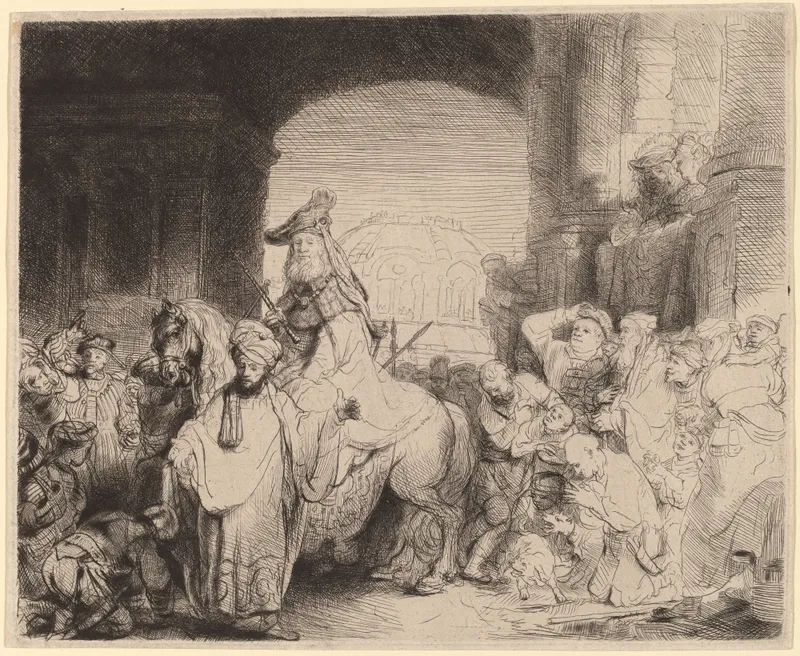
3 Maccabees 6:1-15Eleazar's Prayer · The God Who Remembers
1caused the elders that were about him to cease to call upon the holy God 2 3drowning them in the sea 4 5thou didst refresh with dew in the midst of the fiery furnace 6thou didst bring up to the light unhurt 7 8make thyself swiftly known to all the nations 9 10so that the surrounding valleys echoed it back 11 12 13 14 15for when he saw and heard the work of God, he reproached himself bitterly
The chapter opens at the edge of catastrophe, and the answer to it is an old man. The king's drugged elephants are about to be loosed on a defenceless crowd; there is no rescue in human reach. And it is at exactly this point that Eleazar steps forward - a man honoured among the priests of the country, who had attained to a ripe old age and had passed his life adorned with every virtue (v. 1).
He quiets the elders around him and begins to pray, and the shape of his prayer is worth marking before its content: he addresses God first by who He is - King, mighty in power, most high… who governest all creation with tender mercy - and only then names the danger (v. 2). Then he reaches back into the people's memory and starts with Egypt, where every prayer in Israel begins. Pharaoh, when he lifted himself up in his lawless insolence and tongue of pride, was destroyed with his host, drowning them in the sea, while on Israel God madest the light of thy mercy to shine (v. 3).
The very first rescue Eleazar names is one in which the oppressor's strength became his grave and the helpless went free - the pattern the whole chapter is about to repeat.1
The roll-call gathers force as it goes, each rescue a fresh proof of the same God. Sennacherib, the grievous king of the Assyrians, boasted in his countless hosts and lifted himself against thy holy city, speaking grievous words in his arrogance - and God didst break in pieces that army, the deliverance of one night that Isaiah records, when an angel struck down the Assyrian camp and the great king went home in shame (v. 4; 2 Kings 19:35).
Then the furnace: the three companions in Babylon, who of their own will gave up their lives to the flame rather than serve vain things, whom God didst refresh with dew in the midst of the fiery furnace and deliver unharmed, even to a hair (v. 5; Dan. 3). Notice the thread running through the list. Each of these was a situation with no human exit - a sea with an army behind and water ahead, a city ringed by the world's greatest power, a furnace heated past killing.
Eleazar is building a case. Every rescue he names is one where deliverance came from God alone because nothing else could deliver, which is precisely the corner the Jews of Alexandria are now in.
The last two examples narrow from nations to single endangered men, and they are the most intimate of the five. Daniel, who through envious slanders was cast down into the ground to the lions as food for wild beasts, God didst bring up to the light unhurt (v. 6; Dan. 6) - rescued from a pit dug by jealous men, the mouths of the lions shut by an unseen hand. Jonah, as he wasted away unpitied in the belly of the monster of the deep, God didst look upon again and restore to the sight of his own (v. 7) - brought up alive from the one place no one returns from, the deep itself.
With these two the prayer has reached its point: God delivers not only His people as a nation but the single person sunk past all hope, the one slandered into a death-pit and the one swallowed by the sea. Eleazar, praying for a whole people about to die together, has quietly insisted that the God who hears him is attentive to each life in it. The God of the Red Sea is also the God who counted the hairs of three young men and went down into the fish's belly after one runaway.
He is not so taken up with the crowd that He loses sight of you in it.2
Only now, the memories laid out, does Eleazar make his ask - and it is not the ask one expects. He does not first cry save us. He prays, thou that hatest insolence, thou that art rich in mercy… make thyself swiftly known to all the nations, that thou art with us, O Lord, and hast not turned away thy face from us (v. 8). The deliverance he seeks is, before anything else, that God's own faithfulness be seen - that the watching nations learn the LORD has not abandoned His people.
He even hands God His own word back to Him: Not even when they were in the land of their enemies have I forgotten them (v. 8, echoing Lev. 26:44), and asks Him to make it good. And as the prayer ends the danger arrives in person: the king enters the hippodrome with the wild beasts and all the haughty array of his host, and the Jews lift a great cry to heaven until the valleys echo it back (vv. 9-10).
The chapter has set its two forces face to face - an armed king with a herd of maddened beasts on one side, and on the other a people with nothing but a remembered God and a voice raised to Him. What happens next will decide which of the two was truly strong.
3 Maccabees 6:16-29The Angels and the Great Reversal
16the king reproached his friends, saying 17 18 19 20 21 22they should keep the day of their deliverance with all gladness 23 24 25 26 27arrayed that dance and kept the feast with the gladness of thanksgiving 28 29
The hinge of the whole book is in three short verses (vv. 11-14, narrated at the close of the prayer scene), and it is worth holding them in view here. The all-glorious, almighty, and true God, making manifest his holy countenance, opened the gates of heaven, out of which two angels… came down, visible to all but the Jews; they filled the enemy host with confusion and terror, and the beasts turned back upon the armed forces that followed them (vv. 11, 12, 14).
Three things in that answer repay notice. First, the deliverance is by messengers - the same means by which Sennacherib's army fell in Eleazar's own prayer (v. 4), so that God answers in the very idiom the prayer remembered. Second, the angels are seen by all but the Jews: the people for whom they came do not behold them, and are spared the terror, while the enemy meets the full weight of the heavenly presence.
And third - the great reversal - the elephants, the chosen instrument of slaughter, become the instrument of the slaughterers' undoing, treading down the ranks that drove them.3
The reversal reaches into the king himself. The man who entered the hippodrome with all the haughty array of his host is seized with horror, his insolent boldness drained away (vv. 13, 15), and his wrath collapses to pity and to tears at that which he had before devised (v. 15). Then he rounds on the very counsellors who had urged the cruelty: Ye have done wrong above all kings, and have surpassed even the tyrants in cruelty (v. 16).
It is a startling about-face - the king who ordered the massacre now indicts his own advisers for it, and even reframes the plot as treason against himself, a scheme of no profit to the kingdom (v. 16). He recalls that the Jews in faith held the fortresses of our country and from the beginning surpassed all nations in goodwill toward us (vv. 17-18) - the loyal service he had repaid with death. The narrator does not pause to weigh how sincere the change is or how durable; the point in the moment is plainer than that.
A power no army possessed has bent the unbendable king. What threats and pleas and the reading of the law could not do in earlier chapters, the visible hand of God does in an hour.
The king's new orders run exactly opposite to his old ones, and he gives the reason in the orders themselves. Loose, yea, loose the unjust bonds; send them to their homes in peace - and more, asking pardon for what hath been done (v. 19); release the sons of the almighty and living God of heaven, who… hath granted to our affairs a glory unbroken (v. 20). The man who would not yield to a boundary now confesses the God behind it, owning that the very stability of his reign has been God's gift.
And they, set free in that same hour, gave thanks to the holy God their Saviour, having but now escaped from death (v. 21). The detail to hold is the speed and the totality of it: in that same hour, the people who stood in death's mouth are loosed; and their first act, before relief or revenge or rest, is thanksgiving. They do not credit a change of royal mood or a stroke of luck.
They name their Saviour, the God to whom Eleazar had prayed, and give the rescue back to Him in praise - which is the only fitting response to a deliverance no one but God could have worked.
Then comes the picture the whole grim book has been moving toward, and the narrator lingers on its irony. The king commands a feast of seven days, that the Jews might keep the day of their deliverance with all gladness in the very place wherein they had looked to meet their doom (v. 22). The hippodrome - the killing-ground, fitted out for their destruction - becomes a banquet hall: they… that had gone down into its gates, made themselves a banquet of deliverance instead of a bitter and grievous death, and full of joy parcelled out for couches the place that had been prepared for their destruction and burial (v. 23).
They put away their most pitiful strain of lamentation and take up the song of their fathers, turning all wailing and weeping into dances in token of peaceful joy (v. 24). The exact spot meant for mourning is filled with music. And the reversal is complete on the other side too: those who had registered the Jews for death groaned amongst themselves, being filled with shame, and the fire of their insolent boldness was quenched in dishonour (v. 26).
The persecutors are left in the grief they had prepared for their victims, and the victims dance where they were to have died.1
3 Maccabees 6:30-40The Festival of Salvation · Remember and Rejoice
30 31having been delivered in body and soul as by the hand of God 32 33 34 35having escaped this great peril 36 37they kept as a festival 38 39 40
The deliverance, having freed the people, now restores them, and the chapter follows them all the way home. The king who had decreed their death writes a letter to all the governors of the cities, charging them to deal generously with the Jews, and to supply all things needful for their journey to their own homes (v. 30). The persecuting machinery of the state is turned to their care; the same royal authority that had marked them for slaughter now guarantees their safe passage.
And again the narrator names the true author of the rescue. They go out having been delivered in body and soul as by the hand of God… giving thanks with one accord to the God of their fathers, the everlasting Saviour of Israel (v. 31). Notice the phrase “in body and soul.” They were not only saved from the elephants; they were saved from despair. They had been, in their own eyes and their enemies', as good as dead.
Now they are returned to themselves, and they know exactly Whom to thank for it.
The people's response to so great a rescue is to make sure it will never be forgotten. The Jews, having escaped this great peril, consecrated the days of their sojourning, in which they had found their salvation, as a season of gladness (v. 35); they pass a public ordinance and decree, ratified by an oath, that all the generations of their nation after them should keep these days of joy (v. 36). The reason given is precise and guards the festival against being mistaken for mere revelry: not for the sake of feasting and drinking, but in memory of the deliverance which they had received from God (v. 36).
The same word that opened the chapter - remember - now closes it. Eleazar began by remembering God's past rescues in order to pray; the people end by building remembrance into the calendar so that the rescue they have just seen will become, for their children, exactly the kind of memory Eleazar prayed from. A festival is memory made durable, a way of handing the next generation a deliverance they did not witness so that they too may trust the God who worked it.3
The remembrance is fixed in place as well as in time. They graved the days as it were, upon a pillar, and consecrated a place of prayer in that spot where they had kept the feast (v. 37). The very ground of the intended massacre becomes holy ground - a house of prayer raised where the gallows had stood. Then the homeward movement is told in full: they depart unmolested, free, and overjoyed, carried safely through land and sea and river… by the command of the king (v. 38).
And the restoration is complete down to their property: having gained more authority among their enemies than they had before, in honour and fear, they recover their possessions, every man… according to the register, from neighbours who return them with exceeding fear (vv. 39-40). The book closes its central rescue on a flat declaration of cause: for the most high God had wrought great wonders for their salvation (v. 40). Everything - the freedom, the safe roads, the restored goods, the new standing - is laid at one door.
The wonders were God's, and the salvation was His doing.1
Research trail
Sources & further study
These references support the historical, linguistic, manuscript, and contextual notes in this chapter. Scripture remains the primary text; external sources are provided so readers can inspect the research directly.
- 3 Maccabees · introduction, dating, and full textBackground on 3 Maccabees as a Greek work of Hellenistic Judaism - its likely Alexandrian setting, its date, and its theme of a foreign king's assault on Jewish worship answered by divine deliverance - with scholarly notes that help place Eleazar's hippodrome prayer and the rescue of chapter 6 (vv. 1-29) in their own historical world.
- III Maccabees 6 · text with cross-linksThe text of 3 Maccabees 6 in an English translation with links into the wider Jewish library - useful for tracing the roll-call of deliverances in Eleazar's prayer (vv. 3-8), the plea that God show His face to the nations (vv. 9-15), and the great reversal of the beasts (vv. 18-21). (The deep-link to this lesser-printed book may not always resolve; it is included as the standard scholarly reference.)
- 3 Maccabees · overview, canon, and receptionA survey of 3 Maccabees - its contents, authorship, date, and its standing across Christian traditions (received in Eastern Orthodoxy and the Eastern churches, printed in some Bibles, regarded by others as edifying history) - useful for understanding how the deliverance at the hippodrome (vv. 16-21) and the festival instituted afterward (vv. 30-40) function within the book as a whole.
Where this echoes in Scripture
Eleazar's Prayer · The God Who Remembers
- Psalm 46:1God is our refuge and strength, a very present help in trouble.The faith beneath Eleazar's prayer (vv. 1-8) - the God who is found, and found near, in the moment of crisis.
- Psalm 34:7The angel of the LORD encampeth round about them that fear him, and delivereth them.The answer about to come (vv. 11-14) anticipated - the LORD's messenger as the means of rescue for those who fear Him.
- Psalm 77:11I will remember the works of the LORD: surely I will remember thy wonders of old.The very method of Eleazar's prayer (vv. 3-7) - laying hold of present hope by rehearsing past deliverance.
- 2 Kings 19:35the angel of the LORD went out, and smote in the camp of the Assyrians.The destruction of Sennacherib that Eleazar names (v. 4) - a whole host undone in a night by one messenger.
- Leviticus 26:44yet for all that... I will not cast them away... to destroy them utterly.The promise Eleazar hands back to God (v. 8) - that He would not forget His people in the land of their enemies.
The Angels and the Great Reversal
- Psalm 7:15-16He made a pit, and digged it, and is fallen into the ditch which he made.The great reversal of verse 14 - the destroyer's own device turned back upon his own head.
- Esther 7:10So they hanged Haman on the gallows that he had prepared for Mordecai.The same pattern as the king's undone plot (vv. 14-16) - the snare laid for the righteous closing on the wicked.
- Esther 9:1in the day that the enemies of the Jews hoped to have power over them... it was turned to the contrary.The day braced for slaughter (vv. 14-16) - a people that looked to be destroyed seeing their enemies fall instead.
- Psalm 30:11Thou hast turned for me my mourning into dancing... and girded me with gladness.The feast and dances in the place of doom (vv. 23-24) - God turning the lament itself into joy.
- Psalm 126:5They that sow in tears shall reap in joy.The lamentation turned to the song of their fathers (v. 24) - sorrow that God brings round to gladness.
- Hebrews 1:14Are they not all ministering spirits, sent forth to minister for them who shall be heirs of salvation?The two angels of verse 11 - sent ones who minister to those God is rescuing.
- John 16:20-22your sorrow shall be turned into joy... and your joy no man taketh from you.The deepest form of what verse 24 shows - weeping turned, by God, into a joy that cannot be taken away.
The Festival of Salvation · Remember and Rejoice
- Exodus 12:14this day shall be unto you for a memorial; and ye shall keep it a feast... throughout your generations.The festival decreed in verses 36-37 - a day of rescue fixed in memory and handed to the generations.
- Psalm 126:1-3When the LORD turned again the captivity of Zion, we were like them that dream... the LORD hath done great things for us.The homeward joy of verses 31-38 - a delivered people overwhelmed by the great thing God has done.
- Luke 1:46-47My soul doth magnify the Lord, and my spirit hath rejoiced in God my Saviour.The praise of the rescued (vv. 31-32) - joy that names God Himself as the Saviour.
- Luke 22:19this do in remembrance of me.The deepest form of verse 36 - a deliverance kept in perpetual, thankful memory.
- Luke 10:20rejoice, because your names are written in heaven.The gladness the festival enshrines (v. 36) - joy rooted in the God who saves.
- Psalm 103:1-4Bless the LORD, O my soul... who redeemeth thy life from destruction.The whole movement of verses 31-40 - remembering and blessing the God who redeems life from the pit.