Acts 20
People in this chapter
Paul is leaving. Three years in Ephesus, and a riot of silversmiths has forced him out. He moves through Macedonia and Greece, strengthening the churches he planted, surrounded by men he discipled. Something has shifted in him. The Spirit has warned him, city after city, that chains and afflictions wait in Jerusalem. He cannot turn back. He cannot protect himself. He is bound toward a fate he cannot see past.
Tap any highlighted phrase to jump to the commentary that unpacks it.
Acts 20:1-2Embracing and Departing
1And after the uproar was ceased, Paul called unto him the disciples, and embraced them, and departed for to go into Macedonia. 2And when he had gone over those parts, and had given them much exhortation, he came into Greece,
Nearly three years in Ephesus, and the riot of the silversmiths has forced him out. Before he goes, he embraces the disciples - a gesture of affection and comfort. He will not see most of these faces again. Yet he does not linger in grief. He moves forward with purpose. Macedonia and Greece await. Churches planted in recent years need strengthening. The gospel's momentum cannot stop.
Acts 20:3-6Three Months and Many Companions
3And there abode three months. And when the Jews laid wait for him, as he was about to sail into Syria, he purposed to return through Macedonia. 4And there accompanied him into Asia Sopater of Berea; and of the Thessalonians, Aristarchus and Secundus; and Gaius of Derbe, and Timotheus; and of Asia, Tychicus and Trophimus. 5These going before tarried for us at Troas. 6And we sailed away from Philippi after the days of unleavened bread, and came unto them to Troas in five days; where we abode seven days.
Paul spends three months in Greece, traveling among the churches. He is giving them exhortation - calling them deeper, calling them higher. But the Jewish opposition is building. A plot forms. Paul learns of it and changes his route, returning through Macedonia rather than sailing directly to Syria. The path is longer, but it keeps him alive.
A remarkable list: Sopater from Berea, Aristarchus and Secundus from Thessalonica, Gaius from Derbe, Timothy, Tychicus and Trophimus from Asia. These are Paul's gospel partners, men he has mentored and discipled, men who carry the gospel forward with him. They represent the fruit of his ministry: a movement carried by many hands.
Acts 20:7-9Eutychus Falls
7And upon the first day of the week, when the disciples came together to break bread, Paul preached unto them, ready to depart on the morrow; and continued his speech until midnight. 8And there were many lights in the upper chamber, where they were gathered together. 9And there sat in a window a certain young man named Eutychus, being fallen into a deep sleep: and as Paul was long preaching, he sunk down with sleep, and fell down from the third loft, and was taken up dead.
Paul and the disciples gather on the first day of the week - the Lord's Day - to break bread1. This is the central act of Christian worship: remembering Jesus through the breaking of bread, the outpouring of wine, the shared meal. Paul knows he is leaving tomorrow. He will not gather with these people again. So he preaches until midnight. He has much to say. His final hours with them matter.
Luke is a physician, and he does not soften the diagnosis: dead. The disciples gather him up already grieving, the fact as final as a stone. Sleep is no sin here - the boy is simply spent, overcome by the late hour. And yet the dead will not stay dead when the risen Jesus is present through His apostle.
Acts 20:10-12Eutychus Rises
10And Paul went down, and fell on him, and embracing him said, Trouble not yourselves; for his life is in him. 11When he therefore was come up again, and had broken bread, and eaten, and talked a long while, even till break of day, so he departed. 12And they brought the young man alive, and were not a little comforted.
There is no liturgy here. Paul does not pause to pray, does not lay on hands in some formal rite. He throws himself down the way Elijah stretched over the widow's son and Elisha over the Shunammite's, body against body, and the warmth of the living poured into the dead. Then he says it plainly: his life is in him. The word of a man who has met the risen Jesus on the Damascus road turns out to be enough.
The weight lifts off the whole room. Eutychus breathes; Paul climbs back upstairs, breaks bread, eats, and talks until dawn as if nothing could be more ordinary. They came for a sermon and went home with a sign. And if you have ever sat up through a long night fearing the worst, you know the particular hush that falls when the dreaded thing simply does not happen - the risen Jesus is still Lord over the deaths we fear most.
Acts 20:13-16Bound in the Spirit
13And we went before to ship, and sailed unto Assos, there intending to take in Paul: for so had he appointed, minding himself to go afoot. 14And when he met with us at Assos, we took him in, and came to Mitylene. 15And we sailed thence, and came the next day over against Chios; and the next day we arrived at Samos, and tarried at Trogyllium; and the next day we came to Miletus. 16For Paul had determined to sail by Ephesus, because he would not spend the time in Asia: for he hasted, if it were possible for him, to be at Jerusalem the day of Pentecost.
Picture a man pulled forward by an invisible cord he has no wish to cut. That is Paul on this road. The Spirit has named the cost in every city, and still he leans into it. This is not force that overrides him; it is a will so joined to God's that the two move as one. He cannot see past the next harbor. He goes anyway.
Paul hastens. He does not linger. He passes by Ephesus - the city where he spent nearly three years, where the church is strong, where his heart is - because he is consumed by the calling forward. The geography of his journey becomes a map of his obedience. Every mile is intentional. Every day is moving him toward the crucible.
Acts 20:17-19Serving the Lord with Tears
17And from Miletus he sent to Ephesus, and called the elders of the church. 18And when they were come to him, he said unto them, Ye know, from the first day that I came into Asia, after what manner I have been with you at all seasons, 19Serving the LORD with all humility of mind, and with many tears, and temptations, which befell me by the lying in wait of the Jews:
From Miletus, Paul sends messengers to Ephesus, summoning the elders. They come to him. What unfolds is a ministry review - one apostle speaking to those he's trained to carry the gospel forward. The tone is tender and clear. Paul is making a record. Miletus, the seaport of Ephesus, has been excavated extensively2, revealing the harbor where Paul would have arrived and the theater where such gatherings might have occurred.
Acts 20:20-23Bonds and Afflictions Abide Me
20And how I kept back nothing that was profitable unto you, but have shewed you, and have taught you publickly, and from house to house, 21Testifying both to the Jews, and also to the Greeks, repentance toward God, and faith toward our Lord Jesus Christ. 22And now, behold, I go bound in the spirit unto Jerusalem, not knowing the things that shall befall me there: 23Save that the Holy Ghost witnesseth in every city, saying that bonds and afflictions abide me.
Paul recalls his ministry among them. He has held back nothing. Public teaching and private house-to-house ministry - no filtering, no performance for the crowds and reserve at home. He has given everything. The consistency of his witness in every setting is his claim on their hearts now.
The Spirit has testified repeatedly: bonds and afflictions await in Jerusalem. Paul is not naive. He has heard the warning in every city. Yet he goes anyway, in clarity. He knows the cost. He has counted it. And it does not move him. This is the clarity of a man who has lost everything and found that nothing matters except finishing the course.
Acts 20:24-27I Am Pure from the Blood of All Men
24But none of these things move me, neither count I my life dear unto myself, so that I might finish my course with joy, and the ministry, which I have received of the Lord Jesus, to testify the gospel of the grace of God. 25And now, behold, I know that ye all, among whom I have gone preaching the kingdom of God, shall see my face no more. 26Wherefore I take you to record this day, that I am pure from the blood of all men. 27For I have not shunned to declare unto you all the counsel of God.
It is a courtroom image. A watchman who warned the city has clean hands when the enemy comes; a watchman who stayed silent is answerable for the blood. Paul has sounded every alarm. He soft-pedaled nothing for comfort, hid no hard truth to dodge a beating. Everyone in Ephesus heard the whole gospel from him. If any of them perish now, it is not on his hands. He gave them everything. What they do with it is theirs.
Acts 20:28-31Feed the Church of God
28Take heed therefore unto yourselves, and to all the flock, over the which the Holy Ghost hath made you overseers, to feed the church of God, which he hath purchased with his own blood. 29For I know this, that after my departing shall grievous wolves enter in among you, not sparing the flock. 30Also of your own selves shall men arise, speaking perverse things, to draw away disciples after them. 31Therefore watch, and remember, that by the space of three years I ceased not to warn every one night and day with tears.
The elders are overseers - pastors, bishops, those who shepherd the flock. But Paul reminds them: you did not make yourselves overseers. The Holy Ghost made you. You are caretakers of something that belongs to Christ. Your role is to feed, to guard, to shepherd. The weight of the office is responsibility.
Weigh the price tag for a moment. Blood. Anyone who tends the church has to hold that fact in both hands: this is the body Christ died to gather. Your calling is simply to love it the way He loves it, and to guard it the way He guards it.
Grievous wolves. Not sheep wearing sheep's clothing, but wolves - predators whose nature is to devour. Paul is not being paranoid. He is being prophetic. He sees the danger. From outside will come false teachers. From inside will come those who distort the gospel to gather followers for themselves. The shepherd's job is to know the difference between wolves and sheep, and to protect the flock.
Paul has warned them for three years with tears, in weeping love. He has stayed awake, calling them to stay awake. The shepherd who cares most will sometimes be the least popular, because he will name the danger no one else wants to name. Paul is modeling what faithfulness looks like at the end.
Acts 20:32-35More Blessed to Give
32And now, brethren, I commend you to God, and to the word of his grace, which is able to build you up, and to give you an inheritance among all them which are sanctified. 33I have coveted no man’s silver, or gold, or apparel. 34Yea, ye yourselves know, that these hands have ministered unto my necessities, and to them that were with me. 35I have shewed you all things, how that so labouring ye ought to support the weak, and to remember the words of the Lord Jesus, how he said, It is more blessed to give than to receive.
Paul commends them to God and to the word of His grace. To God alone. The word of grace is able to build them up, to give them an inheritance. The Word of God is the bedrock on which they must stand.
Paul has coveted nothing. No money, no fine clothes, no comfort. He has supported himself by making tents. He has given his strength, his time, his very life. He has nothing to show for it except the gospel spread and lives changed. And this, somehow, is the evidence of his integrity. A leader who covets nothing is a leader who can be trusted.
These hands have ministered in preaching and in working. Paul made tents. He worked with his hands. He provided for himself and for those with him. The apostle who declared the gospel was also the worker who paid his own way.
This saying of Jesus - "It is more blessed to give than to receive" - appears nowhere else in the four Gospels. It is an unwritten saying, an agraphon, preserved only in Paul's recollection. Paul heard it, remembered it, treasured it. Now, in his farewell, he passes it on. These elders must learn what Paul has learned: the blessing lives in the giving. A church built on that principle will be unstoppable.
Acts 20:36-38Kneeling and Weeping
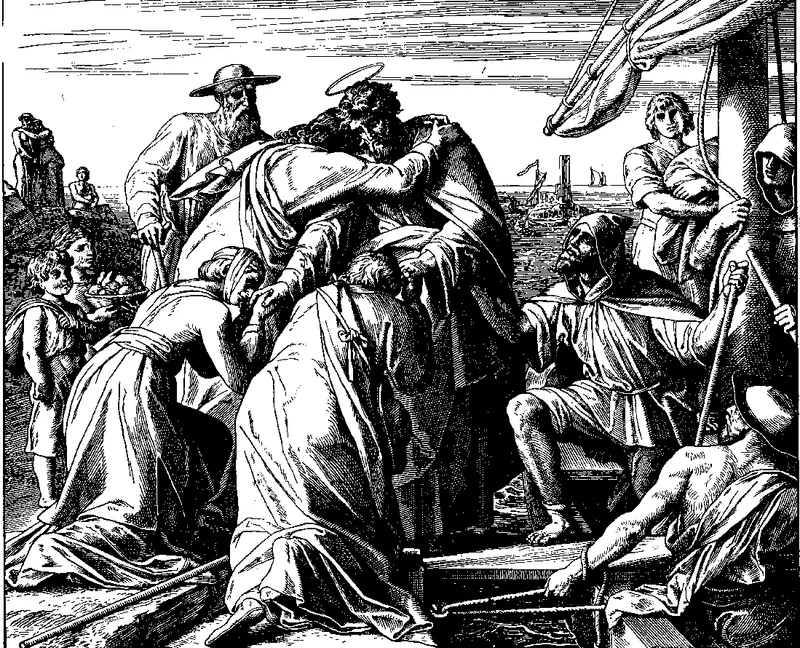
36And when he had thus spoken, he kneeled down, and prayed with them all. 37And they all wept sore, and fell on Paul’s neck, and kissed him, 38Sorrowing most of all for the words which he spake, that they should see his face no more. And they accompanied him unto the ship.
After every word has been spoken, the apostle drops to his knees on a beach. Prayer is not the polite ending to ministry; it is the thing itself. And he prays with them, not merely for them - down at their level, shoulder to shoulder in the sand. The pastor kneels with the flock, never above it.
They weep sore - a great weeping. Men and women who have been taught by Paul, who have seen him face-to-face, who have heard the gospel from his lips now weep because they know they will not see him again. He is leaving them forever. The finality breaks open their hearts.
They fall on his neck and kiss him. This is the embrace of goodbye. Each elder steps forward, wraps his arms around Paul, kisses him. Some embrace him more than once. The physical affection says what words cannot: You matter. You have shaped us. Your leaving breaks our hearts. Will you remember us?
They sorrow most of all because they will see his face no more. The word "face" is key. They wanted his face - his presence, his eyes, his acknowledgment of them as people he knows and loves. A letter or a report from a distance could not supply that. And now that face will never appear to them again.
Acts 20The Binding of the Spirit
This is a chapter about a man emptying himself out. Paul knows Jerusalem will end in chains, maybe in death, and he walks toward it strengthening churches the whole way. He pours out resurrection power over a dead boy. He pours out the whole counsel of God on the elders, holding nothing back. He pours out his own hands, his own tears, his own goodbye. By the time they walk him to the ship, there is almost nothing left to give - which was always the point. A shepherd is something you spend.
We hear “bound” and think of a cage. Paul means the opposite. His will has been so fully fused to the Father's that the two now pull in one direction, and that direction is Jerusalem. He does not know if he will come back. He knows his course, and he means to finish it with joy. A man can be most free at the exact moment he can no longer turn around.
Research trail
Sources & further study
These references support the historical, linguistic, manuscript, and contextual notes in this chapter. Scripture remains the primary text; external sources are provided so readers can inspect the research directly.
- Didache: Teaching on the EucharistEarly apostolic manual describing the breaking of bread and agape meal as core Christian practice, contemporary with Paul's era.
- Miletus ExcavationsOngoing excavations of the Miletus harbor and theater complex where Paul's farewell to the Ephesian elders likely took place.
Where this echoes in Scripture
Eutychus Rises
- John 11:43-44And when he thus had spoken, he cried with a loud voice, Lazarus, come forth. And he that was dead came forth.The same risen Lord who called Lazarus out of the tomb now raises Eutychus through His apostle.
- Mark 5:41-42And he took the damsel by the hand, and said unto her, Talitha cumi... And straightway the damsel arose, and walked.Jesus raises Jairus' daughter by taking her hand - the dead restored at His touch.
- Luke 7:14-15And he came and touched the bier... And he said, Young man, I say unto thee, Arise. And he that was dead sat up.The widow's son at Nain - another young man called back from death.
- 1 Kings 17:21-22And he stretched himself upon the child three times... and the soul of the child came into him again, and he revived.Elijah's posture over the dead boy that Paul's embrace deliberately echoes.
- 2 Kings 4:34-35And he went up, and lay upon the child... and the flesh of the child waxed warm... and the child sneezed seven times, and the child opened his eyes.Elisha raises the Shunammite's son the same way - body laid on body until life returns.
Feed the Church of God
- John 10:11I am the good shepherd: the good shepherd giveth his life for the sheep.The Chief Shepherd whose laid-down life is the purchase price of the flock.
- 1 Peter 5:2-4Feed the flock of God which is among you... And when the chief Shepherd shall appear, ye shall receive a crown of glory.Peter gives the elders the same charge - under-shepherds awaiting the Chief Shepherd.
- Ezekiel 34:2-5Woe be to the shepherds of Israel that do feed themselves! should not the shepherds feed the flocks?... and they were scattered.The shepherds who fed themselves instead of the flock - the very danger Paul warns against.
- Matthew 7:15Beware of false prophets, which come to you in sheep's clothing, but inwardly they are ravening wolves.Jesus' own warning about the wolves Paul says will not spare the flock.
More Blessed to Give
- Luke 6:38Give, and it shall be given unto you; good measure, pressed down, and shaken together, and running over.Jesus on the strange economy of giving that Paul's agraphon distills.
- 2 Corinthians 9:7Every man according as he purposeth in his heart, so let him give... for God loveth a cheerful giver.The joy in giving that the word “blessed” here carries.
- Acts 18:3And because he was of the same craft, he abode with them, and wrought: for by their occupation they were tentmakers.The hands that made tents - Paul paying his own way so the gospel cost his hearers nothing.
- 1 Thessalonians 2:9For ye remember, brethren, our labour and travail: for labouring night and day... we preached unto you the gospel of God.Paul's own testimony of working so as not to burden those he served.