Acts 28
People in this chapter
Paul reaches Rome in chains. A viper had already tried him on the beach at Malta and failed; he shook it into the fire and felt no harm.1 Now he sits under guard in a rented house, a soldier wired to his wrist, and from that room he calls the leaders of the Jews together and reasons with them about Jesus from morning till evening. Some believe. Some do not. The chain holds. The word does not.
Tap any highlighted phrase to jump to the commentary that unpacks it.
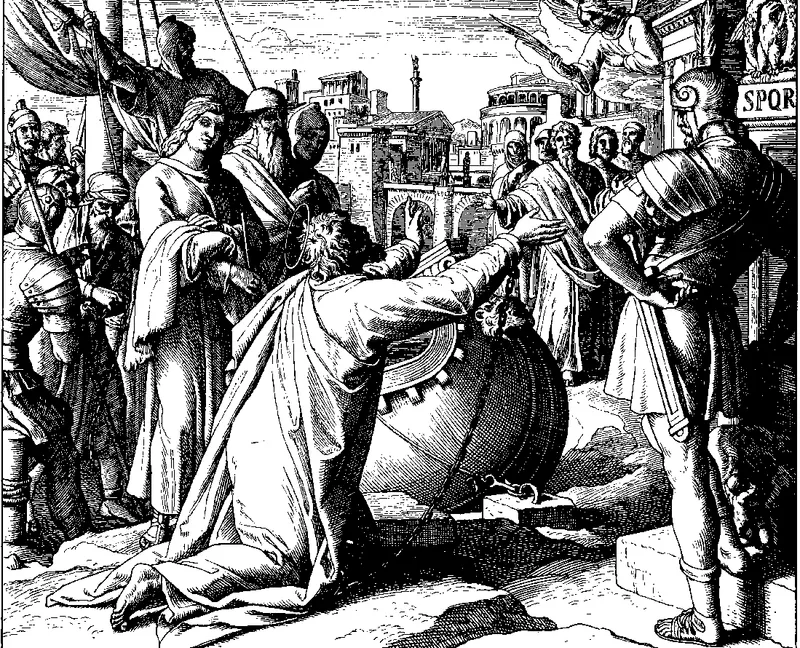
Acts 28:1-3Kindness on a Strange Shore
1And when they were escaped, then they knew that the island was called Melita. 2And the barbarous people shewed us no little kindness: for they kindled a fire, and received us every one, because of the present rain, and because of the cold. 3And when Paul had gathered a bundle of sticks, and laid them on the fire, there came a viper out of the heat, and fastened on his hand.
Malta is an island south of Sicily1, far from Jerusalem, Antioch, and Ephesus, with no churches waiting for Paul. Its people are what Luke calls “barbarians” - literally, non-Greek speakers, outsiders to the covenant. And yet these pagans, these barbarians, show Paul “no little kindness.” They kindle a fire against the cold. They receive him. The gospel has a way of breaking through the thickest walls, opening the hardest hearts.
Acts 28:4-6From Murderer to a God
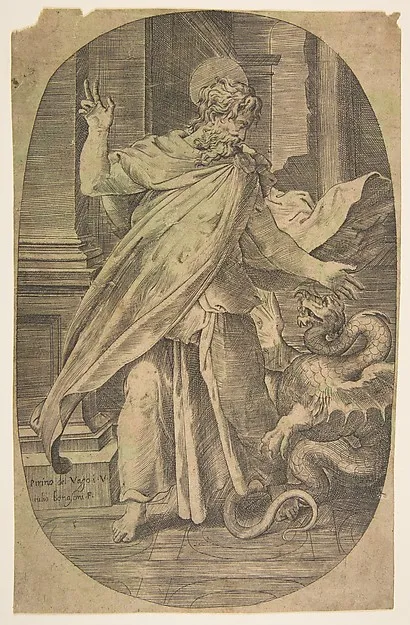
4And when the barbarians saw the venomous beast hang on his hand, they said among themselves, No doubt this man is a murderer, whom, though he hath escaped the sea, yet vengeance suffereth not to live. 5And he shook off the beast into the fire, and felt no harm. 6Howbeit they looked when he should have swollen, or fallen down dead suddenly: but after they had looked a great while, and saw no harm come to him, they changed their minds, and said that he was a god.
The Greek behind “venomous beast” is echidna - the very word Jesus used when He called the Pharisees a “generation of vipers” (Matt. 12:34). The islanders read the bite like a verdict: this man escaped the sea, so the gods are finishing the job. They wait for him to swell and drop. No swelling, no death - just a man flicking a snake off his hand. So they lurch to the opposite verdict and call him a god. Both readings miss it. He is a servant of the One whose life cannot be poisoned out of him.
Acts 28:7-10Healings on the Island
7In the same quarters were possessions of the chief man of the island, whose name was Publius; who received us, and lodged us three days courteously. 8And it came to pass, that the father of Publius lay sick of a fever and of a bloody flux: to whom Paul entered in, and prayed, and laid his hands on him, and healed him. 9So when this was done, others also, which had diseases in the island, came, and were healed: 10Who also honoured us with many honours; and when we departed, they laded us with such things as were necessary.
This was not a head cold. A wasting fever with internal bleeding was, in the ancient world, often a death sentence, and Publius's father was sliding toward it. Paul does what he has done since the early chapters: he goes in, he prays, he lays on his hands, and the man stands up well. Notice how little drama Luke gives it. By now healing is so ordinary to the apostolic life that it barely needs a sentence. The wonder you would build a whole story around, he reports almost in passing.
The laying on of hands is a sign of identification, a moment where the apostle stands with the sick person and brings the power of Christ to bear on the broken body. Throughout Acts, this gesture marks the moment the Spirit breaks through - Philip lays hands, Peter lays hands, Paul lays hands. And what was broken begins to heal.
Acts 28:11-14The Journey to Rome
11And after three months we departed in a ship of Alexandria, which had wintered in the isle, whose sign was Castor and Pollux. 12And landing at Syracuse, we tarried there three days. 13And from thence we fetched a compass, and came to Rhegium: and after one day the south wind blew, and we came the next day to Puteoli: 14Where we found brethren, and were desired to tarry with them seven days: and so we went toward Rome.
A whole winter passes on the island before the sea is safe again. Paul has not wasted it - he has healed, testified, and planted faith in soil far from any synagogue. Then he boards the next ship out, and Luke can't resist the detail: its figurehead is Castor and Pollux, the pagan twins sailors prayed to for protection. A vessel under those gods carries the apostle of the living God straight toward Rome. Even the empire's idols end up ferrying the gospel where it means to go.
At the great southern port of Puteoli, something unexpected is waiting: brethren. Believers already on Italian soil, already gathered, already eager to take Paul in for a week. No apostle planted them. The gospel had simply run ahead of the man, slipping into the empire's harbors before he ever set foot there. He arrives in Italy and finds family.
Acts 28:15-16“Paul thanked God, and took courage”
15And from thence, when the brethren heard of us, they came to meet us as far as Appii forum, and The three taverns: whom when Paul saw, he thanked God, and took courage. 16And when we came to Rome, the centurion delivered the prisoners to the captain of the guard: but Paul was suffered to dwell by himself with a soldier that kept him.
Word of Paul's approach runs up the Appian Way ahead of him, and the Roman believers do not wait at home. They walk out - one group as far as the Forum of Appius, some forty miles south, another to the Three Taverns nearer the city - just to fall in beside a prisoner they have never met. They know him only by his letters. It is enough. The moment Paul catches sight of them on the road, the weight lifts: he thanks God and takes courage.
It is a strange kind of custody - neither a cell nor real freedom. Paul is allowed his own rented quarters with a single soldier assigned to him, the roads of empire having carried him here at Rome's expense2. The chain stays on. The door stays open to visitors. Watch what the machinery of the most powerful state on earth has actually done: it has given a poor preacher a fixed address, a guaranteed audience, and two undisturbed years in the capital of the world.
Caesar thinks he is holding a defendant. He is housing a missionary.
Acts 28:17-19Paul Calls the Chief of the Jews
17And it came to pass, that after three days Paul called the chief of the Jews together: and when they were come together, he said unto them, Men and brethren, though I have committed nothing against the people, or customs of our fathers, yet was I delivered prisoner from Jerusalem into the hands of the Romans. 18Who, when they had examined me, would have let me go, because there was no cause of death in me. 19But when the Jews spake against it, I was constrained to appeal unto Caesar; not that I had ought to accuse my nation of.
Paul's opening is careful. He affirms the customs of the fathers, the traditions of the people. He is a Jew defending the deepest hopes of Judaism itself, speaking to Jews. His message is “the hope your fathers waited for has come.”
Acts 28:20-22Bound for the Hope of Israel
20For this cause therefore have I called for you, to see you, and to speak with you: because that for the hope of Israel I am bound with this chain. 21And they said unto him, We neither received letters out of Judaea concerning thee, neither any of the brethren that came shewed or spake any harm of thee. 22But we desire to hear of thee what thou thinkest: for as concerning this sect, we know that every where it is spoken against.
Paul wants them to see him. To hear him. To understand why he stands before them in chains. He is a Jew speaking to Jews about the faith of Israel. There is no contempt in his voice, only the deep desire that they understand what he has understood: that Jesus is the Messiah Israel has been waiting for since the days of Abraham.
Acts 28:23-27The Hardening of Israel
23And when they had appointed him a day, there came many to him into his lodging; to whom he expounded and testified the kingdom of God, persuading them concerning Jesus, both out of the law of Moses, and out of the prophets, from morning till evening. 24And some believed the things which were spoken, and some believed not. 25And when they agreed not among themselves, they departed, after that Paul had spoken one word, Well spake the Holy Ghost by Esaias the prophet unto our fathers, 26Saying, Go unto this people, and say, Hearing ye shall hear, and shall not understand; and seeing ye shall see, and not perceive: 27For the heart of this people is waxed gross, and their ears are dull of hearing, and their eyes have they closed; lest they should see with their eyes, and hear with their ears, and understand with their heart, and should be converted, and I should heal them.
Paul reasons all day. From the law. From the prophets. From the oldest texts of Israel. He shows them that Jesus is not a departure from what Moses and the prophets said - He is their fulfillment. Some believe. Some do not. And when the conversation breaks down, Paul quotes Isaiah 6, the prophet's own lament over a people who will not hear.
Isaiah 6 is a passage about a people who refuse to hear, who close their own eyes, who harden their own hearts. They refuse God, and the tragedy lies there: the people's resistance has grown so strong they have lost the capacity to perceive what is plainly true.
Acts 28:28-31“No man forbidding him”
28Be it known therefore unto you, that the salvation of God is sent unto the Gentiles, and that they will hear it. 29And when he had said these words, the Jews departed, and had great reasoning among themselves. 30And Paul dwelt two whole years in his own hired house, and received all that came in unto him, 31Preaching the kingdom of God, and teaching those things which concern the Lord Jesus Christ, with all confidence, no man forbidding him.
Paul has given the Jews the first hearing. They have rejected. And so the door turns outward. The salvation of God is sent unto the Gentiles. This is the unfolding of what Jesus Himself said in Acts 1:8 - “ye shall be witnesses unto me… unto the uttermost part of the earth.” Jerusalem first, then Judaea, then Samaria, then the uttermost parts. By Acts 28, that prophecy is being lived out. Paul in Rome means the gospel in the center of the world.
Luke closes with a routine. For the better part of two years Paul keeps an open door, taking in everyone who climbs the stairs - teaching, counseling, dictating letters that the church would read for the next two thousand years. Several of the prison letters take shape in this room. The kingdom is moving the way it usually moves: one visitor at a time, one long conversation after another, patient and unglamorous and unstoppable.
Research trail
Sources & further study
These references support the historical, linguistic, manuscript, and contextual notes in this chapter. Scripture remains the primary text; external sources are provided so readers can inspect the research directly.