Joshua 3
People in this chapter
Joshua 3 is the story of Israel crossing the Jordan River - the final barrier between the wilderness and the promised land. The Jordan runs at flood stage. The priests carry the ark of God. When their feet touch the water, the river stops entirely. The priests stand on dry ground in the middle of the riverbed while all Israel crosses over. It is the second great sign of God's presence that defines a generation: the Red Sea for those who left Egypt, the Jordan for those who will inherit Canaan.
Tap any highlighted phrase to jump to the commentary that unpacks it.
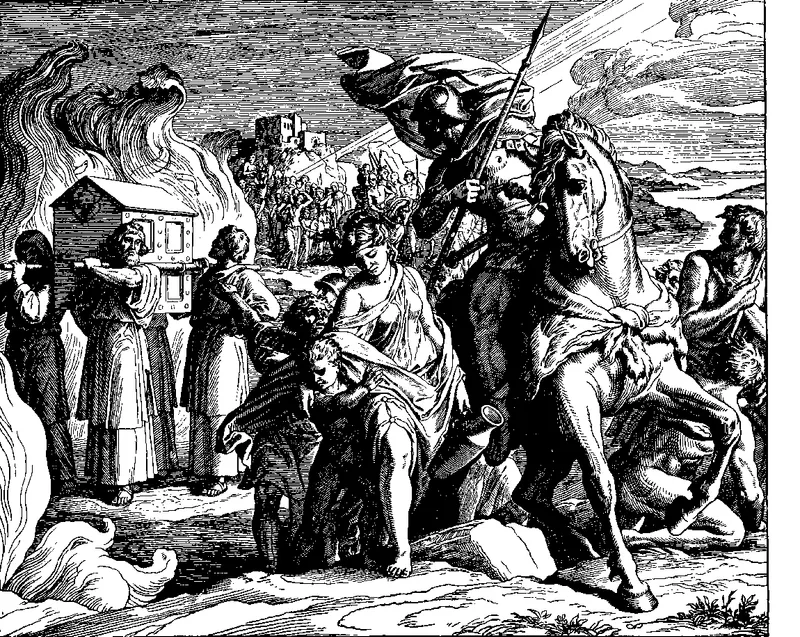
Joshua 3:1-4Sanctify Yourselves
1And Joshua rose early in the morning; and they removed from Shittim, and came to Jordan, he and all the children of Israel, and lodged there before they passed over. 2And it came to pass after three days, that the officers went through the host; 3And they commanded the people, saying, When ye see the ark of the covenant of the LORD your God, and the priests the Levites bearing it, then ye shall remove from your place, and go after it. 4Yet there shall be a space between you and it, about two thousand cubits by measure: come not near unto it, that ye may know the way by which ye must go: for ye have not passed this way heretofore.
Israel must follow the ark1. Not Moses, not Joshua, not even the cloud pillar anymore. The physical presence of God, carried by the priests, leads the way. For a generation that has never crossed a river like this, that has never seen the promised land, that has heard only reports and stories - obedience means following something they cannot yet understand.
Two thousand cubits - roughly half a mile. Distance and proximity both matter. The ark must be followed, yet not crowded, not presumed upon. There is a reverence that keeps space. God goes before; we follow behind, keeping the distance that honour requires.
Joshua 3:5-7The Lord Will Do Wonders
5And Joshua said unto the people, Sanctify yourselves: for to morrow the LORD will do wonders among you. 6And Joshua spake unto the priests, saying, Take up the ark of the covenant, and pass over before the people. And they took up the ark of the covenant, and went before the people. 7And the LORD said unto Joshua, This day will I begin to magnify thee in the sight of all Israel, that they may know that, as I was with Moses, so I will be with thee.
Sanctify means to set apart, to cleanse, to make holy. Joshua calls the people to inner readiness - they cannot make the miracle happen by washing, but they can prepare their hearts to receive it. Sanctification is the prerequisite. God moves for a people who have made themselves ready to honor what He is about to do.
God chooses the moment of flood - the time the obstacle is at its worst. His power is shown when we are most dependent.
Joshua 3:8-10The Ark Passes Over
8And thou shalt command the priests that bear the ark of the covenant, saying, When ye are come to the brink of the water of Jordan, ye shall stand still in Jordan. 9And Joshua said unto the children of Israel, Come hither, and hear the words of the LORD your God. 10And Joshua said, Hereby ye shall know that the living God is among you, and that he will without fail drive out from before you the Canaanites, and the Hittites, and the Hivites, and the Perizzites, and the Girgashites, and the Amorites, and the Jebusites.
Joshua lists eight nations - the obstacles that seem insurmountable. But his word to Israel is: one God. Not eight gods competing with one God. Not a god as powerful as these nations' gods. The living God. The one who alone breathes, moves, acts. When the presence of God is real and active among a people, all other powers shrink to their true size.
Joshua 3:11-13The Priests Step Into the Flood
11Behold, the ark of the covenant of the LORD of all the earth passeth over before you into Jordan. 12Now therefore take you twelve men out of the tribes of Israel, out of every tribe a man. 13And it shall come to pass, as soon as the soles of the feet of the priests that bear the ark of the LORD, the LORD of all the earth, shall rest in the waters of Jordan, that the waters of Jordan shall be cut off from the waters that come down from above; and they shall stand upon an heap.
The text will tell us where the water piles up: near the city of Adam, at a place called Zaretan2. The water does not disappear; it gathers into a heap, dammed up by God's hand. Below, toward the Dead Sea, the waters fail and are cut off. For the priests and for Israel, there is dry ground.
Notice the order: the priests must step in first. They do not wait for the river to stop before advancing. The word of God comes first - "as soon as the soles of your feet touch the water, the waters will be cut off." Faith does not wait for sight. The priests step in on the promise, and then the waters part. This is the only order that matters: obedience first, then deliverance.
Joshua 3:14-16The Waters Heap Up
14And it came to pass, when the people removed from their tents, to pass over Jordan, and the priests bearing the ark of the covenant before the people; 15And as they that bare the ark were come unto Jordan, and the feet of the priests that bare the ark were dipped in the brim of the water, (for Jordan overfloweth all his banks all the time of harvest,) 16That the waters which came down from above stood and rose up upon an heap very far from the city Adam, that is beside Zaretan: and those that came down toward the sea of the plain, even the salt sea, failed, and were cut off: and the people passed over right against Jericho.
The text pauses to remind us: this is not a normal time to cross. The Jordan overflows at harvest. The water is at its worst - deep, fast, impassable by any natural means. And God chooses precisely this moment. Not because He wants to show off. But because when the obstacle is at its worst, we cannot mistake His hand for our own effort.
The waters gather at Adam - a name that means "man" or "humankind." Thousands of miles upstream, the waters pile up at the city of Adam. The precision is not incidental. The text is saying: from the very human place upriver, waters are held back so that God's people can pass. God does not eliminate the obstacle; He gathers it, controls it, makes it stand as a monument to His power.
Joshua 3:17All the People Crossed on Dry Ground
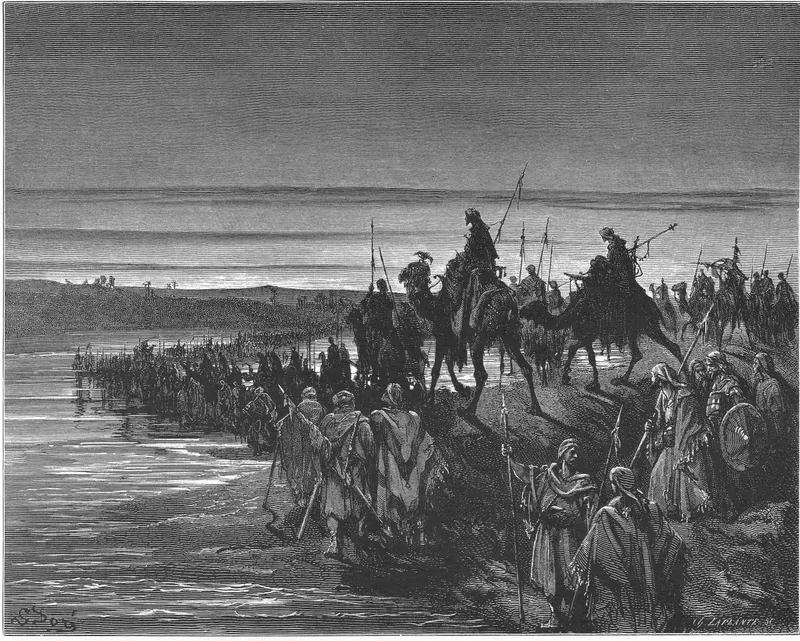
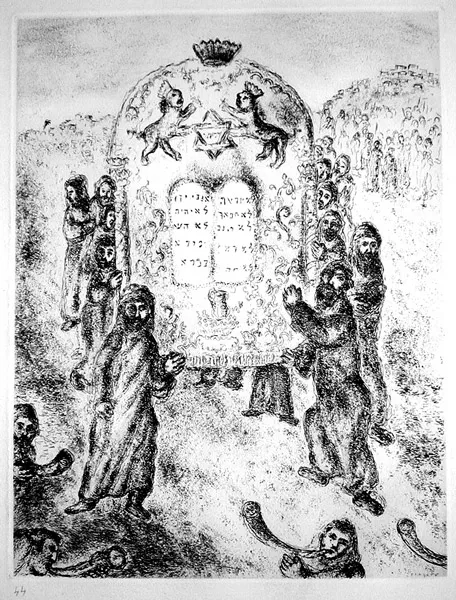
17And the priests that bare the ark of the covenant of the LORD stood firm on dry ground in the midst of Jordan, and all the Israelites passed over on dry ground, until all the people were passed clean over Jordan.
The priests do not move. They stand unmoved while the entire nation walks past them - men, women, children, livestock, and everything they possess. The presence of God, embodied in the ark and the priests bearing it, is stable. They do not waver. The ground under them is dry. And because the ark stands firm in the midst of the waters, all the people can pass through safely.
Not a single person was left behind. Not a child was lost. All the people were passed clean over. This is the sign of God's care: His presence was sufficient for everyone. The whole nation, at its most vulnerable in the middle of a river that wants to sweep them away, crossed on dry ground because one thing held firm: the presence of God.
Research trail
Sources & further study
These references support the historical, linguistic, manuscript, and contextual notes in this chapter. Scripture remains the primary text; external sources are provided so readers can inspect the research directly.