Joshua 4
People in this chapter
Joshua 4 picks up the instant the crossing is finished. The Jordan has been held back, the priests bearing the ark have stood firm in the dry riverbed, and the whole nation has passed over from the wilderness into the promised land. And the very first thing the LORD commands is a monument. Take you twelve men out of the people, out of every tribe a man… Take you hence out of the midst of Jordan… twelve stones, and ye shall carry them over with you, and leave them in the lodging place (vv. 2-3).
Before Israel does anything else in the land, God has them gather stones - because what He has just done must not be allowed to slip out of memory.1
Tap any highlighted phrase to jump to the commentary that unpacks it.
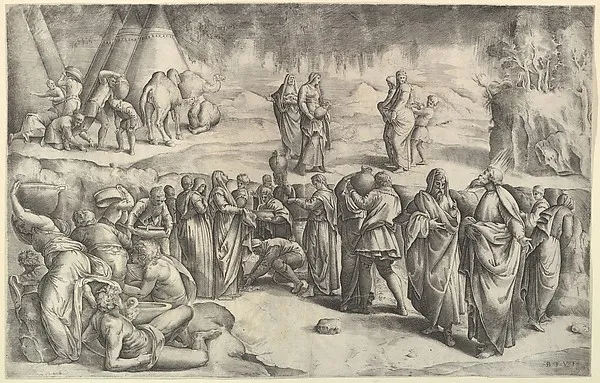
Joshua 4:1-8Take You Twelve Stones Out of the Midst of Jordan
1And it came to pass, when all the people were clean passed over Jordan, that the LORD spake unto Joshua, saying, 2Take you twelve men out of the people, out of every tribe a man, 3And command ye them, saying, Take you hence out of the midst of Jordan, out of the place where the priests’ feet stood firm, twelve stones, and ye shall carry them over with you, and leave them in the lodging place, where ye shall lodge this night. 4Then Joshua called the twelve men, whom he had prepared of the children of Israel, out of every tribe a man: 5And Joshua said unto them, Pass over before the ark of the LORD your God into the midst of Jordan, and take you up every man of you a stone upon his shoulder, according unto the number of the tribes of the children of Israel: 6That this may be a sign among you, that when your children ask their fathers in time to come, saying, What mean ye by these stones? 7Then ye shall answer them, That the waters of Jordan were cut off before the ark of the covenant of the LORD; when it passed over Jordan, the waters of Jordan were cut off: and these stones shall be for a memorial unto the children of Israel for ever. 8And the children of Israel did so as Joshua commanded, and took up twelve stones out of the midst of Jordan, as the LORD spake unto Joshua, according to the number of the tribes of the children of Israel, and carried them over with them unto the place where they lodged, and laid them down there.
The chapter opens at the moment the crossing is complete: when all the people were clean passed over Jordan, that the LORD spake unto Joshua (v. 1). The phrase clean passed over insists on the totality of it - not most of the people, not the strong and the swift, but all the people, every family and every tribe, wholly across. The miracle has touched the entire nation; there is no one left in the riverbed, no one stranded behind.
And it is precisely at this point of completion that God speaks. The first word He gives in the new land is a command about remembering. Before Israel has struck a single blow at Jericho, before they have built a house or planted a field, the LORD turns their attention backward to what He has just done and tells them to make sure it is never lost. The instinct of the moment would be to press on while the way is open; God's instinct is to stop and mark the place.1
The command is exact in its arithmetic: Take you twelve men out of the people, out of every tribe a man (v. 2), and the stones are to be taken up according unto the number of the tribes of the children of Israel (v. 5). Twelve men, twelve stones, one for each tribe - the number is not incidental. Every branch of the nation has a representative who goes down into the riverbed and shoulders a stone, so that no family line stands outside the witness.
This is the testimony of the whole people, gathered up tribe by tribe. And the place from which the stones are taken is specified with care: out of the place where the priests' feet stood firm (v. 3). The memorial is to be built from the very ground the ark had sanctified, the spot where the waters were held back. Each stone carries with it the memory of where it came from - the heart of the dry riverbed, beneath the feet of the men who bore the presence of God.
Then comes the purpose, and it is the hinge of the whole chapter: That this may be a sign among you, that when your children ask their fathers in time to come, saying, What mean ye by these stones? (v. 6). The stones are a sign, an object designed to raise a question. God anticipates the scene exactly - a child of a later generation, who never stood at the Jordan, will see this strange heap of river-stones at the camp and ask what it is for.
That question is the entire point. The monument is built to be asked about. And when the child asks, the parent has an answer ready: Then ye shall answer them, That the waters of Jordan were cut off before the ark of the covenant of the LORD… and these stones shall be for a memorial unto the children of Israel for ever (v. 7). Notice the mechanism God has set up. He does not command the parents to lecture; He arranges the world so the children will ask, and so the telling will be drawn out of the parent by a child's own curiosity.
Faith is here designed to pass down through wonder - the stone provokes, the child inquires, the story is told, and the deliverance lives another generation.
Joshua 4:9-14The People Hasted Over · The LORD Magnified Joshua
9And Joshua set up twelve stones in the midst of Jordan, in the place where the feet of the priests which bare the ark of the covenant stood: and they are there unto this day. 10For the priests which bare the ark stood in the midst of Jordan, until everything was finished that the LORD commanded Joshua to speak unto the people, according to all that Moses commanded Joshua: and the people hasted and passed over. 11And it came to pass, when all the people were clean passed over, that the ark of the LORD passed over, and the priests, in the presence of the people. 12And the children of Reuben, and the children of Gad, and half the tribe of Manasseh, passed over armed before the children of Israel, as Moses spake unto them: 13About forty thousand prepared for war passed over before the LORD unto battle, to the plains of Jericho. 14On that day the LORD magnified Joshua in the sight of all Israel; and they feared him, as they feared Moses, all the days of his life.
Alongside the twelve stones carried out to Gilgal, there is a second set: And Joshua set up twelve stones in the midst of Jordan, in the place where the feet of the priests… stood: and they are there unto this day (v. 9). Two memorials, then, not one. Twelve stones lifted out of the river and set up where the people would camp and pass and remember; and twelve stones set up in the riverbed itself, in the exact spot the priests had stood, soon to be covered by the returning waters.
The note they are there unto this day tells us they remained - standing beneath the river, unseen by the generations that would later walk the bank, but real all the same. There is something quietly instructive in this. One memorial is visible, public, made to be asked about; the other is hidden under the water, witnessed by no one but God. Both belong to the story. What God does in the open and what He does where no eye can follow are equally His work, equally worth marking, equally remembered - even when only He can see the stones.
Verse 10 holds the most arresting image in the chapter: the priests which bare the ark stood in the midst of Jordan, until every thing was finished… and the people hasted and passed over. Picture it. The priests carry the ark down into the dry riverbed and there they stand - in the very midst, where the wall of water hangs back on either side. And they do not move. They hold their position until every last command is fulfilled and every last Israelite is across.
The people hasted; the priests stood. The whole nation streams past them to safety while the bearers of the ark remain in the place of greatest exposure, the boundary held open by their staying put. This is leadership of a particular kind: standing firm in the dangerous middle so that everyone else can get through. The priests are the last to leave the riverbed precisely because they are first in responsibility. Their stillness is what makes the people's haste possible.
Verses 11 through 13 turn to the order of the crossing. When all the people were over, the ark of the LORD passed over, and the priests, in the presence of the people (v. 11) - the ark, which had gone first into the river, comes up last, the whole congregation watching. Then the eastern tribes are singled out: the children of Reuben, and the children of Gad, and half the tribe of Manasseh, passed over armed before the children of Israel (v. 12).
These were the tribes who had received their inheritance on the near side of the Jordan and could have stayed home; instead, as Moses had bound them, they crossed over armed - about forty thousand prepared for war (v. 13) - to fight alongside their brethren until the land was won. The detail matters. Their own portion was already secure, yet they would not rest in it while their brothers still had battles to fight. They kept their word, took up arms ahead of the others, and went over before the LORD unto battle. The crossing is the threshold of the story; a united, armed nation now stands on the plains of Jericho.
The section ends with a sentence about Joshua that carefully keeps the credit in the right place: On that day the LORD magnified Joshua in the sight of all Israel; and they feared him, as they feared Moses, all the days of his life (v. 14). The LORD magnifies Joshua. The standing he gains in the eyes of the people is the fruit of God working visibly through a man who obeyed. This is the fulfillment of a promise given at the start: This day will I begin to magnify thee in the sight of all Israel, that they may know that, as I was with Moses, so I will be with thee (Josh. 3:7).
The fear the people now have toward Joshua is really reverence for the God they have seen at work through him - the same God who had been with Moses is plainly with his successor. True authority, the verse suggests, is conferred by God. It comes to the leader who steps aside enough that the hand of God can be seen, and it lasts - all the days of his life.
Joshua 4:15-24The Waters Returned · That All the Earth Might Know
15And the LORD spake unto Joshua, saying, 16Command the priests that bear the ark of the testimony, that they come up out of Jordan. 17Joshua therefore commanded the priests, saying, Come ye up out of Jordan. 18And it came to pass, when the priests that bare the ark of the covenant of the LORD were come up out of the midst of Jordan, and the soles of the priests’ feet were lifted up unto the dry land, that the waters of Jordan returned unto their place, and flowed over all his banks, as they did before. 19And the people came up out of Jordan on the tenth day of the first month, and encamped in Gilgal, in the east border of Jericho. 20And those twelve stones, which they took out of Jordan, did Joshua pitch in Gilgal. 21And he spake unto the children of Israel, saying, When your children shall ask their fathers in time to come, saying, What mean these stones? 22Then ye shall let your children know, saying, Israel came over this Jordan on dry land. 23For the LORD your God dried up the waters of Jordan from before you, until ye were passed over, as the LORD your God did to the Red sea, which he dried up from before us, until we were gone over: 24That all the people of the earth might know the hand of the LORD, that it is mighty: that ye might fear the LORD your God for ever.
The miracle ends as deliberately as it began. The LORD commands the priests to come up out of Jordan, Joshua relays the word, and then: when the priests… were come up out of the midst of Jordan, and the soles of the priests' feet were lifted up unto the dry land… the waters of Jordan returned unto their place, and flowed over all his banks, as they did before (v. 18). The river was held back only so long as the ark was in its midst; the moment the bearers of the presence of God set foot on the bank, the waters came roaring back to their full flood.
The timing makes a quiet point about where the power lay. Nothing in the riverbed itself parted the Jordan - not the courage of the priests, not the urgency of the people. The waters stood and the waters returned in step with the ark, the manifest presence of the LORD. And once they returned, they overflowed all his banks, as they did before. The crossing leaves no bridge behind, no lingering dry path. The way that had opened for Israel closes; the river resumes its barrier, and the people stand in the land with the flood between them and the wilderness they came from.
A small chronological note carries more weight than it first appears: the people came up out of Jordan on the tenth day of the first month, and encamped in Gilgal (v. 19). The tenth day of the first month is the very day, set down in Exodus, when each household was to take up its Passover lamb: In the tenth day of this month they shall take to them every man a lamb (Ex. 12:3).
Israel enters the land on the same calendar day its fathers had begun the first Passover in Egypt. The two great deliverances are bound to one date. The exodus from Egypt began with a lamb taken on the tenth day and its blood on the doorposts; the entry into Canaan is completed as the people come up from the Jordan on that same tenth day. Salvation history is woven through with such echoes - the God who brought them out is plainly the God who brings them in, and He marks the bringing-in on the day He once marked the bringing-out.
From Gilgal, just within the land, the conquest will begin; but it begins on a day already heavy with the memory of redemption.
Now the chapter draws its two threads together. Those twelve stones, which they took out of Jordan, did Joshua pitch in Gilgal (v. 20) - the stones carried up from the riverbed are at last set in their place, and Joshua repeats over them the charge the LORD had given at the start: When your children shall ask their fathers in time to come, saying, What mean these stones? Then ye shall let your children know, saying, Israel came over this Jordan on dry land (vv. 21-22).
The answer the parents are to give is concrete and unembellished - an event, plainly told: Israel came over this Jordan on dry land. And it is set in the long line of God's saving acts: For the LORD your God dried up the waters of Jordan from before you… as the LORD your God did to the Red sea (v. 23). The children who ask are to be told two things together - that God dried the Jordan for them, and that He had done the very same at the Red sea for their fathers.
The new deliverance is tied to the old; the story handed down is one continuous story of the mighty hand of God, reaching from the sea their grandparents crossed to the river they themselves now stand beyond.
Research trail
Sources & further study
These references support the historical, linguistic, manuscript, and contextual notes in this chapter. Scripture remains the primary text; external sources are provided so readers can inspect the research directly.
- Joshua 4 - Translators' NotesThe NET Bible's detailed footnotes on Joshua 4 - the gathering of the twelve stones from the riverbed (vv. 2-3), the two sets of stones (the carried and the buried, vv. 8-9), the meaning of the children's question (vv. 6, 21), and the closing statement of purpose in verse 24.
- Joshua 4 · Hebrew + classical Jewish commentaryThe Hebrew text of Joshua 4 with Rashi, Radak, and other classical commentators side by side - useful for avanim (the “stones” of vv. 3, 6, 21 set up as a memorial), for zikkaron (the “memorial” of v. 7), and for the phrase yad-YHWH chazaqah - the “mighty hand of the LORD” the monument proclaims in verse 24.
- Joshua 4 ↔ Exodus 12 & 14 · Psalm 78 · Luke 22Traces the threads tying Joshua 4 to the rest of Scripture - the drying of Jordan read beside the drying of the Red sea (Ex. 14:21-22), the tenth-day timing read beside the selecting of the Passover lamb (Ex. 12:3), and the charge to tell the children read beside shewing to the generation to come the praises of the LORD (Ps. 78:4) and the memorial of the Lord's table, This do in remembrance of me (Luke 22:19).
Where this echoes in Scripture
Take You Twelve Stones Out of the Midst of Jordan
- Exodus 12:26-27when your children shall say unto you, What mean ye by this service? That ye shall say, It is the sacrifice of the LORD's passover.The same pattern as verses 6-7 - a sign that prompts the child's question, and a parent ready to tell the saving story.
- Psalm 78:4-7shewing to the generation to come the praises of the LORD... that the generation to come might know them... and not forget the works of God.The duty the stones embody - the mighty acts of God deliberately handed down to the children coming after.
- Genesis 28:18And Jacob... took the stone that he had put for his pillows, and set it up for a pillar, and poured oil upon the top of it.A stone set up to mark the place where God acted - the same impulse as the twelve stones of verse 8.
- Luke 22:19This is my body which is given for you: this do in remembrance of me.A memorial appointed by the Lord so His deliverance would not be forgotten - the shared language of remembrance with verse 7.
- Deuteronomy 6:20-21when thy son asketh thee... then thou shalt say unto thy son, We were Pharaoh's bondmen in Egypt; and the LORD brought us out.The child's question and the father's answer (vv. 6-7) set as the very engine of Israel's memory.
The People Hasted Over · The LORD Magnified Joshua
- Joshua 3:7This day will I begin to magnify thee in the sight of all Israel, that they may know that, as I was with Moses, so I will be with thee.The promise fulfilled in verse 14 - the standing Joshua gains is the LORD's doing, the sign that God is with him as He was with Moses.
- Exodus 14:21-22the LORD caused the sea to go back... and the children of Israel went into the midst of the sea upon the dry ground.The first crossing the second one answers - the LORD making a dry way through the waters for His people.
- Isaiah 43:2When thou passest through the waters, I will be with thee; and through the rivers, they shall not overflow thee.The deliverance of verses 10-11 read as a pattern - God bringing His people safely through the waters.
- Numbers 32:20-22if ye will go armed before the LORD to war... and the land be subdued before the LORD: then afterward ye shall return.The pledge the eastern tribes keep in verses 12-13 - crossing over armed though their own inheritance was already secure.
- Hebrews 4:8-9For if Jesus [Joshua] had given them rest, then would he not afterward have spoken of another day... There remaineth therefore a rest to the people of God.Joshua leading Israel into the land (v. 14) read as a sign of the greater rest into which the people of God are finally brought.
The Waters Returned · That All the Earth Might Know
- Exodus 12:3In the tenth day of this month they shall take to them every man a lamb, according to the house of their fathers.The day Israel comes up from the Jordan (v. 19) is the same calendar day the first Passover lamb was taken - the two deliverances bound to one date.
- Joshua 3:15-17the waters which came down from above stood and rose up upon an heap... and all the Israelites passed over on dry ground.The crossing this chapter remembers - the waters that stood while Israel passed now return in verse 18.
- Exodus 14:31Israel saw that great work which the LORD did upon the Egyptians: and the people feared the LORD.The same response the Jordan was meant to produce (v. 24) - seeing the mighty hand of God and fearing Him.
- Joshua 2:10-11we have heard how the LORD dried up the water of the Red sea for you... our hearts did melt.Proof that the drying of the sea was already known among the nations - the very purpose of verse 24, that all the earth might know.
- Matthew 28:19Go ye therefore, and teach all nations, baptizing them in the name of the Father, and of the Son, and of the Holy Ghost.The reach of verse 24 carried to its end - the mighty acts of God proclaimed to all the people of the earth.