Joshua 6
People in this chapter
Joshua 6 is one of the strangest military campaigns in Scripture. Jericho is fortified, its gates shut tight, its king waiting. God gives Joshua a plan that sounds like no military strategy ever devised: march around the city once a day for six days, then on the seventh day march seven times, and when the priests blow their trumpets, shout. The walls will fall flat. Every man, woman, and child inside - except Rahab and her household - will be devoted to destruction.
Tap any highlighted phrase to jump to the commentary that unpacks it.
Joshua 6:1-5The Strange Plan from God
1Now Jericho was straitly shut up because of the children of Israel: none went out, and none came in.
Jericho is locked down tight. The city has already heard about the plagues of Egypt, the parting of the Red Sea, the conquest of kingdoms on the far side of the Jordan. Fear has shut the gates. This is where the story begins - with terror already on Jericho's side.
2And the LORD said unto Joshua, See, I have given into thine hand Jericho, and the king thereof, and the mighty men of valour.
The Lord speaks in the past tense: “I have given.” The victory is already His to give; the result is already settled. Joshua's only job is to receive what God has already prepared.
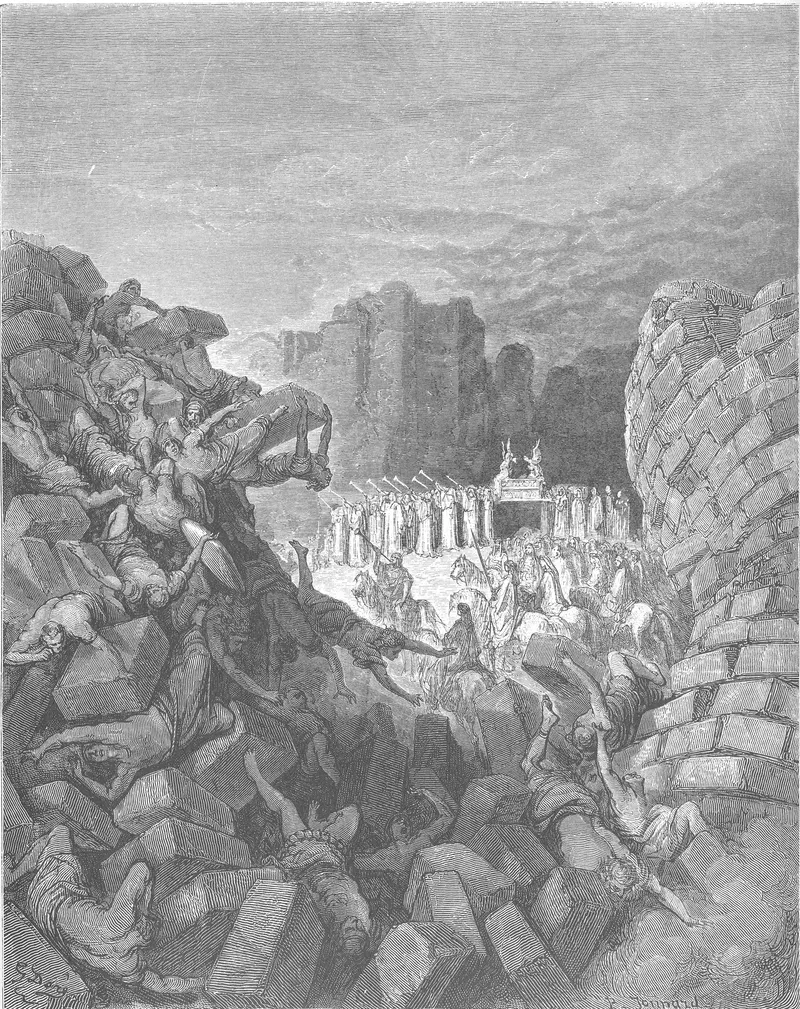
3And ye shall compass the city, all ye men of war, and go round about the city once. Thus shalt thou do six days. 4And seven priests shall bear before the ark seven trumpets of rams’ horns: and the seventh day ye shall compass the city seven times, and the priests shall blow with the trumpets. 5And it shall come to pass, that when they make a long blast with the ram’s horn, and when ye hear the sound of the trumpet, all the people shall shout with a great shout; and the wall of the city shall fall down flat, and the people shall ascend up every man straight before him.
Seven priests at the center of the procession. The conquest of Jericho is a priestly act. The priests who carry the ark of the covenant are at the center - not the generals, not the strategists. God is the Commander.
Seven times on the seventh day. The number seven is woven through the whole plan: seven priests, seven trumpets, seven days, and finally, on the culminating day, seven circuits. In Hebrew numerology, seven is the number of completion and wholeness - the fullness of God's work.
Joshua 6:6-9Six Days of Silence
6And Joshua the son of Nun called the priests, and said unto them, Take up the ark of the covenant, and let seven priests bear seven trumpets of rams’ horns before the ark of the LORD. 7And he said unto the people, Pass on, and compass the city, and let him that is armed pass on before the ark of the LORD.
Joshua gives the command. The priests take up the ark - the physical sign of God's presence. The armed men surround it. The whole nation is about to learn what it means to march as one body under the direction of God's covenant.
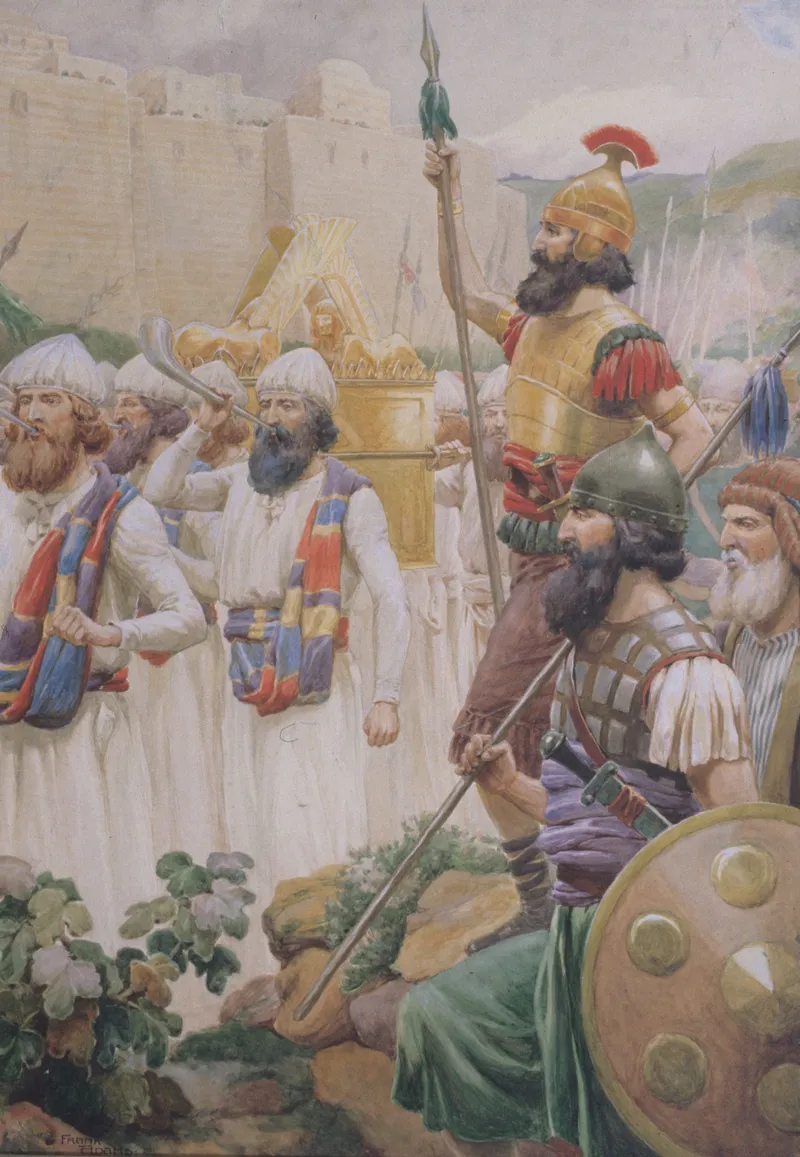
8And it came to pass, when Joshua had spoken unto the people, that the seven priests bearing the seven trumpets of rams’ horns passed on before the LORD, and blew with the trumpets: and the ark of the covenant of the LORD followed them. 9And the armed men went before the priests that blew with the trumpets, and the rereward came after the ark, the priests going on, and blowing with the trumpets.
The order is deliberate: priests with trumpets first, then the ark, then the fighting men, then the rearguard. God's presence is in the middle, protected and proclaimed. Everything else orbits it.
The rereward - the rearguard - closes the procession. The entire community is walled in by God's presence. No one is outside. This is a liturgy, a procession, a corporate act of worship.
10And Joshua had commanded the people, saying, Ye shall not shout, nor make any noise with your voice, neither shall any word proceed out of your mouth, until the day I bid you shout; then shall ye shout.
Complete silence. For six days. Twelve tribes, warriors, families, children - all marching around a walled city in total silence except for the priests' trumpets. This is the hardest kind of obedience: holding the silence. Not to shout in victory before the battle is won. Not to whisper plans or doubt or fear. Silence is the test of faith.
Joshua 6:11-14The Pattern Holds
11So the ark of the LORD compassed the city, going about it once: and they came into the camp, and lodged in the camp. 12And Joshua rose early in the morning, and the priests took up the ark of the LORD. 13And seven priests bearing seven trumpets of rams’ horns before the ark of the LORD went on continually, and blew with the trumpets: and the armed men went before them; but the rereward came after the ark of the LORD, the priests going on, and blowing with the trumpets. 14And the second day they compassed the city once, and returned into the camp: so they did six days.
Day one done. One circuit complete. No change. The walls are still standing. No visible progress. Faith that shouts before the result appears is just noise - faith that marches while the walls stand is the real thing.
Joshua rises early. Again. For six consecutive days he gets up in the dark, leads the same silent march, accomplishes nothing visible, and trusts God's promise anyway. This is repetition as a form of prayer - the same motion, the same faith, day after day.
Joshua 6:15-21The Seventh Day
15And it came to pass on the seventh day, that they rose early about the dawning of the day, and compassed the city after the same manner seven times: only on that day they compassed the city seven times.
The seventh day. The final repetition. But this time not once - seven times. The full measure of God's work. The completion. Everything else has been a lead-up to this moment.
16And it came to pass at the seventh time, when the priests blew with the trumpets, Joshua said unto the people, Shout; for the LORD hath given you the city.
Now. Only now. After silence has stretched for six days, Joshua gives the signal. “Shout; for the Lord hath given you the city.” He announces the victory that God has already given, not asking for anything uncertain, not hoping against hope - declaring what is already true. The timing matters. A shout yesterday would have been premature. A shout an hour from now would have been late. God's timing is exact.
17And the city shall be accursed, even it, and all that are therein, to the LORD: only Rahab the harlot shall live, she and all that are with her in the house, because she hid the messengers that we sent.
Rahab. A woman. A prostitute. A foreigner living inside an enemy city. She hid the Israelite spies on her roof, let them down by a scarlet cord, and told them, “I know that the Lord hath given you the land” (Josh. 2:9). Her faith was sharper than a sword. She sees what Israel sees - that God is winning - and she chooses His side. Now, as the judgment falls around her, she and her entire household stand on the scarlet cord of her covenant and live.
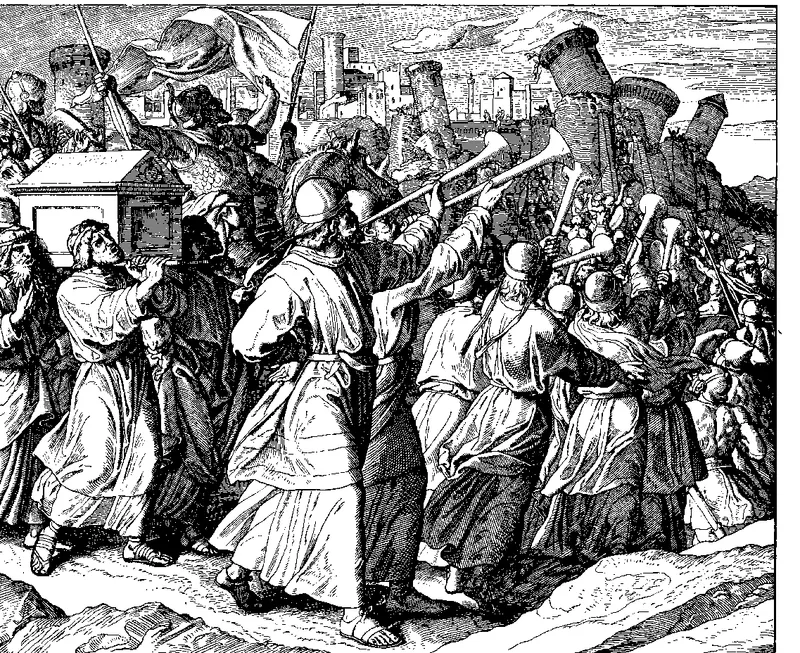
18And ye, in any wise keep yourselves from the accursed thing, lest ye make yourselves accursed, when ye take of the accursed thing, and make the camp of Israel a curse, and trouble it. 19But all the silver, and gold, and vessels of brass and iron, are consecrated unto the LORD: they shall come into the treasury of the LORD. 20So the people shouted when the priests blew with the trumpets: and it came to pass, when the people heard the sound of the trumpet, and the people shouted with a great shout, that the wall fell down flat, so that the people went up into the city, every man straight before him, and they took the city.
The wall falls flat. Not gradually - flat. Not breached or weakened - flat, so every man walks straight forward into the city. There is no human explanation for this. The faith of a nation, the obedience of a leader, the timing of God - all converge in a single moment, and the impossible becomes visible.
21And they utterly destroyed all that was in the city, both man and woman, young and old, and ox, and sheep, and ass, with the edge of the sword.
The judgment is total. Every living thing except Rahab and her household. This is difficult Scripture - the cherem, the devoted destruction of an entire city. The text itself anchors this in history: centuries of Canaanite iniquity. God's judgment is real, particular, and limited to this city in this moment. It is not a template for Christian conduct. The conquest of Canaan has its own story, its own time. What we see here is God's judgment falling and one woman of faith being saved inside it.
Joshua 6:22-25Rahab Spared
22But Joshua had said unto the two men that had spied out the country, Go into the harlot’s house, and bring out thence the woman, and all that she hath, as ye sware unto her. 23And the young men that were spies went in, and brought out Rahab, and her father, and her mother, and her brethren, and all that she had; and they brought out all her kindred, and left them without the camp of Israel.
Joshua does not forget the covenant. The spies remember what Rahab did. She is brought out with her whole household - extended family, servants, all who are hers. The scarlet cord has marked her house, and now it marks her path to safety.
24And they burnt the city with fire, and all that was therein: only the silver, and the gold, and the vessels of brass and of iron, they put into the treasury of the house of the LORD. 25And Joshua saved Rahab the harlot alive, and her father’s household, and all that she had; and she dwelleth in Israel even unto this day; because she hid the messengers, which Joshua sent to spy out Jericho.
Rahab dwelt in Israel even unto this day - meaning, even as the book of Joshua was being written, Rahab's descendants were living as full members of the covenant community. She became one of them. Not a footnote to the conquest story. A mother of Israel. And when you read Matthew 1:5, there she is in the genealogy of Jesus: “And Salmon begat Booz of Rachab.” The prostitute from Jericho is an ancestor of the Messiah.
Joshua 6:26-27The Curse on Rebuilding
26And Joshua adjured them at that time, saying, Cursed be the man before the LORD, that riseth up and buildeth this city Jericho: he shall lay the foundation thereof in his firstborn, and in his youngest son shall he set up the gates of it.
Joshua pronounces a curse on anyone who rebuilds Jericho. The curse is specific: the man who lays the foundation will lose his firstborn; the man who sets up the gates will lose his youngest son. It is a binding curse, sealed in God's name.
27So the LORD was with Joshua; and his fame was noised throughout all the country.
God's presence with Joshua is visible in the land's fear. The news spreads. The conquest of Jericho becomes a warning to every city ahead: their walls will fall too if they oppose the Lord.
The curse is not forgotten. Four hundred and sixty-two years later, in 1 Kings 16:34, a man named Hiel of Bethel rebuilds Jericho. The text tells us: “In his days did Hiel the Bethelite build Jericho: he laid the foundation thereof in Abiram his firstborn, and set up the gates thereof in his youngest son Segub.” The curse spoken on the day the walls fell is fulfilled centuries later, word for word. God's word does not lapse. His promises and His judgments both outlast the generation that speaks them.
Research trail
Sources & further study
These references support the historical, linguistic, manuscript, and contextual notes in this chapter. Scripture remains the primary text; external sources are provided so readers can inspect the research directly.
- Jericho Walls[res:iaa-jericho-walls] and Conquest EvidenceArchaeological evidence from Tell es-Sultan showing the destruction layers and wall structures of ancient Jericho.
- Jericho: City and ConquestSBL study of Jericho in Scripture and archaeology, including the narrative of Joshua's siege.
- Faith and the Walls (Joshua 6 and Hebrews 11)Connection between Joshua 6 and Hebrews 11:30, which cites the fall of Jericho as an example of faith.