Nehemiah 9
People in this chapter
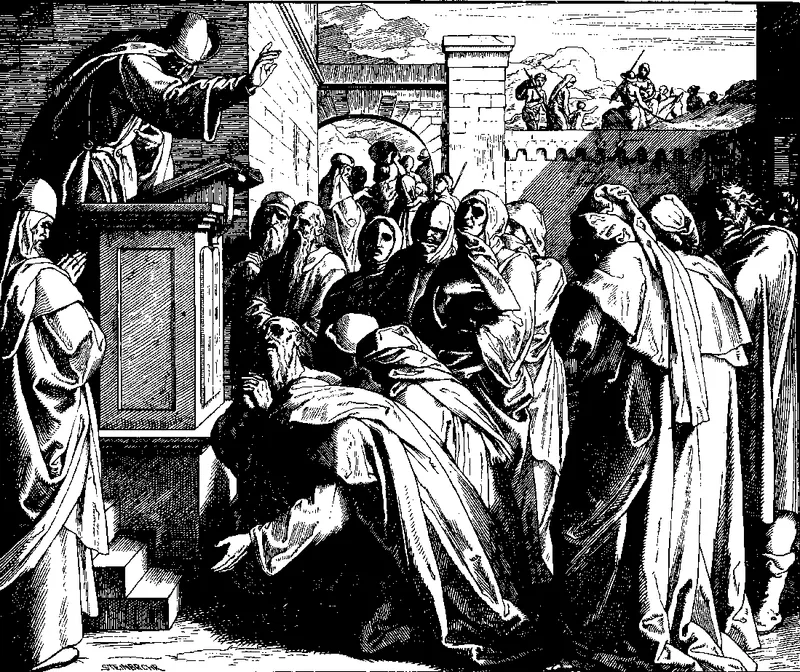
The scene is one of corporate lamentation and solemnity. The twenty-fourth day of the month arrives. The people assemble with fasting, wearing sackcloth - the garments of mourning - and sitting in ashes, a gesture of humility before God. They have separated themselves from all strangers, setting themselves apart as a covenant people entering into confession. The work of rebuilding is complete. The walls stand. The gates are set. Now comes the harder work: the inner rebuilding, the turning of the heart toward God.
Tap any highlighted phrase to jump to the commentary that unpacks it.
Nehemiah 9:1-3Sackcloth and Ashes
1Now in the twenty and fourth day of this month the children of Israel were assembled with fasting, and with sackclothes, and earth upon them. 2And the seed of Israel separated themselves from all strangers, and stood and confessed their sins, and the iniquities of their fathers. 3And they stood up in their place, and read in the book of the law of the LORD their God one fourth part of the day; and another fourth part they confessed, and worshipped the LORD their God.
The assembly gathers with fasting - a refusal of sustenance as a sign of inward turning. They wear sackcloth, the rough material of mourning, and place earth upon themselves - a physical expression of humility, of dust returning to dust. The body speaks what the mouth will later confess. They do not come with confidence or ease. They come as penitents. 1
They separate themselves from all strangers. This is covenant identity - the seed of Israel setting themselves apart as a people who have made a binding agreement with God. The separation is meant to heighten focus, to create sacred space for the work of confession and renewal2.
Nehemiah 9:4-5Stand Up and Bless the Lord
4Then stood up upon the stairs, of the Levites, Jeshua, and Bani, Kadmiel, Shebaniah, Bunni, Sherebiah, Bani, and Chenani, and cried with a loud voice unto the LORD their God. 5Then the Levites, Jeshua, and Kadmiel, Bani, Hashabniah, Sherebiah, Hodijah, Shebaniah, and Pethahiah, said, Stand up and bless the LORD your God for ever and ever: and blessed be thy glorious name, which is exalted above all blessing and praise.
The Levites stand upon the stairs - a place of elevation and authority. They do not whisper. They cry with a loud voice. In a moment of communal grief and confession, they lift a call that is a command: Stand up. Bless. Your God stands ready to receive your praise. The Levites are calling the people up toward God.
The verb is striking: "Bless the Lord your God." To bless God is to recognize blessing - to declare that God is worthy of praise, that His name is glorious. The Levites are asking the people to move from the verticality of confession to the horizontality of proclamation: they have confessed who they are; now they are called to declare who God is.
The phrase "exalted above all blessing and praise" holds a paradox. If God is above all blessing and praise, then how can the people bless Him? The answer is that human blessing cannot adequately contain God's glory - yet the attempt itself, the reaching upward, the opening of the mouth to praise what cannot be fully praised, is itself an act of faith.
Nehemiah 9:6-8Thou Art the Lord Alone
6Thou, even thou, art LORD alone; thou hast made heaven, the heaven of heavens, with all their host, the earth, and all things that are therein, the seas, and all that is therein, and thou preservest them all; and the host of heaven worshippeth thee. 7Thou art the LORD the God, who didst choose Abram, and broughtest him forth out of Ur of the Chaldees, and gavest him the name of Abraham; 8And foundest his heart faithful before thee, and madest a covenant with him to give the land of the Canaanites, the Hittites, the Amorites, and the Perizzites, and the Jebusites, and the Girgashites, to give it, I say, to his seed, and hast performed thy words; for thou art righteous:
This is the central confession of the prayer: "Thou, even thou, art Lord alone." The repetition - thou, even thou - emphasizes singularity, uniqueness. There is no other. No competitor. No rival. The Creator stands alone, and all creation stands before Him in order. This declaration anchors everything that follows; all of Israel's history is the history of what the Lord alone has done.
The God who creates also preserves. "Thou preservest them all" - the heavens, the earth, the seas. The work is creation and continual sustenance. This God does not wind up the cosmos and leave it. He holds it. He maintains it. The theological claim is that creation is an ongoing act, not a past event.
The prayer moves from cosmic creation to covenant history. The same God who made the heavens chose Abram. He brought him out of Ur of the Chaldees - out of idolatry, out of the realm of false gods - and gave him a new name, Abraham. The act is both intimately personal and historically significant. One man, called by name, becomes the beginning of a people.
Abraham is described as one whose heart God "foundest faithful." Not perfect - Scripture is clear about Abraham's failures - but faithful. There is a difference. Faithfulness is the orientation of the heart toward God, the willingness to follow even into the unknown. God sees that faithfulness and responds with covenant.
God "performed thy words" - the promise made was the promise kept. The text emphasizes that God is righteous - not merely powerful but just, reliable, bound by His own character to keep His word. This is the foundation of all that follows in the prayer: a God whose words can be trusted.
Nehemiah 9:9-31Mercy and Rebellion Through the Ages
9And didst see the affliction of our fathers in Egypt, and heardest their cry by the Red sea; 10And shewedst signs and wonders upon Pharaoh, and on all his servants, and on all the people of his land: for thou knewest that they dealt proudly against them. So didst thou get thee a name, as it is this day. 11And thou didst divide the sea before them, so that they went through the midst of the sea on the dry land; and their persecutors thou threwest into the deeps, as a stone into the mighty waters. 12Moreover thou leddest them in the day by a cloudy pillar; and in the night by a pillar of fire, to give them light in the way wherein they should go. 13Thou camest down also upon mount Sinai, and spakest with them from heaven, and gavest them right judgments, and true laws, good statutes and commandments:
The people wandered forty years. God fed them. He gave them the law. Fire on Sinai made His word visible. The wilderness was harsh, but not forsaken. Every provision points to a God who never abandoned them.
14And madest known unto them thy holy sabbath, and commandedst them precepts, statutes, and laws, by the hand of Moses thy servant: 15And gavest them bread from heaven for their hunger, and broughtest forth water for them out of the rock for their thirst, and promisedst them that they should go in to possess the land which thou hadst sworn to give them. 16But they and our fathers dealt proudly, and hardened their necks, and hearkened not to thy commandments, 17And refused to obey, neither were mindful of thy wonders that thou didst among them; but hardened their necks, and in their rebellion appointed a captain to return to their bondage: but thou art a God ready to pardon, gracious and merciful, slow to anger, and of great kindness, and forsookest them not. 18Yea, when they had made them a molten calf, and said, This is thy God that brought thee up out of Egypt, and had wrought great provocations;
The golden calf represents the deepest failure - a people who, fresh from deliverance, craft an idol from their own desires. Yet the prayer centers on mercy: “Yet thou in thy manifold mercies forsookest them not.” Even in this moment of rebellion, God maintains the pillar of cloud and fire. The mercies are described as manifold - many, multiple, overwhelming. One sin cannot exhaust God's mercy.
19Yet thou in thy manifold mercies forsookest them not in the wilderness: the pillar of the cloud departed not from them by day, to lead them in the way; neither the pillar of fire by night, to shew them light, and the way wherein they should go. 20Thou gavest also thy good spirit to instruct them, and withheldest not thy manna from their mouth, and gavest them water for their thirst.
The prayer shifts from declaration to narrative. God is narrating His own actions through the mouth of the people. The structure is rhythmic, almost musical: affliction (Egypt), deliverance (Red Sea), provision (manna, water), rebellion (golden calf, hardened necks), yet mercies and restoration. This is a confession that memory itself - the act of recalling God's works - is an act of worship.
God "got thee a name, as it is this day." The phrase suggests that God's reputation, His renown, was established through the deliverance from Egypt. God acted not only to save His people but to make His name known - to demonstrate His power and faithfulness to all the nations.
The cloud pillar by day and the pillar of fire by night become symbols of God's presence. They are not mere guidance; they are manifestations of God's glory. The people are led not by map or compass but by the visible presence of God Himself. To wander in the wilderness is to be surrounded by divine presence.
The manna is described as "bread from heaven." It is not natural bread, gathered or baked. It falls from the sky, a daily miracle, a daily reminder that life itself comes as a gift from God. The people cannot hoard it; they cannot save for tomorrow. They must trust that tomorrow will bring its own provision.
Water flows from the rock - another impossibility made actual. The barren stone becomes a source of life. This becomes a rich image throughout Scripture: the rock that is Christ, the water that is the Spirit, the provision that appears in the most unlikely place.
Then comes the turning point: "They dealt proudly." Pride is the opposite of the faithfulness Abraham showed. It is the refusal to bow, the assertion of the self against God's will. The prayer does not minimize or excuse this. It names it clearly: our fathers dealt proudly. The confession offers stark acknowledgement.
Hardened necks - a consistent image throughout Scripture for the refusal to bow, to turn toward God. The neck is stiff, unbending. The people refuse to turn around, to face the direction God is pointing. They advance into their own rebellion.
Yet the refrain appears again: "Yet thou in thy manifold mercies forsookest them not." Even at the moment of the golden calf - one of the most egregious failures in Israel's history - God did not abandon His people. The mercies are described as manifold, multiple, abundant. One rebellion is met with many mercies. The math favors grace.
Nehemiah 9:32-37Now Therefore: We Are Servants
32Now therefore, our God, the great, the mighty, and the terrible God, who keepest covenant and mercy, let not all the trouble seem little before thee, that hath come upon us, on our kings, on our princes, and on our priests, and on our prophets, and on our fathers, and on all thy people, since the time of the kings of Assyria unto this day. 33Howbeit thou art just in all that is brought upon us; for thou hast done right, but we have done wickedly: 34Neither have our kings, our princes, our priests, nor our fathers, kept thy law, nor hearkened unto thy commandments and thy testimonies, wherewith thou didst testify against them. 35For they have not served thee in their kingdom, and in thy great goodness that thou gavest them, and in the large and fat land which thou gavest before them, neither turned they from their wicked works. 36Behold, we are servants this day, and for the land that thou gavest unto our fathers to eat the fruit thereof and the good thereof, behold, we are servants in it: 37And it yieldeth much increase unto the kings whom thou hast set over us because of our sins: also they have dominion over our bodies, and over our cattle, at their pleasure, and we are in great distress.
The confession reaches its culmination: "We are servants this day." These are literal servants - under Persian rule, bound to foreign kings, lacking freedom. The prayer faces this fact squarely. The people are not free. The troubles that have come are real. The acknowledgement is not soft or evasive.
Yet the prayer insists: "Thou art just in all that is brought upon us." This is the acknowledgement of justice. The people are not claiming innocence. They have broken the covenant. God's judgment has been righteous. The complaint is not "God, you have been unjust" but "God, you have been just in our judgment, and we confess it."
God gave them a land described as "large and fat" - abundant, fertile, generous. Yet they did not turn from their wicked works. The abundance did not breed gratitude. The provision did not compel obedience. The image is tragic: a people given everything, turning away to their own destruction.
The paradox is complete: they are servants in the very land they were given as freedom. The land that was meant to be an inheritance has become a place of servitude. They eat the fruit, but the fruit goes to serve the masters. They belong to it as servants to masters.
Nehemiah 9:38We Make a Sure Covenant
38And because of all this we make a sure covenant, and write it; and our princes, Levites, and priests, seal unto it.
After confession comes covenant. The people make a commitment themselves. "We make a sure covenant" - sure, firm, binding. They are saying: we have heard ourselves in confession, and now we bind ourselves to covenant.
The covenant is written, inscribed. The writing makes it permanent, official, witnessed. The page becomes a sign, something that can be returned to, something that binds across time. Writing is the technology of covenant - it says: this was decided on this day, by these people, and it remains.
The princes, Levites, and priests seal the covenant. The leadership of Israel - civil, religious, and priestly - all commit themselves. This is a public, embodied commitment. The seal is the mark of the signers, binding them to the words. When they sign, they become accountable to what they have written.
Nehemiah 9 · AllHistory as Prayer, Prayer as History
Nehemiah 9 contains the longest prayer in the Bible - a prayer that encompasses history: God's acts, Israel's response, God's faithfulness, Israel's rebellion, all woven together into one sustained conversation with God. The prayer teaches that memory is prayer. To remember what God has done is to speak to God. To confess what we have failed to do is to open ourselves to transformation.
The prayer's refrain is mercy. Over and over: "Yet thou forsookest them not." Even when judgment came, mercy remained. Even in exile, the mercies of God held the people. The prophet Jeremiah will later express this with poetic precision: "His compassions fail not. They are new every morning. Great is thy faithfulness" (Lamentations 3:22-23). This is the truth Nehemiah 9 embodies in history: mercy endures. God's faithfulness is the one constant across all the turning tides of human failure.
Research trail
Sources & further study
These references support the historical, linguistic, manuscript, and contextual notes in this chapter. Scripture remains the primary text; external sources are provided so readers can inspect the research directly.