Numbers 16
People in this chapter
Numbers 16 opens with an explosion of pride. Korah, a Levite who is Moses' own cousin, stands up with two Reubenite chieftains - Dathan and Abiram - and 250 princes of the congregation. Their charge is simple and vicious: Moses and Aaron have gone too far. "All the congregation are holy, every one of them, and the Lord is among them: wherefore then lift ye up yourselves above the congregation of the Lord?" It is the language of flattery wrapped around a fist. They are asking for the priesthood that God has already given to Aaron.
Tap any highlighted phrase to jump to the commentary that unpacks it.
Numbers 16:1-11The Complaint Against Authority
1Now Korah, the son of Izhar, the son of Kohath, the son of Levi, and Dathan and Abiram, the sons of Eliab, and On, the son of Peleth, sons of Reuben, took men: 2And they rose up before Moses, with certain of the children of Israel, two hundred and fifty princes of the assembly, famous in the congregation, men of renown:
Korah is a Levite, a cousin of Moses. He should be honored by his role in the tabernacle service. But his name, and the names of his co-conspirators, tell the story: Korah (baldness, exposure), Dathan (contention), Abiram (high father - claiming authority for himself). These are not men at peace with their station. 1
3And they gathered themselves together against Moses and against Aaron, and said unto them, Ye take too much upon you, seeing all the congregation are holy, every one of them, and the LORD is among them: wherefore then lift ye up yourselves above the congregation of the LORD?
The accusation is smooth but poisonous. Korah is saying that because all are holy, Moses and Aaron should not be set apart. This is how rebellion talks: by appealing to a half-truth to justify overturning what God has commanded.
Korah uses the word "holy" - kadosh - the same word God used to set apart the Levites and priests for His service. But he distorts it to mean "equal authority." To say all the congregation is holy does not erase the particular callings God has made. The people are holy in one sense - set apart to God - but that does not grant them access to the altar or the inner priesthood.
4And when Moses heard it, he fell upon his face: 5And he spake unto Korah and unto all his company, saying, Even to morrow the LORD will shew who are his, and who is holy; and will cause him to come near unto him: even him whom he hath chosen will he cause to come near unto him.
Moses falls on his face. This is his posture at every crisis - prostrate before God. His authority comes from his trust in God's judgment.
8And Moses said unto Korah, Hear, I pray you, ye sons of Levi: 9Seemeth it but a small thing unto you, that the God of Israel hath separated you from the congregation of Israel, to bring you near to himself to do the service of the tabernacle of the LORD, and to stand before the congregation to minister unto them? 10And he hath brought thee near to him, and all thy brethren the sons of Levi with thee: and seek ye the priesthood also?
God does not choose because the person is already holy. God chooses, and that choosing is what makes the person holy for that role. Korah confuses the order. He thinks: because I am already holy, I should have access to the priesthood. God's logic is: because I choose you for this role, you are set apart as holy for this role.
Numbers 16:12-15Dathan and Abiram Refuse to Come
12And Moses sent to call Dathan and Abiram, the sons of Eliab: which said, We will not come up: 13Is it a small thing that thou hast brought us up out of a land that floweth with milk and honey, to kill us in the wilderness, except thou make thyself altogether a prince over us?
Dathan and Abiram refuse to appear before Moses. They will not submit to the test. This is defiance of a different kind: openly rejecting the authority God has placed over them.
14Moreover thou hast not brought us into a land that floweth with milk and honey, or given us inheritance of fields and vineyards: wilt thou put out the eyes of these men? we will not come up.
Here is the bitter core of it: Dathan and Abiram have been wandering in the wilderness for 40 years. They are exhausted. The promise seems broken. And they blame Moses. "You brought us out to die here. You are taking land from us." It is partly false (they refused to enter) and partly a cry of despair, but it comes out as accusation.
The glory of the Lord is visible before the test even happens. God is signaling: I am here. I am watching. This is not a mere human trial.
Numbers 16:16-24The Test of the Censers
16And Moses said unto Korah, Be thou and all thy company before the LORD, thou, and they, and Aaron, to morrow: 17And take every man his censer, and put incense in them, and bring ye before the LORD every man his censer, two hundred and fifty censers; thou also, and Aaron, each of you his censer.
Moses proposes a test. Let each of the 250 princes bring a censer with fire and incense to the tabernacle. And let Aaron bring his. The man God chooses will have his offering accepted. This is not Moses defending his authority; it is Moses calling on God to make the choice visible to everyone.
18And they took every man his censer, and put fire in them, and laid incense thereon, and stood in the door of the tabernacle of the congregation with Moses and Aaron. 19And Korah gathered all the congregation against them unto the door of the tabernacle of the congregation: and the glory of the LORD appeared unto all the congregation.
Korah has pulled the whole congregation to the tabernacle door. What was a leadership dispute is now a public spectacle. Everyone is watching. The stakes are visible.
20And the LORD spake unto Moses and unto Aaron, saying, 21Separate yourselves from among this congregation, that I may consume them in a moment. 22And they fell upon their faces, and said, O God, the God of the spirits of all flesh, shall one man sin, and wilt thou be wroth with all the congregation?
Moses and Aaron fall on their faces a second time. They have the authority to step aside and let God destroy the rebels. They choose instead to intercede for the whole congregation. This is what true authority looks like: standing between judgment and the people.
Moses and Aaron are asking God not to wipe out the whole congregation because of the sins of the rebels. It is an intercession rooted in justice: should the innocent die for the guilty?
The bronze covering of the censers will be a visible, permanent sign. Every future priest who approaches the altar will see it and be reminded: do not presume on the priestly office. 2
The glory of the Lord is visible before the test even happens. God is signaling: I am here. I am watching. This is not a mere human trial.
For the third time, Moses and Aaron fall on their faces before God. This is the shape of their entire ministry: when judgment comes, they intercede.
23And the LORD spake unto Moses, saying, 24Speak unto the congregation, saying, Get you up from about the tabernacle of Korah, Dathan, and Abiram.
Numbers 16:25-35The Earth Opens and Swallows Them
25And Moses rose up and went unto Dathan and Abiram; and the elders of Israel followed him. 26And he spake unto the congregation, saying, Depart, I pray you, from the tents of these wicked men, and touch nothing of theirs, lest ye be consumed in all their sins. 27So they gat up from the tabernacle of Korah, Dathan, and Abiram, on every side: and Dathan and Abiram came out, and stood in the door of their tents, and their wives, and their sons, and their little children.
Moses tells the congregation to step back. God is about to act. The people obey. Dathan and Abiram come out to stand in their tent doors with their wives and children. They are facing Moses openly, defiantly, in front of the entire congregation.
28And Moses said, Hereby ye shall know that the LORD hath sent me to do all these works; for I have not done them of mine own mind. 29If these men die the common death of all men, or if they be visited after the visitation of all men; then the LORD hath not sent me. 30But if the LORD make a new thing, and the earth open her mouth, and swallow them up, with all that appertain unto them, and they go down quick into the pit; then ye shall understand that these men have provoked the LORD.
Moses calls God to make the judgment visible and unmistakable. A new thing altogether, unmistakable to every eye. The earth itself will become God's instrument of judgment, and everyone will see.
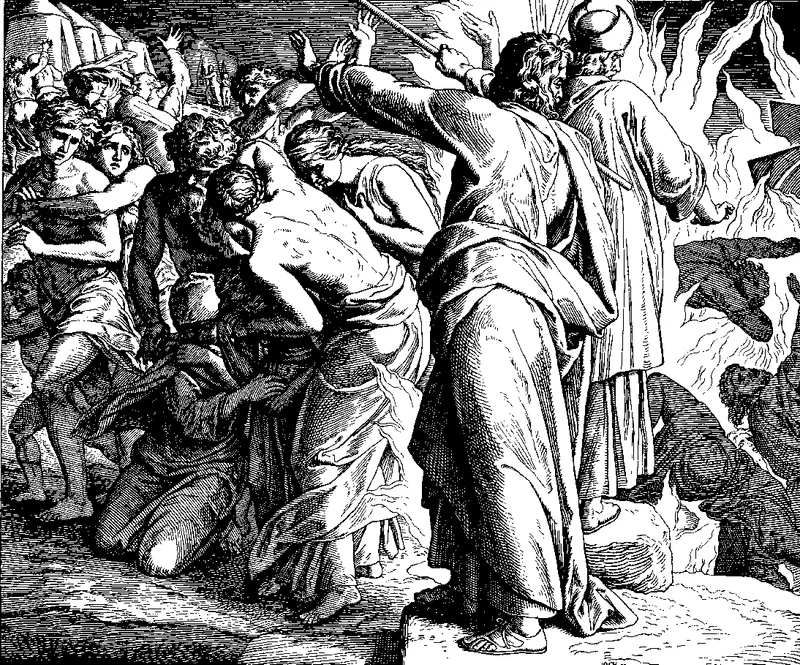
31And it came to pass, as he had made an end of speaking all these words, that the ground clave asunder that was under them: 32And the earth opened her mouth, and swallowed them up, and their houses, and all the men that appertained unto Korah, and all their goods. 33They, and all that appertained to them, went down alive into the pit, and the earth closed upon them: and they perished from among the congregation.
The very next day, the people turn. The ground has closed over Korah and his company. The fire has consumed the 250. Everyone saw. And yet the morning brings accusation. "You have killed the people of the Lord." The people cannot yet see that they were being offered the same choice Korah had: obey or rebel. They only see judgment and mistake it for cruelty.
Korah, Dathan, Abiram, and all the men who belong to them - as well as their households, their wives, their children, all their goods. The rebellion involves the whole household. The judgment falls on them all. This is devastating. It is also, in the logic of the chapter, what happens when a family leader raises his fist against God.
34And all Israel that were round about them fled at the cry of them: for they said, Lest the earth swallow us up also. 35And there came out a fire from the LORD, and consumed the two hundred and fifty men that offered incense.
Numbers 16:36-40The Bronze Censers - A Warning and a Sign
36And the LORD spake unto Moses, saying, 37Speak unto Eleazar the son of Aaron the priest, that he take up the censers out of the burning, and scatter thou the fire yonder; for they are hallowed. 38The censers of these sinners against their own souls, let them make them broad plates for a covering of the altar: for they offered them before the LORD, therefore they are hallowed: and they shall be a sign unto the children of Israel.
39And Eleazar the priest took the brasen censers, wherewith they that were burnt had offered; and they were made broad plates for a covering of the altar: 40To be a memorial unto the children of Israel, that no stranger, which is not of the seed of Aaron, come near to offer incense before the LORD; that he be not as Korah, and as his company: as the LORD said to him by the hand of Moses.
The censers are not hidden away or destroyed. They are hammered into plates and fastened to the altar itself - where every priest, every day, would see them and remember. The judgment becomes a permanent teaching: This is what happens when you presume on the priesthood. The memorial is a sign of how serious the covenant is.
Only Aaron and his sons may offer incense before the Lord. No stranger - no one from outside the priestly line - may approach with a censer. The boundary is reinforced by the bronze covering. The censers that were meant to grant access become a reminder that access is not granted to just anyone.
Numbers 16:41-50Aaron Stands Between the Dead and the Living
41But on the morrow all the congregation of the children of Israel murmured against Moses and against Aaron, saying, Ye have killed the people of the LORD.
The very next day, the people turn. The ground has closed over Korah and his company. The fire has consumed the 250. Everyone saw. And yet the morning brings accusation. "You have killed the people of the Lord." The people cannot yet see that they were being offered the same choice Korah had: obey or rebel. They only see judgment and mistake it for cruelty.
42And it came to pass, when the congregation was gathered against Moses and against Aaron, that they looked toward the tabernacle of the congregation: and, behold, the cloud covered it, and the glory of the LORD appeared. 43And Moses and Aaron came before the tabernacle of the congregation. 44And the LORD spake unto Moses, saying, 45Get you up from among this congregation, that I may consume them as in a moment. And they fell upon their faces.
The glory of the Lord appears a second time. God is about to act again. And Moses and Aaron fall on their faces a third time and intercede for the people.
46And Moses said unto Aaron, Take a censer, and put fire therein from off the altar, and put on incense, and go quickly unto the congregation, and make an atonement for them: for there is wrath gone out from the LORD; the plague is begun. 47And Aaron took as Moses commanded, and ran into the midst of the congregation; and, behold, the plague was begun among the people: and he put on incense, and made an atonement for the people.
Aaron runs into the place where the plague is already spreading. He takes a censer from the altar - the same kind of censer the rebels took, but Aaron's is filled from the altar fire, the authorized fire. He puts incense in it and stands in the midst of the dying, making atonement. This is the priestly act at its purest: standing between judgment and grace.
48And he stood between the dead and the living; and the plague was stayed. 49Now they that died in the plague were fourteen thousand and seven hundred, beside them that died about the matter of Korah. 50And Aaron returned unto Moses unto the door of the tabernacle of the congregation: and the plague was stayed.
Research trail
Sources & further study
These references support the historical, linguistic, manuscript, and contextual notes in this chapter. Scripture remains the primary text; external sources are provided so readers can inspect the research directly.
- Numbers 16Full text with classical Jewish commentary on Korah's rebellion and the distinction between the priesthood and lay leadership.
- Aaron's Rod (Numbers 17)Commentary on the staffs of the twelve tribes and Aaron's blossoming almond rod as vindication of the Levitical priesthood.
- Numbers 16 ↔ Jude 11Cross-reference showing how Jude applies Korah's rebellion as a warning of presumption and rebellion against authority.