Numbers 17
People in this chapter
Numbers 16 has just ended in horror.1 Korah and his company challenged the priesthood of Aaron, and the ground opened and swallowed them; fire consumed two hundred and fifty men offering incense they had no right to offer; and when the people murmured the next day that Moses and Aaron had “killed the people of the LORD,” a plague broke out and fourteen thousand seven hundred more died before Aaron ran with a censer and stood between the dead and the living. Now the dust settles, and the great question still hangs in the smoke: who, in fact, has been chosen by God to draw near to Him on the people's behalf?
The murmuring has not been answered. It has only been frightened into silence for the moment.
Tap any highlighted phrase to jump to the commentary that unpacks it.
Numbers 17:1-5The Twelve Rods, and the Test
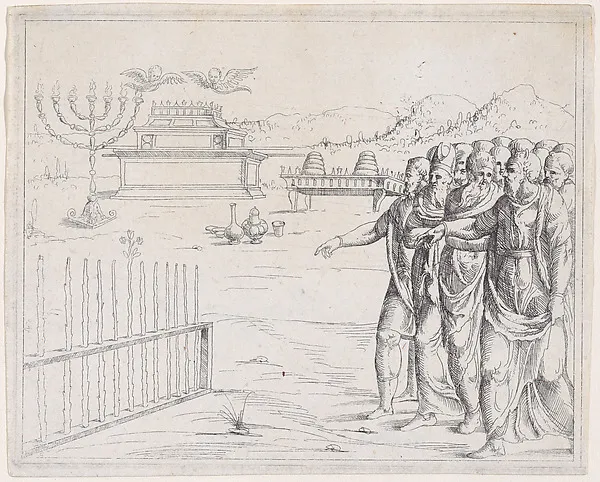
1And the LORD spake unto Moses, saying, 2Speak unto the children of Israel, and take of every one of them a rod according to the house of their fathers, of all their princes according to the house of their fathers twelve rods: write thou every man’s name upon his rod. 3And thou shalt write Aaron’s name upon the rod of Levi: for one rod shall be for the head of the house of their fathers. 4And thou shalt lay them up in the tabernacle of the congregation before the testimony, where I will meet with you. 5And it shall come to pass, that the man’s rod, whom I shall choose, shall blossom: and I will make to cease from me the murmurings of the children of Israel, whereby they murmur against you.
Notice exactly where the test is to be conducted: in the tabernacle of the congregation before the testimony, where I will meet with you. The “testimony” is the ark of the covenant, where the tablets of the law were kept - the innermost place, where the visible glory of the LORD dwelt above the mercy seat. The rods are placed in the holiest place of all, behind the veil, where no human eye will see what happens.
Whatever takes place to those twelve sticks happens in the dark, alone, in the immediate presence of God. There can be no tampering, no sleight of hand, no charge that someone grafted a living branch onto a dead one while the camp slept. The only witness to the miracle is the LORD Himself - and that is precisely the point. The verdict will be His, rendered in His own presence, and no one will be able to say otherwise.
The terms of the test are stated with startling economy: the man's rod, whom I shall choose, shall blossom. Consider what is being staked on this. A rod is a dead thing - a length of wood cut from its tree long ago, dried, hardened, stripped of any power to grow. It cannot blossom; that is the whole nature of a rod. To say that the chosen man's rod will blossom is to say that God will reverse the irreversible, that He will make the dead wood do the one thing dead wood cannot do.
And the purpose is not display for its own sake. I will make to cease from me the murmurings of the children of Israel. The grumbling has worn at the camp like water on stone - complaint after complaint that Moses and Aaron had seized an honor God never gave them. God will settle the question underneath the murmur, visibly and permanently, and the silence will follow. He answers the dispute about who is chosen by doing what only the Chooser of life and death can do.
Numbers 17:6-9The Rod Buds, Blooms, and Yields Almonds
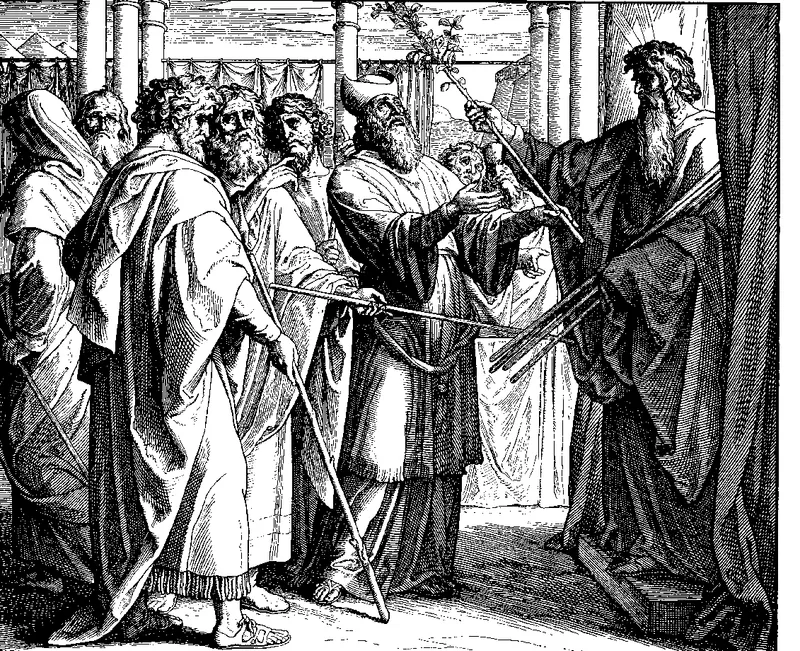
6And Moses spake unto the children of Israel, and every one of their princes gave him a rod apiece, for each prince one, according to their fathers’ houses, even twelve rods: and the rod of Aaron was among their rods. 7And Moses laid up the rods before the LORD in the tabernacle of witness. 8And it came to pass, that on the morrow Moses went into the tabernacle of witness; and, behold, the rod of Aaron for the house of Levi was budded, and brought forth buds, and bloomed blossoms, and yielded almonds. 9And Moses brought out all the rods from before the LORD unto all the children of Israel: and they looked, and took every man his rod.
The narrator is careful to establish that the test was perfectly fair before he reveals the result. Every prince handed in his rod; the rod of Aaron was among their rods - one of twelve, indistinguishable from the rest as they lay together through the night. And then the morning: behold, the rod of Aaron for the house of Levi. One rod. Eleven remained exactly as they had been laid down - dry, lifeless wood - and one had come alive.
The contrast is total and it is the heart of the sign. There is no ambiguity to argue over, no “well, Reuben's budded a little too.” God's choice is singular and unmistakable, set in stark relief against eleven dead sticks. The phrase for the house of Levi is the verdict: this is the tribe, this is the family, this is the man through whom the nation may draw near to God.
Look closely at what the rod actually did, for the text piles up the verbs deliberately: it was budded, and brought forth buds, and bloomed blossoms, and yielded almonds. This is the entire life of a fruit tree, stage upon stage, all present at once. There are the first swelling buds; there are open blossoms, the white and pink flowers of the almond; and there are almonds themselves - ripe, finished fruit. In nature these stages unfold across weeks of spring, each waiting on the one before.
On this rod they appear together, in a single night, in their proper sequence yet without the time the sequence requires. And it matters that the miracle runs all the way to fruit. God could have made the rod merely sprout a green shoot and the point would have been proven - dead wood living again. But He carries it to almonds: to what can be eaten, what holds seed, what can be planted and bear more life still.
A bud says life has begun; ripe fruit says life has triumphed, and will multiply. The chosen priesthood is not merely alive but fruitful - able to nourish, able to reproduce, able to feed the people it was set apart to serve.
Numbers 17:10-13The Token, and the People's Cry
10And the LORD said unto Moses, Bring Aaron’s rod again before the testimony, to be kept for a token against the rebels; and thou shalt quite take away their murmurings from me, that they die not. 11And Moses did so: as the LORD commanded him, so did he. 12And the children of Israel spake unto Moses, saying, Behold, we die, we perish, we all perish. 13Whosoever cometh any thing near unto the tabernacle of the LORD shall die: shall we be consumed with dying?
The rod is not displayed once and discarded. Bring Aaron's rod again before the testimony, to be kept for a token against the rebels. It goes back into the holiest place, beside the ark, to be preserved - and a token is a sign that endures, a standing piece of evidence kept so that it can be appealed to again and again. The phrase against the rebels sounds at first like a threat, as if the rod were a weapon held over the people's heads.
But the LORD says plainly what it is for: that thou shalt quite take away their murmurings from me, that they die not. The rod is kept to stop the murmuring, and stopping the murmuring is how the people are kept from death. Far from being an instrument of further judgment, the token is an act of mercy - a permanent answer set up so that the deadly cycle of grumbling and judgment need never begin again.
The dead rod that bore fruit becomes the settled, visible proof, kept where the nation can know it is there: God has chosen, the question is closed, and there is no need to die over it anymore.
The chapter ends on raw dread: Behold, we die, we perish, we all perish. The threefold cry - we die… we perish… we all perish - is the sound of people overwhelmed by what they have just seen. They have watched the ground swallow rebels, a plague cut down thousands, and now a dead rod come alive overnight in the presence of God. The cumulative weight of it lands all at once, and what they feel is not comfort but terror.
They have grasped something true and frightening: they are living next door to absolute holiness. The God in their midst is not a force they can bargain with or manage; He has shown He can open the earth, send the plague, and raise the dead, and they sense how perilous it is to dwell so close to such power while being the kind of people they are. Their fear is not wrong - it is the beginning of wisdom, the appropriate trembling of mortal, sinful people before the living God.
What they have not yet seen is that the same God who terrifies them has just kept a sign of life in their midst, and means it for their good.
The specific fear is named in the last verse: Whosoever cometh any thing near unto the tabernacle of the LORD shall die. This was the very thing Korah's rebellion had been about - the longing of many to draw near, to come close to God's presence as Aaron did, and the deadly truth that no one could simply approach the holy on his own terms and live. The people now feel the full weight of that truth pressing on them.
If the tabernacle is so holy that unauthorized nearness means death, and they must live camped around it for years, how can they survive? Shall we be consumed with dying? It is a genuine and serious question, and the law as it stood could not fully answer it. There was a barrier between a holy God and a sinful people; nearness was dangerous; the budded rod had just declared that drawing near was the privilege of the chosen priest alone, and not of everyone who wished it.
The chapter leaves the people standing exactly there - aware of the holiness, aware of the danger, longing to draw near and afraid that to do so is to die. It is a question that aches for an answer the chapter cannot yet give.
Research trail
Sources & further study
These references support the historical, linguistic, manuscript, and contextual notes in this chapter. Scripture remains the primary text; external sources are provided so readers can inspect the research directly.
- Numbers 17 - Translators' NotesThe NET Bible's detailed footnotes on Numbers 17 - the chapter division and its link to the Korah rebellion of chapter 16, the wordplay between matteh as “staff” and as “tribe,” the staging of the rods “before the testimony,” and the force of the people's closing cry, “shall we be consumed with dying?”
- Numbers 17 · Hebrew + classical Jewish commentaryThe Hebrew text of Numbers 17 with Rashi, Ibn Ezra, and other classical commentators side by side - useful for the double sense of matteh (both “rod” and “tribe”), for shaqed (the almond, bound by sound to shaqad, “to watch, to hasten”), and for the verb parach, “to bud, blossom, flourish,” that the whole sign turns on.
- Numbers 17 ↔ Hebrews 7 · Hebrews 9 · John 15Traces the threads tying Aaron's budded rod - kept in the ark (Heb. 9:4) - to the priest made… after the power of an endless life who has an unchangeable priesthood (Heb. 7:16, 24-25), and the fruit that vindicates Aaron to the vine whose branches bring forth much fruit (John 15:5, 16).
Where this echoes in Scripture
The Twelve Rods, and the Test
- Numbers 16:48And he stood between the dead and the living; and the plague was stayed.The verses just before - Aaron's priesthood already saving the people, now to be confirmed by the rod.
- Hebrews 5:4And no man taketh this honour unto himself, but he that is called of God, as was Aaron.The whole point of the test - the priesthood is given, and God Himself does the choosing.
- Exodus 4:2-3And the LORD said unto him, What is that in thine hand? And he said, A rod… and it became a serpent.The same word matteh - once a sign of judgment in Moses' hand, now a sign of life in Aaron's.
The Rod Buds, Blooms, and Yields Almonds
- Hebrews 9:4The golden pot that had manna, and Aaron's rod that budded, and the tables of the covenant.The budded rod kept in the ark for centuries - a sign of life from dead wood, treasured beside the law itself.
- Hebrews 7:24-25But this man, because he continueth ever, hath an unchangeable priesthood… he ever liveth to make intercession.The priesthood the budded rod foreshadows - confirmed by a life that death cannot end.
- Romans 6:9Christ being raised from the dead dieth no more; death hath no more dominion over him.The dead rod that woke into fruit - the resurrection compressed into a single image.
- John 15:5I am the vine, ye are the branches… the same bringeth forth much fruit: for without me ye can do nothing.The almonds that vindicated Aaron - fruit as the mark of the true, and the life that comes only from abiding.
The Token, and the People's Cry
- Hebrews 10:19-20Boldness to enter into the holiest by the blood of Jesus, by a new and living way… through the veil.The answer to “shall we be consumed?” - the barred way into God's presence thrown open in Christ.
- Hebrews 4:16Let us therefore come boldly unto the throne of grace, that we may obtain mercy.Where Israel feared to draw near and die, the gospel commands the trembling to come near and live.
- Revelation 1:17-18Fear not… I am he that liveth, and was dead; and, behold, I am alive for evermore… and have the keys of hell and of death.The dread of the holy answered by the Living One who passed through death - the budded-rod life made personal.
- Proverbs 9:10The fear of the LORD is the beginning of wisdom.Israel's terror was the first step of wisdom - awe before the holy God who also makes a way.