Painter of the Bible
Andrea della Robbia
Andrea della Robbia was a Florentine sculptor and the principal continuer of the Della Robbia ceramic-sculpture workshop founded by his uncle and master Luca della Robbia.

Their faith
Why Andrea della Robbia painted Christ
Andrea della Robbia was a devout Christian who dedicated his life to creating sacred art that reflects his deep faith. As a member of the influential Della Robbia family, he was immersed in the artistic traditions of Renaissance Florence, where spirituality and artistry intertwined. Andrea inherited his uncle Luca's workshop and continued the family legacy, producing numerous works that adorned churches and religious institutions throughout Tuscany. His commitment to his craft was not merely professional; it was a devotional practice. The glazed terracotta technique he refined allowed him to create vibrant and enduring representations of biblical figures, particularly the Madonna and Child, which held significant meaning for him and his patrons. His works were often commissioned for altarpieces and devotional spaces, emphasizing the importance of faith in his artistic vision.
Andrea's faith is vividly expressed in his masterpieces, such as the series of glazed-terracotta tondi of the Foundlings, which grace the facade of the Ospedale degli Innocenti in Florence. These medallions, depicting swaddled infants, symbolize the church's care for the vulnerable and reflect Andrea's compassion and devotion to Christ's teachings. Additionally, his high altarpiece cycles for the Franciscan sanctuary at La Verna, including the Crucifixion and the Annunciation, showcase his reverence for pivotal moments in the Christian narrative. Through these works, Andrea della Robbia's artistry transcends time, inviting viewers to experience the beauty of faith and the love of Christ, reminding us that devotion can be expressed through the transformative power of art.
Life & work
Andrea della Robbia was a Florentine sculptor and the principal continuer of the Della Robbia ceramic-sculpture workshop founded by his uncle and master Luca della Robbia. Born in Florence in 1435, trained in his uncle Luca's workshop (which he inherited around 1481 on Luca's death), and active in Florence for almost his entire career with major commissions across Tuscany, he died in Florence in 1525 at age ninety. The Della Robbia workshop operated almost continuously from the 1440s through the late sixteenth century, with Luca, Andrea, and Andrea's son Giovanni della Robbia successively heading the firm.
The Della Robbia signature contribution to Italian Renaissance art was the invention of glazed terracotta as a major sculptural medium. The technique — modeling figures in clay, glazing them with a white tin-oxide enamel for the flesh and with deep colored glazes (cobalt blue, manganese purple, copper green) for the drapery and ornament, and firing the result at high temperatures to produce a permanent, weather-resistant, brilliantly colored sculptural surface — was effectively invented by Luca della Robbia in the early 1440s and refined into the standard Della Robbia workshop product across the next century.
Andrea's Christian religious work is enormous and is concentrated in altarpieces, devotional roundels, and architectural sculpture for the Florentine and broader Tuscan ecclesiastical commissions. The great series of glazed-terracotta tondi of the Foundlings (the swaddled-infant medallions on the facade of the Ospedale degli Innocenti in Florence, 1487 — the orphanage designed by Brunelleschi a generation earlier; the medallions remain in their original location and are among the most reproduced Florentine Renaissance sculptural images), the high altarpiece glazed-terracotta cycles for the Franciscan sanctuary at La Verna in the Casentino (1480–1499 — the entire Madonna della Cintola, Crucifixion, Annunciation, and Saint Anthony Abbot altar group), the Madonnas at Prato Cathedral, and dozens of small Madonna and Child roundels and altarpieces in churches across Tuscany anchor the painted-and-glazed corpus.
His son Giovanni della Robbia continued the workshop after his death; the Della Robbia ceramic-sculpture tradition continued in workshop variants through the late sixteenth century, when the technique was largely abandoned in favor of more conventional polychrome wood sculpture.
Notable works in detail
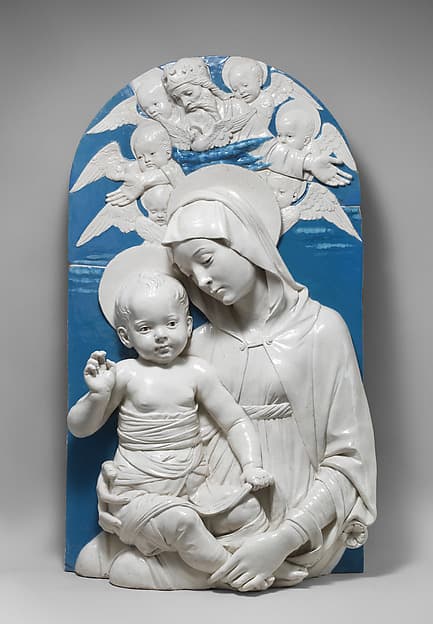
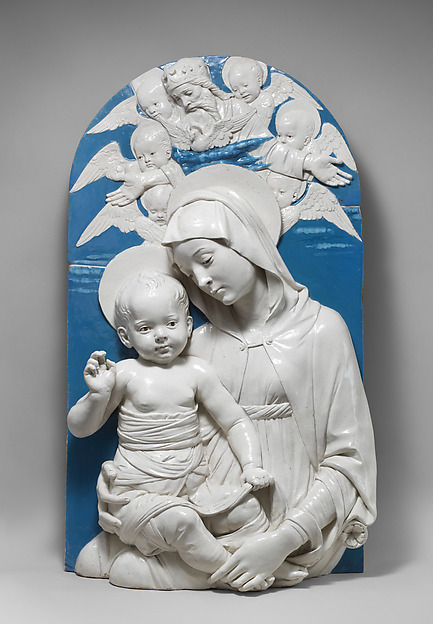
Virgin and Child, modeled by Andrea della Robbia around 1465 in glazed terracotta and now in the Metropolitan Museum of Art in New York, is one of the small-format glazed-terracotta Madonnas from his early Florentine workshop years. The composition shows the Virgin in three-quarter view holding the Christ Child upright against her chest; the figures glazed in the unmistakable Della Robbia white tin-oxide for the flesh, the drapery in deep saturated cobalt blue against the deep ultramarine ground that became the workshop signature. The roundel is among the standard Della Robbia private-devotional formats — small enough to hang above the altar in a Florentine merchant's household chapel but durable enough to survive five centuries of continuous display.
met-204567
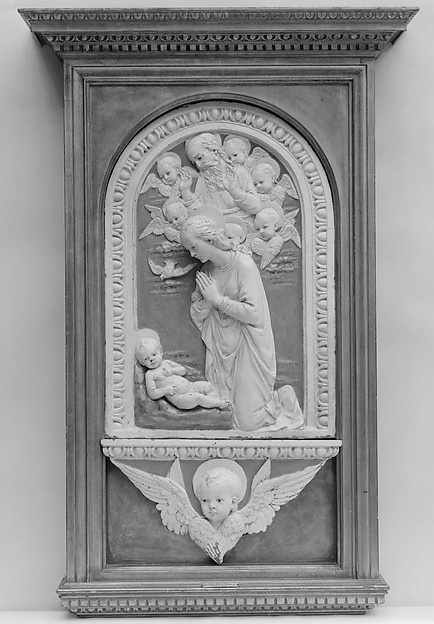
Virgin Adoring the Christ Child, modeled by Andrea della Robbia around 1479 in glazed terracotta and now in the Metropolitan Museum of Art in New York, is from the central productive period of his Florentine workshop. The composition shows the Virgin kneeling in profile with her hands folded in adoration before the newborn Christ Child laid on the ground in front of her — the iconographic compositional type known as the Adoration of the Christ Child, derived from Marian devotional contemplation rather than from a specific Gospel narrative. The glazed-terracotta surface — white tin-oxide for the flesh, deep ultramarine for the ground, the carefully observed garland of fruit and flowers around the central scene — is the unmistakable Andrea della Robbia signature.
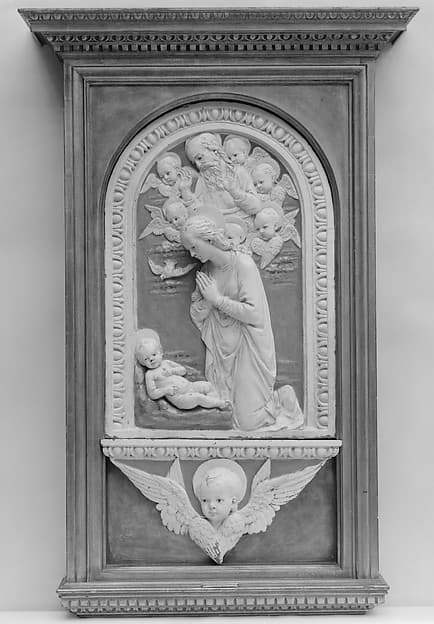
Virgin Adoring the Christ Child
Virgin Adoring the Christ Child, modeled by Andrea della Robbia around 1479 in glazed terracotta and now in the Metropolitan Museum of Art in New York, is a workshop variant of the same Adoration composition as the related 1479 panel — the Della Robbia workshop produced multiple versions of standard compositions in workshop variants for distribution across the Florentine and broader Tuscan domestic-altar market. The minor variations between versions (the precise composition of the fruit-and-flower garland, the exact angle of the Virgin's head, the small details of the surrounding architectural framing) demonstrate the workshop's standard practice of producing editions of successful compositions while preserving the supreme tin-oxide white flesh and saturated blue background that defined the Della Robbia visual brand.
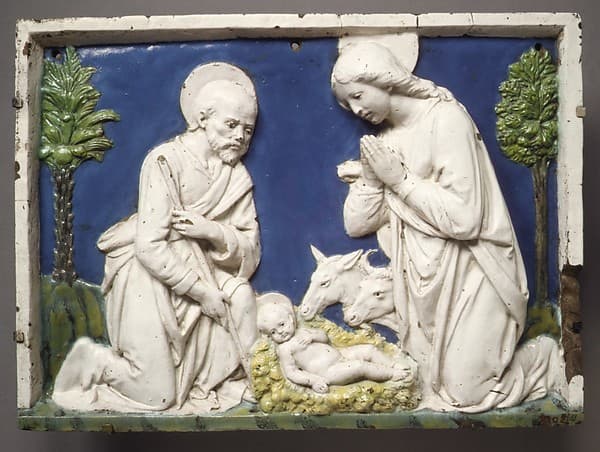
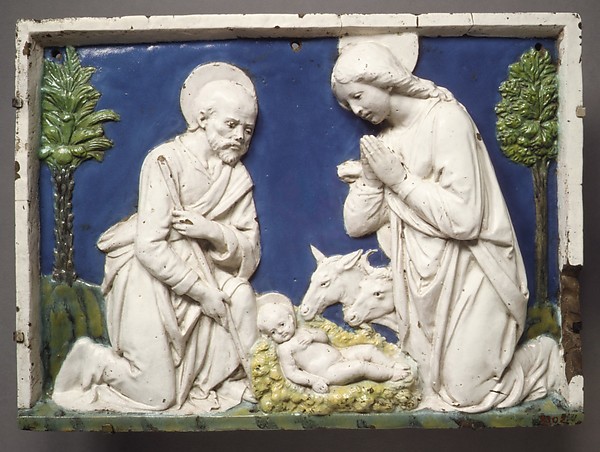
Nativity, modeled by Andrea della Robbia around 1485 in glazed terracotta and now in the Metropolitan Museum of Art in New York, depicts the moment of the birth of Christ in the small dwelling at Bethlehem. The composition shows the Virgin kneeling in profile in adoration before the newborn Christ Child laid on her cloak in the foreground, Joseph standing behind in formal attendance, the small thatched stable of Bethlehem rising behind. The polychrome glazed surface — flesh-white for the figures, deep ultramarine for the ground, swag-and-fruit garland borders, and the characteristic Della Robbia blue-green for the small trees and rocks — demonstrates the mature Andrea della Robbia workshop signature at the height of its commercial productivity in the 1480s.
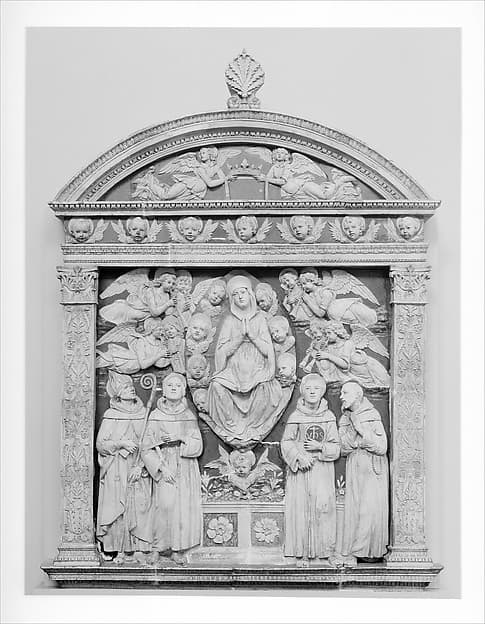
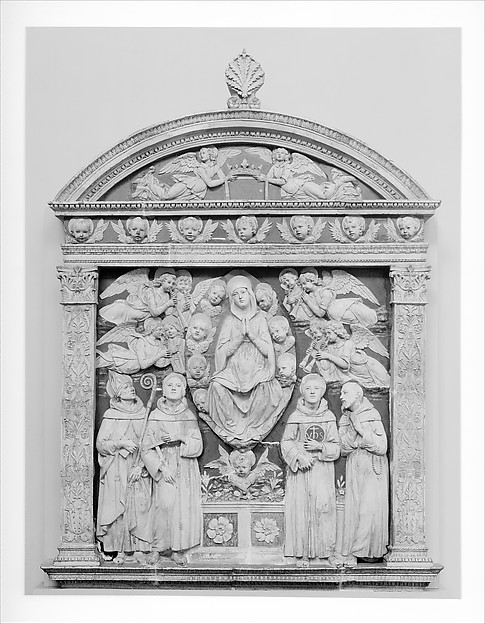
The Assumption of the Virgin, modeled by Andrea della Robbia around 1485 in glazed terracotta and now in the Metropolitan Museum of Art in New York, depicts the apocryphal subject of the Virgin Mary's bodily assumption into heaven at her death. The Virgin floats in a luminous mandorla in the upper center of the panel; small attending angels surround her on every side; the apostles gather at the open tomb in the lower foreground in postures of astonishment. The composition was one of Andrea della Robbia's standard altarpiece subjects for Catholic Counter-Reformation parish-church commissions across Tuscany, and survives in workshop variants in numerous Tuscan ecclesiastical sites alongside the Met version.